
Where to Focus Your Federal Advocacy Efforts Right Now to Have the Greatest Impact


 Apple Podcasts

 Spotify

 Pandora

 Amazon Music
It can be really hard right now as a Nonprofit leader to know where to focus your attention, what to be spending your advocacy energy on and what's going to have the biggest impact.
For the vast majority of direct service nonprofits, federal dollars make up at least some part of your total funding. And for any nonprofit in that situation, most of the critical action that's going to determine the long-term wellbeing of our organizations, our programs, our services, and the people we serve is happening at the federal level.
So even if you're not normally focused primarily on federal advocacy stuff, now is the time. That's where the biggest policy decisions are being made that are going to have massive ripple effects for years to come.
For an immediate case in point, I'm sure you're aware that the House just passed their disastrous budget bill. There’s a lot we can do to make sure that the worst aspects of that bill get turned around, and that we protect vital safety net services. To do that, we have to navigate a hyper-partisan environment, and find a way to engage every member of Congress. And that means using some strategies that may be new to us, but that are proving to be effective right now.
In this episode, we share:
- How to understand the House budget bill and what it means for your services
- Where the best advocacy opportunities lie in this still-ongoing budget process
- Exciting evidence of what’s working right now to influence Congressional decisionmaking
- Best ways to get the attention of your member of Congress
- Why your supporters are craving the opportunity to advocate on your behalf
- How to create easy advocacy action opportunities for your donors, volunteers, board members and clients
- A simple advocacy messaging framework you can use today
Help spread the word! If you found value in this episode, please share it with other progressive nonprofit leaders. Thanks!
0:00 You're listening to the Nonprofit Power Podcast. In today's episode, we share where to focus your advocacy efforts right now to have the greatest impact. So stay tuned. If you want to have real and powerful influence over the money and policy decisions that impact your organization and the people you serve, then you're in the right place. I'm Cath Patrick, and I've helped dozens of progressive non profit leaders take their organizations to new and higher levels of impact and success by building powerful influence with the decision makers that matter.
0:40 It is possible to get a critical mass of the money and policy decision makers in your world to be as invested in your success as you are, to have them seeking you out as an equal partner, Bringing opportunities and resources to you. This podcast will help you do just that. Welcome to the Nonprofit Power Podcast. Hey there folks. Welcome to another episode of the Nonprofit Power Podcast. I'm your host, Kath Patrick. I'm so glad you're here for today's episode because we are having a time. And it can be really hard right now as a Nonprofit leader to know where to focus your attention, what to be spending your advocacy energy on and what's gonna have the biggest impact right now.
1:29 For the vast majority of direct service nonprofits, federal dollars make up at least some part of your total funding. And for any Nonprofit in that situation most of the critical action that's going to determine the long-term wellbeing of our organizations, our programs, our services, and the people we serve is happening at the federal level. So even if you're not normally focused primarily on federal advocacy stuff, now is the time. That's where the biggest policy decisions are being made that are going to have massive ripple effects for years to come. For an immediate case in point, I'm sure you're aware that the house just passed their budget bill.
2:11 By a very narrow margin along strictly party lines with just one Republican voting no.. So this is a reminder, first of all, that even though we are non-partisan in all of our work, including our advocacy work, the reality is that we are operating in an extremely partisan environment. We can't ignore that. That said, we need to be focusing our advocacy energy on members of both parties and specifically at the congressional level. Mhm. So this week the house Republicans passed their budget bill. And on its face it is a disaster. It calls for massive cuts to critical safety net programs in order to pay for tax cuts for billionaires and corporations.
2:58 But hold on a second, because depending on which headlines you look at, you could come away with the impression that the house passed this bill, and now all these bad things are kind of a done deal, and that's not true. This is so important for us as advocates to understand. That this is one small step in a long and complex process, and we have the opportunity to have influence and wield power at every step in that process. And we absolutely must do that. 'Cause if we don't, then the done deal will come about and we'll be in a world of hurt. But we have the ability right now to throw wrenches in the works and stop or at least slow down this disastrous train and hopefully reduce the amount of damage that they're able to do.
3:51 Here's something that's really important to know about this budget process. The House passed a budget bill that is a framework. It's broad numbers in broad categories, and stating some priorities within that. It is not an appropriations package. It includeso no pecifics around policy. That is all yet to be determined and worked out. And from a political standpoint, there's something really important to understand about that. Which is that even though this was just broad brush, Hey, here's this kind of stuff we should do with the budget this year, and these should be the priorities and these should be the ways we get there.
4:35 Broadly speaking. Even without specifics, even in this very broad brush bill, the Republicans struggled to keep all their members in line. And remember that they have an exceedingly slim majority in the house. They can only afford to lose a couple of votes before they can't pass the stuff that they want to pass. They struggled to get that done even on this bill. The next step is gonna be to then start putting specifics around all those broad things. And that's where things are very likely to run into serious problems. and you hear the phrase all the time, especially in policy,, the devil is in the details.
5:20 The Republicans are going to probably have a lot of trouble corralling the votes they need to pass the specifics of how you actually achieve these broad brush goals. So all that to say, we've got time and we've got space in which to exert power and leverage. This is a huge opportunity for us to make an impact. And it's so, so important given what the consequences could be. So let's talk about what they actually did here. The purpose of this budget bill is to do two things. It's to create massive scale tax cuts for the extremely wealthy and corporations. And the goal is to pay for as much of that as possible by cutting safety net programs, which is also a policy priority of the right wing and most of the Republican party, because basically they're one and the same at this point.
6:14 What this bill did was say, okay, we want these ginormous tax cuts for the extremely wealthy and for corporations. Now, all you committees in Congress, you need to go figure out what to cut in order to pay for that, and we're gonna give you dollar figure targets. So the dollar figure target they gave the House Energy and Commerce Committee, which if you weren't really focused on this stuff, you'd be like, well, whatever. I don't even know what they do. Well, what they do is that they oversee Medicare and Medicaid. So when the instruction in the budget bill to them is you've gotta find$880 billion in cuts over the next 10 years out of just the stuff your committee oversees.
6:58 The only place they can get that kind of money from is Medicare and Medicaid. Make no mistake, they don't have lots of other stuff that they're in charge of that has anywhere near that volume of money associated with it. So bottom line, in order to pay for tax cuts for the top 1% and corporations, they wanna cut massively Medicare and Medicaid. So first of all, that tells you a lot about their priorities and about their values. In case you were unclear. That is crystal clarity on that front. Similarly, the bill instructs the agriculture committee to cut at least$230 billion. You know where they want to get that from?
7:38 They want to get that from SNAP, from food stamps. They want the Education and workforce committee to cut at least$330 billion dollars. Where is their biggest budget item that they can play with, that can take money out of? Would be student loans. So these targets are not arbitrary and they're not meaningless, they're not accidental. They are a thinly veiled way of saying, we wanna take a chainsaw to the major safety net programs that huge swaths of Americans depend on. That is their values statement that they're putting out there. Decimate the vast majority of your constituents so that your handful of billionaire friends can get a tax cut that they don't need in the first place.
8:22 That's a heck of a value statement. Okay, so that's real. That just happened. And that's potentially devastating, but the emphasis is on the potentially part of that message. The thing to understand is this is not a done deal. They've got a ways to go before any of this becomes policy. And as I said, there are a number of roadblocks that are built into the system that are gonna give them trouble. And those built in roadblocks are opportunities for us as Nonprofit leaders to raise our voices and to help the people we serve raise their voices, and to help members of our communities.
9:04 Because the truth is these kinds of massive service cuts would fundamentally affect more people than it would leave out. If you look at everybody who gets Medicare and everybody who gets Medicaid in your community, that's a lot of people. And what's important to translate that to is that that's a lot of constituents of these members of Congress that will be deeply harmed. And they're starting already to get that. Even before the ink was dry, even before the final vote was done, they were already scrambling to shift their messaging on this. And the White House is trying to say, oh no, we don't mean those programs.
9:45 Well, you can't say you want$880 billion in cuts from energy and commerce, and imagine that that's gonna happen without massive cuts to Medicare and Medicaid. That's simply the only place that you can get that kind of cash. So they can say what they want, but the budget bill they just passed makes it loud and clear that that is their intent. So a couple of things. When you're engaging your members of Congress, particularly on the Republican side, don't let them lie to you about this. Know the facts. They may not wanna be held accountable for cutting those very popular programs, but the bill they just passed signals their intent to do so.
10:25 Here's what's really exciting. Pressure is working. Last week was recess week, and a lot of members of Congress were home in their districts meeting with their constituents in one way or another. Many of them held town halls, many of them did other events and gatherings. And what happened was folks showed up. Folks showed up angry and demanding accountability, demanding answers. What's interesting is that many Republican Congress people held town hall meetings. Which was a bit of a surprise that they were even willing to expose themselves to their constituents in that way. But the ones that did got a massive earful. Those town halls were packed to the rafters with angry constituents demanding accountability, demanding to know what that member of Congress was gonna do to protect the services that the community depends on, and to get an unelected billionaire who is ransacking the private data of US citizens to get him the heck outta there too.
11:26 So there was a lot of anti-Musk messaging, and there was a lot of pro safety net services messaging. Saying, stop this nonsense. This is not what we want. It's not what we voted for. Stop it. The other thing that is very exciting, if you happen to listen to last week's episode on countering the waste, fraud and abuse messaging that the right wing has been using for so long and amplifying heavily. Those Republicans who held town hall meetings, tried to trot that messaging out in the town halls, and they got booed out of the room. They were jeered and booed, and it was made clear in no uncertain terms that people are not buying that lie.
12:12 That's huge. So keep up your messaging, exposing the lie around waste, fraud, and abuse. That's never what this was really about, but it's a convenient piece of messaging to deflect attention from what they're really doing. And people are onto that. So that's really good. That's really exciting that people have understood that that is bogus messaging. It's a lie, and they're not having it, and they're demanding accountability. I wanna share a quote with you from a Republican Congress person in New Jersey that was said around this budget deal. And it's offensive on its face, but it's also really instructive.
12:54 Here's what Republican Congressman Jeff Van Drew said,"don't touch seniors Medicare and don't cut Medicaid, because it's not just for lazy welfare people, it's for real people." The man actually said that. But set aside the offensiveness of it and listen to what's important here. Which is that when they understand who the actual beneficiaries of safety net programs are, specifically within their district, it changes their thinking about whether those programs are worth protecting. And that's the whole game for us as Nonprofit leaders. We've got to get every single member of Congress feeling like these programs have to be protected.
13:39 These programs are under a level of threat that they've never been before. I've been in this game a long time and have seen a lot of really nasty right-wing attacks on safety net programs. This is far and away worse than anything that's come before. So we have to fight like never before to ensure that they will not be successful in this quest. And the only way we can do that is to bring the power of constituent voices directly to them as loud and as strong and repeatedly as is possible. And we have an incredibly important role to play in that as Nonprofit leaders because we're most directly connected to the folks who are accessing those services.
14:20 And we understand those programs and how they're funded better than the average bear. So we are a great bridge, but we're also an organizing force. So our job is to organize as many people as possible to put massive pressure on your US representatives and senators to protect these programs and services. And that means that those budget bills can't stand. Now, the house has passed their budget bill. The Senate will have to vote on this bill as well. That process takes a while. And when you're dealing with slim vote margins, it's not quick. .Remember the Senate is controlled by a relatively small majority of Republicans as well.
15:03 They don't have a lot of extra votes. So we have two critical missions in the Senate right now, which is to shore up all the Democrats and make sure that none of them support this and to peel away as many Republicans as possible. Let every single member of Congress, regardless of party, know that we are paying very close attention. And that what they're trying to do is not wanted. It's not popular. It is harmful. It is damaging to the people that they were elected to represent. As long as we still live in a democracy, they have to worry about getting reelected. And if every time they step foot in their district, they are inundated with angry constituents who don't like what they're doing and are being vocal about it, that gets their attention.
15:52 That concentrates an elected official's mind. Because they get the math. They gotta have the voter's support. So we need to organize and we need to raise our voices. As a Nonprofit leader, this is always a three-prong effort for us. In our role as leaders, we have direct relationships with our members of Congress, so we need to be having conversations with them directly or with their staff directly. Where we can get into a little bit of detail about here is the precise harm that will be caused in this district. This is how many people will be harmed. This is what will happen to them. We are the ones who are in the position to tell the full story of the impact. Then there's our role as leaders to organize the people we serve.
16:36 And the people in the community who support our work. So that includes our board, it includes our volunteers, it includes our donors. Anybody who has shown support for our work in any way is a potential individual to be brought in to raise their voice on behalf of protecting the services that you provide. And our job is to then give them simple messaging that they can use. 'Cause this has to be an easy lift. I'm gonna take board members separately in a second because they can be special case people. But with your donors, your volunteers, your members of the community who support your work, simple messaging is best.
17:17 And it's just protect X program slash funding that allows X, Y, Z services to be provided to the members of our community right here in name of town, name of state. Oppose any budget measures that would cut this programming. That's it. That's the messaging. When you're organizing large numbers of people to say a thing to their member of Congress, you're not trying to make it super complicated and explain all the nuances. You're just trying to say, we oppose this. Don't do it. There are lots of us, and we're paying attention is the subtext of that message. And the easiest and most effective way for that communication to happen is that all of those folks who are willing to do this on your behalf should make a phone call to their member of Congress and to their two US senators with the same basic message.
18:11 That's the core message. And then the second layer of messaging is, for your member of Congress, how they voted on the budget bill. If they voted for it, express your displeasure. I'm very disappointed that you voted in favor of this bill. This is the consequence it will have. These services are terribly important. They are vital to our community. They must be protected. I expect you to protect them. If they voted no on the budget bill, thank them for that. And then the same thing. These services are especially important. They need to be protected. You can also do the additional research to find out exactly what the cut instructions are for the committee or committees that oversee your federally funded programs.
18:56 That will really help you fine tune your messaging. And for the most part, there's two basic places to get that information. One, whatever national issue organizations you're part of, where you're part of a network of nonprofits who deliver a specific type of service. You probably have a relationship with an umbrella national organization or two that advocate on behalf of the work that you do and your services. So look to those national organizations. They will probably have information they're putting out on the budget and what the messaging should be, and more of the nuance of, here's the committee that's involved, here's the numbers that are attached to it, et cetera.
19:37 Here's what those numbers mean and what they translate to in the context of funding the services. That information is very likely gonna be available. Now, as I'm recording this, the budget vote happened just last night. And so that information is not yet out, but by the time this is published in a couple of days, that should be available. So that's the simplest way to get that information. And then in terms of crafting your impact messaging of here's what this would mean in this community or in this state. If you wanna attach numbers to that, or you wanna do the reality check for folks who think the way that New Jersey Congressman does.
20:19 If you want to provide actual information about who's really affected, because this is important, you do wanna be able to provide accurate information about who is actually served. Some of that will come from your own client data. You probably know what their income level is and whether they're working. So you can talk about, this is who we serve. We serve people who are working often two or three jobs, but because none of them are full-time, they don't have health benefits from anywhere. And so they're working 60 hours a week, but they're on Medicaid because none of their jobs carries health insurance. And even with all those jobs pieced together, because some of them are seasonal, some of them are sporadic, they never string together enough to be able to afford an ACA plan.
21:04 And so for them, Medicaid is the primary option. Or they're disabled or they have whatever else is going on. A lot of people who are receiving safety net services are working. Inconvenient for those who wanna cast them all as lazy, but it's the facts. So the more of that information you have, the better. And you can just say, look, in this community, this is the deal. This is who's getting these services. Boom, boom, boom. And you lay out as much factual information as you can. And if you wanna speak to what's going on in the state, a lot of times you can just do a simple online search to find that out. You just search on name of service or program, demographic information, name of state, and plug that little formula in and you'll get back tons of hits.
21:46 You're gonna get back data from the state. You might get it from a national agency depending on the service. There's very likely gonna also be some national organizations that pop up that they've got stuff that they're sharing. There's lots of good sources for information to knock apart that myth without giving any legitimacy to the myth. So when you talk about this, you don't first restate the myth. You don't say, people aren't lazy. Here's what's really going on. You just say, look, this is who's served. This is who is benefiting from these services in this community. This is a typical person who's receiving these benefits and here's some data that backs that up. You know, 87% of the people who receive this benefit are employed.
22:28 Lay out the data that supports the characterization you're giving of who's a typical client. And then say, and there are x many people just like them in this town, county, district, state, whatever's the relevant geographic boundary, who will be deeply harmed. And here's what will happen to them if these services go away. That's the other thing. They really don't wanna acknowledge that these services really matter that much. And part of this is, I've talked about this in other episodes. One of the massive blind spots of policymakers in general is that they're not in a situation economically where they're operating on the edge all the time.
23:10 They have resources, they have credit cards, they have emergency funds. So if a crisis happens, they can solve it fairly easily. They don't have any visceral understanding or experience in their day-to-day life that's recent, about what it's like to be just inches away from economic disaster in your daily life. And so they have no real concept of what it's like to be constantly patching stuff together and hoping that everything holds together long enough for you to get through the next month. They don't really get that. In their world, if a problem happens, you just whip out your credit card and solve it. We have to just be aware that they don't really get it why any one of the services that you provide, or the vital underpinnings of healthcare, of Medicaid and Medicare and of SNAP benefits.
24:02 That without those, most of the people we serve, their carefully patched together existence would fall apart. So there's the messaging on your specific program and services. There is also, I think, merit in explaining how cutting, particularly Medicaid and SNAP would be absolutely devastating. Because those are the underpinnings for everything else. If people can't feed their kids and they can't get healthcare when they're sick or fill the prescriptions that keep their chronic conditions under control, those are so fundamental, so foundational that if they don't have those, everything else falls apart.
24:43 Now you'll decide your messaging based on what's going on with your members of congress. Pull that messaging together. And then have a simple, concise version that you ask your supporters to convey to their house member and their two US senators. And ask them to make phone calls. Now there's ways to do that that are super effective and ways to do that that might or might not get you much in return. So if you wanna do the super effective version, which is what I recommend, and it's not that much extra work. Send a direct communication, either text or email to those lists of supporters. And ask them to do a specific thing. Explain the situation in a paragraph or two.
25:25 Don't go on and on and on. Just say you know how important our services are. You've seen it firsthand. These vital services are under direct threat right now in the congressional budget process. And then you can say a couple of specific sentences about what that threat looks like. We need your help. We need you to make three phone calls. This will only take five minutes of your time, but it's so, so important and it will really help. Please make these three calls. And then reply to this email to let us know that you made the calls. Boom. If you're sending it as an email, you can do a little attachment with the names of the three members of Congress, and the brief message you want to go to them. And the phone number to reach them at at the US Capitol.
26:08 Every member of Congress has a website, and their contact information is on their website. This is super easy to get. And then if you text them, create a Google Doc or something similar of the PDF that you gave as an attachment in the email. And in the text you give them a link to the Google Doc. And then say, please make the three phone calls. Please text us back when you've made the calls. Either way, you're getting some information back about whether people are taking action, and if they're not, you can ask them again. Don't assume that if you didn't get them to take action right away, it means that they don't care. What it means probably is that they're like everybody else, which is that they're completely overwhelmed and half the time they don't see even half of their email because there's just too much of it coming in all the time.
26:56 So it's better if you can text them, but you're not gonna be in that situation with everybody. If you have to email, you're gonna almost certainly have to follow up a couple of times. But do follow up. Following up with them is a service. You are doing them a favor. You're not harassing them, you're not nagging them. You're helping them take action. Because we know this, everybody's in a state of overwhelm anyway, just because of normal state of information overload. And then in this political climate, people are not only overwhelmed the normal amount, they're overwhelmed extra because of the fire hose of chaos and crazy that's coming from this administration.
27:36 But also from the demoralizing effect of the kinds of attacks that are happening. Lots of people are really struggling with feeling demoralized. So when you come along and you say, Hey, you can help. There's a thing you can do to help protect the vital services we provide, and to help your neighbors who receive those services. I just need you to do this simple thing. Will you please do that? That's a gift. You are giving that person a gift. Everyone who cares about this stuff is looking for what can they do to make a difference. And it often feels like there isn't anything, right? It's very easy to feel powerless. So you're giving them the gift of opportunity for action, of opportunity to empower themselves to make a difference.
28:23 So don't feel like you're imposing. Not at all. You are giving a gift. And when you follow up and ask them a second time and say, we didn't hear back from you. I'm hoping you're willing to do this, will you please just take a moment right now or before the end of the day. And then as soon as you've done it, just ping us back and let us know. So that's huge. For every additional call we generate, that is more impact. That's stronger voice. Understand that we're part of a groundswell movement that is only just beginning to flex its mighty muscles. And we're about to all be flexing a lot harder, a lot more powerfully in unison as we go along.
29:05 The more people we pull in with us, as we're moving toward that, the better it is and the more powerful this movement becomes, the more quickly. And we need to be moving fast because the right wing is moving fast. Their basic strategy here is to break as much as they can before people wake up and try to stop'em. So we're in a race to stop them before they can break too much. Now with your board, I mentioned that they are sometimes a special case. In all probability, you've recruited at least some of your board members because they have influence in places that you don't. So you can ask your board members individually based on what you know their sphere of influenc is.
29:46 And ask them to communicate with the members of Congress in a way that is going to be particularly resonant coming from them. Ask them too do what is going to be the most powerfully influential thing they can based on the kind of power and influence they wield. And that is gonna be something that only you and your board members know. I can't speculate on the specifics, but I wouldn't be surprised if some of your board members have personal relationships with one or more of your members of Congress. And this would be a really good time to leverage those personal relationships. On all of this, you keep your messaging simple. You keep it focused on who you help, what their life circumstances are like, and how the services make a difference in their life.
30:30 And how specifically they would be harmed if those services were dramatically cut. It is also helpful to have a sentence or two about the broader impact on the community if those services were cut back on a widespread basis. There is not some imaginary alternative where this will all just turn out just fine if they yank away the federal funding. And yet they often tell some sort of a story that well somehow charities will pick up the slack or, you know, whatever. People won't really die. People won't really starve. The charities will step in, the churches will, somebody will step in. No, not at the scale of support that is provided by federal funds. We have to completely destroy the lies they are telling the public and that they are telling themselves about how this is really a victimless crime.
31:21 It's not. It will be devastating. And so we have to show them and help them get exactly what that looks like. That's our mission. The exciting thing is, and I just can't say this enough, that we are already seeing how much impact an energized, angry constituency is having. When you watch video of the town hall meetings where people gave their Republican Congress people an absolute earful all over the country. When you watch the video of those meetings, a bunch of things are happening. One, they are literally shouting down any attempt to cast this as getting rid of waste, fraud, and abuse. People see right through that.
32:01 They know it's a lie, which is excellent. That means it's destroying that avenue of attack. They're basically not having any excuses. They're demanding that the member of Congress do their job and represent the people who are in the room. And they're not taking any mealy mouth answers. They're insisting on accountability. They're insisting on having the services they depend on be protected. What we're seeing already is some backpedaling. And the first backpedaling is happening around Medicare and Medicaid and saying, oh, well, now you know, maybe not that. That's only a tiny first step, but it is an important one, because that's a crack in the armor.
32:42 That's them showing that they don't have the stomach for this if it's going to be unpopular enough. If enough people who voted for them are angry now and are not gonna vote for them again. Now that all is subtext. Obviously. You never, ever, ever threaten an elected official with how you're gonna vote. But they understand that an angry constituency is not good for them. If you've got it in you to organize people to go to town halls and do that, that is awesome. But let's start with those phone calls because they're vital and they're making a difference. I mentioned a couple of episodes ago, constituents calling in literally broke the US Senate phone system for a little while.
33:27 And they had to massively upgrade it to be able to handle the volume of calls that were coming in because it's unlike anything they've ever gotten before. We need to keep that up. It's excellent that there's tons and tons of pressure around Medicaid and around SNAP benefits. That's really good. And we need that level of pressure also coming for each and every one of the services that you provide that maybe aren't as well understood or as widely popular. Pretty much everybody gets what Medicaid is. Everybody gets what SNAP slash food stamps are and how they help. But they might not get what you do and how it helps. So we have to make sure that we're elevating all of our Nonprofit services to the attention of the members of Congress so that they know that those services have to be protected too.
34:15 But know that as we do this, we are part of a growing groundswell that is starting to build power and is starting to make a real difference and is starting to give members of Congress a little bit of discomfort and being a little less willing to just go along with whatever the administration says it wants. Especially in those districts where Republican members of Congress won their seats by a narrow margin this time around. They are hypersensitive to angry constituents right now because they know that they only won by a little bit in the first place. And if they screw up, they're not gonna stay in office. And the number one goal of every elected official is to stay in power pretty much.
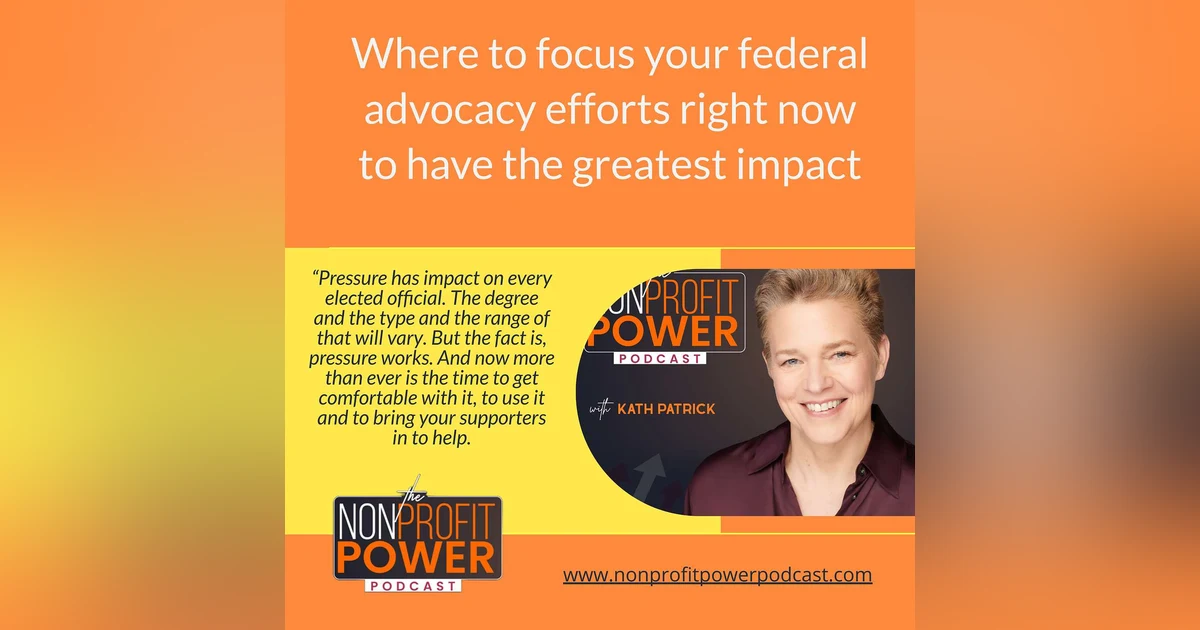
34:58 So use that knowledge. And if you are in a swing district, triple down on your pressure because it's going to have an outsize effect. But even Republicans in very safe seats don't like it when the nightly news coverage is about how 200 angry constituents confronted them in a town hall and said, you're screwing up. We want you to do better. The people of this community need you to do better. That's not a good look. They don't want that. Pressure has impact on every elected official. The degree and the type and the range, and all of that will vary. But the fact is, pressure works.
35:38 And now more than ever is the time to be using it and a time to get comfortable with it and to bring your supporters in. Because remember, the truth is that everyone who's likely to support the work that you do is appalled at what's happening right now. And they are probably feeling helpless and powerless and like they wish there was something they could do. When you give them that something, you are giving them an enormous gift. And you're helping to build the power of the voices of the people in your community and across your state and across your country to say, we're not having this. We demand better. And together we have a shot at putting cracks in their power, breaking it apart as best we can wherever we can.
36:24 The more of us there are adding to those voices, the more powerful we will be. Thanks for listening, and I'll see you in the next episode right here on the Nonprofit Power Podcast.