
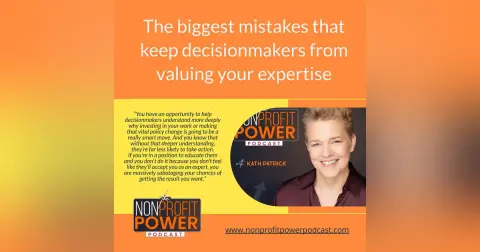
The Biggest Mistakes that Keep Decisionmakers from Valuing Your Expertise

 Apple Podcasts
 Spotify
 Pandora
 Amazon Music
 I had a conversation with a client recently that surprised me. Then I thought about it some more and I realized it was something that a lot of nonprofit leaders struggle with. It's just that this client was experiencing a version of the problem that was a bit unusual.
This client is a CEO who has decades of experience and accumulated wisdom and perspective. But one day, this CEO shared with me that although she was considered a big expert in her previous field, she didn't have the same expert reputation in her current field. And therefore, she didn't feel like she could claim expertise at all in that field.
She was working backwards from the fact that over a span of 20 years, she had built this really strong reputation as a huge expert in her previous field. And then reducing that to the conclusion that it takes 20 years to build the knowledge, the reputation the relationships, etc. And that is patently not true.
But her biggest mistake was she made the erroneous assumption that the only reason her expertise in that prior field was valued was because of those 20 years of investment. And that anything less was not enough.
This is a really insidious form of self-limiting thinking. A lot of leaders may not have anywhere near 20 years of expertise. And yet some of them are very successfully claiming the expertise they do have and getting great results from decisionmakers because of that. Others are operating from the same self-doubting and self-limiting thinking as my client of, "I don't have enough (fill in the blank) yet, so I can't claim I'm an expert."
My client was taking herself out of the game before she even started. The stories she was telling herself led her to avoid claiming the expertise she already has. And that meant she wasn’t sharing her expert analysis and perspective with the decisionmakers that needed it in order to make smarter decisions.
Including decisions about funding and policy that directly impact her organization and the people she serves.
In this episode, we share:
- The two main causes of failing to claim our status as an expert
- Common fears and stories that cause leaders to doubt their expert status
- One powerful reframe that will help you claim the identity of expert
- The easiest and fastest way to establish your expert identity
- One highly effective practice you can start today to increase your comfort with owning your expertise
If you found value in this episode, please share it with other progressive nonprofit leaders. And I’d be grateful if you would leave a rating and review on Apple podcasts, which will help even more people find out about this podcast.
Thanks!
You're listening to the Nonprofit Power Podcast. In today's episode, we share the biggest mistakes that keep decision-makers from valuing your expertise. So, stay tuned. If you want to have real and powerful influence over the money and policy decisions that impact your organization and the people you serve, then you're in the right place. I'm Kath Patrick, and I've helped dozens of progressive nonprofit leaders take their organizations to new and higher levels of impact and success by building powerful influence with the decision makers that matter. It is possible to get a critical mass of the money and policy decision makers in your world to be as invested in your success as you are, to have them seeking you out as an equal partner, and to have them bringing opportunities and resources to you. This podcast will help you do just that. Welcome to the Nonprofit Power Podcast. Hey There, folks. Welcome to the Nonprofit Power Podcast. I'm your host, Kath Patrick. I'm so glad you're here because there's a problem out there that a lot of nonprofit leaders are struggling with, and this might be you. I had a conversation with a client recently that surprised me, and then I thought about it some more and I realized that it was something that a lot of nonprofit leaders struggle with. It's just that this client was experiencing a version of that problem that was a little bit more unusual. This client is a CEO who has a ton of expertise in more than one field. She has decades of experience and accumulated wisdom and perspective. But one day, this CEO shared with me that she felt like she didn't have the reputation as an expert in her current sphere the way she did in her previous sphere, where she'd spent 20-plus years developing a reputation as a big expert. And therefore, she didn't feel like she could claim expertise at all in her current field. And she felt that others wouldn't consider her an expert in this field. She came to that conclusion based on her prior experience of being regarded as a high-level expert. But her mistake was she made the erroneous assumption that the only reason her expertise in that prior field was valued was because of those 20 years of investment. That that's what gave it value, and that anything less was not enough. This is a really insidious form of self-limiting thinking. She's working backwards from the fact that at the end of 20 years, she had built this really strong reputation as a huge expert in her field. And then reducing that to the conclusion that it takes 20 years to do that. It takes 20 years to build the knowledge. It takes 20 years to build the reputation. It takes 20 years to build the relationships, et cetera. And that is patently not true. A lot of other leaders may not have anywhere near 20 years of expertise in anything yet. And yet some of them are very successfully claiming the expertise they do have and getting great results from decision-makers because of that. Others are operating from the same self-doubting and self-limiting thinking as my client of, "I don't have enough," fill in the blank, "yet, so I can't claim I'm an expert." That self-limiting thinking is incredibly dangerous, and we need to be really careful not to let ourselves fall into that. Sure, with each passing year, you develop more depth in relationships, in knowledge, in reputation. Absolutely. But don't lie to yourself and think that it's gonna take a long time to develop subject matter expertise, to develop relationships, and to develop the reputation for expertise. That can all happen fairly quickly. It certainly does not take 20 years. Of course you continue to grow, but don't be afraid to own the expertise you have just because you don't know everything there is to know about the subject on the face of the earth. My client was taking herself out of the game before she even started. She was telling herself that because her expertise in this new field isn't as deep as it was in her old field, that it doesn't count, that it's not good enough. She was telling herself that it takes years and years to develop a reputation for expertise. And since she doesn't have those years yet on this subject, then no one will think she's an expert, and on and on. None of that is true. Where this comes up most often, I find, is when you're engaging decision makers. Maybe one-on-one or maybe you're in a room full of them, and you have an opportunity to educate them about the problem you solve and your unique solution to the problem, or why some element of current public policy is not working, and how that policy needs to change in order to work better. You have the opportunity to help them understand more deeply why investing in your work or making that vital policy change is gonna be a really smart move. And you know that if they don't have that baseline understanding, they probably won't be interested in doing what you're asking. So we gotta get them to that understanding. If you're in a position to do that and you don't do it because you don't feel like they'll accept you as an expert, you are massively sabotaging your chances of getting that investment. So why do nonprofit leaders struggle so much with this problem? It could be grounded in some internal stories about not bragging, about not being too big for your britches, about it's important to be modest. It almost always is grounded at least partly in one or more fears. Let's talk for a minute about what fears are involved in this. There's often the fear of being judged by whomever we think is going to think we are being too big for our britches. Or who do we think we are going around calling ourselves an expert. And they're gonna criticize that and say, "You're not all that." There's the fear of being found out as claiming an expertise that you don't really have, which is a version of imposter syndrome. And in some cases, there could also be a fear of being seen, a fear of being in the spotlight. If any of those stories or fears are operating in the background, you can see why we would struggle to claim our expertise. In my coaching programs, we work a lot on uncovering stories and fears, defanging them, and then rewriting them to something that serves us better. Sometimes that work is quick, sometimes it takes a bit more digging and processing to rework those. But today I wanna share some ways to help you come at this from a different angle and to help you rethink what you've been doing. One of the most important things to call out is that asserting yourself as an expert does not mean you are claiming to be the expert. You're not saying you're the very most expert expert. You're not saying you're the only expert. You are saying you are an expert on this topic, and you have important and valuable things to share that will help decision-makers increase their understanding and make smarter decisions. You can absolutely claim expertise in your area of work, in the problem you solve, how that problem is experienced by the people you serve. Expertise about how to solve that problem in really effective ways that are transformational for the people who get the services. You're expert in all of that if you've been doing it for any length of time. And you've been successful, obviously. That would be an important caveat. And the fact is, the decision-maker you're talking with is almost guaranteed not to have any of that knowledge, any of that perspective. Because the chances of them having worked in the exact same direct service niche that you're in is vanishingly small. Therefore, by definition, you are more expert than they are on this thing. And you have things of value to share with them that are gonna help them get smarter and make smarter decisions. That's your job. There's another really handy way that you can both improve your status as an expert, and increase your comfort with claiming that status. And that is, make a point of getting yourself in public settings where you are sharing your wisdom and perspective with others in a somewhat formal setting. Being a guest on a podcast, presenting as part of a panel at a conference, running a workshop. Any one of those settings is an opportunity for you to take what you know and how you understand things and share that with others who can benefit from that perspective. Make a point of doing more of that. Get yourself on some podcasts. Get yourself on some panels at conferences. They don't have to be big national conferences. They could be local information sessions. They could be city or county gatherings. They could be state-level gatherings. These kinds of gatherings happen all the time, whether they're happening in person or virtually. There's tons of opportunities to be on panels, to either lead a workshop or be part of a workshop, where you're sharing your expertise and perspective. The more you do that, two things are gonna happen. Number one, the more comfortable you're gonna get sharing the expertise you do have and discovering that it adds value. Imagine! You'll discover that as you get feedback from people. People will come up to you afterwards and say, "Wow, that was amazing. When you said blah, blah, blah, I never realized that. Thank you for that perspective. That really helped." Or, "That other thing you said was really brilliant. Thank you. You will get that feedback, and that will help you start to feel like, "Okay, yeah, maybe I am kind of an expert Certainly other people found value in this, so that's good. The other thing that will happen is there will be decision-makers or staff to decision-makers who will be observing these things. Maybe they're in the audience, maybe they're also on the panel with you. Either way, they witness you sharing valuable perspective, and maybe they even learn something in the process. But if nothing else, they have seen you be on a stage where you are operating as an expert. As soon as they see that, in their mind, now you are an expert. That's how that works. Do this repeatedly. Give yourself the exposure and repeat practice of being in that position and having it work out just fine. Nobody jumps up in the middle of what you're saying and says, "Fraud! Impostor! Clearly, this person is no expert. Who let her in the room?" Of course, that's not gonna happen. And your conscious thinking brain knows that. But your nervous system doesn't know that until it has repeated experiences where not only does nothing bad happen, a bunch of really good things happen. The other practical thing you can do is write yourself some new bio sketches. Do a few of them for different topic areas, and in each one, include a few sentences saying what you're an expert on. These will be really handy to have on file when you go to do one of those engagements, 'cause often the organizers will ask for a brief bio. Be sure that each of your bios clearly claims your expertise in the relevant topics, and you can do separate ones for each topic. You can always mix and match if someone's asked you to speak on a couple of things at once. This exercise may be really challenging initially. Just keep at it. And operate from the knowledge that the sentences you write that feel totally immodest and braggadocios are probably too obtuse. They probably don't claim your expertise strongly enough. Test it. Share it with a few other people, and ask if they can tell you, based on reading that, what your areas of expertise are and what that expertise is grounded in. If people aren't clear, you need to be even more direct in your claims. The bonus out of this is that when those folks call and want the bio, it'll be ready. But the real point of the exercise is that it is helping you get comfortable claiming expertise. Give these strategies a try and let me know how it goes. I promise that if you do each of these a few times, your comfort level with claiming your expertise will go up. And when that happens, more decision-makers will start to see you as the expert they need to call on. Thanks for listening, and I'll see you in the next episode right here on the Nonprofit Power Podcast.