
How the Hidden Power of Your Voice can Make or Break Your Biggest Deals
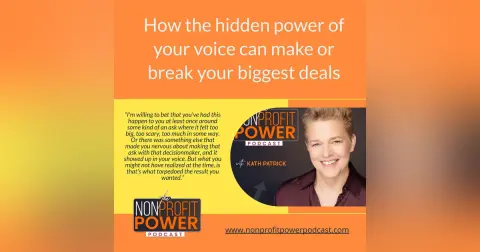
It's time we looked at a piece of your messaging that I haven't talked about enough. Our voice is our most powerful tool, quite honestly. If we are able to use it to its maximum effect. This is the completely secret ingredient that is not getting enough attention. But too often what's going on is that we're not using our voice to maximum effect. You know I am all about great messaging. Great messaging is essential to your advocacy success. But what happens a lot of the tim...

 Apple Podcasts
 Spotify
 Pandora
 Amazon Music
 It's time we looked at a piece of your messaging that I haven't talked about enough. Our voice is our most powerful tool, quite honestly. If we are able to use it to its maximum effect. This is the completely secret ingredient that is not getting enough attention.
But too often what's going on is that we're not using our voice to maximum effect.
You know I am all about great messaging. Great messaging is essential to your advocacy success. But what happens a lot of the time, and particularly in three specific scenarios, is that our voice doesn't match our messaging. And that's where we get into real trouble, because that mismatch can torpedo even the very best messaging.
I don't want that to happen to you.
Here’s what’s going on and why it matters. What we humans do when someone else is talking to us, is our subconscious is processing the sound of the voice and drawing all sorts of conclusions. And making all sorts of decisions about that person before the conscious thinking brain ever gets involved.
If a decisionmaker’s subconscious is processing the sound of your voice as, " yeah, no, that's not for me." That will cost you the investment. That will cost you the thing you came there for. Because their subconscious has already decided that it's a no.
The conscious brain will sit there and listen politely, and it might even smile and nod and ask a couple questions, but it won't engage. Because the subconscious already told it, "Nope. We're not doing this. This isn't for us." That's where it becomes incredibly costly. And we can't afford that.
In this episode, we share:
- What the decisionmaker’s subconscious needs to hear in your voice in order to get to “yes”
- What a decisionmaker’s subconscious hears when your voice is not aligned with your message
- How total alignment between message and voice led to a $15 million investment for one Nonprofit leader
- The three most common scenarios where there’s a high risk of your voice being out of alignment with your message
- The most dangerous wrong conclusion Nonprofit leaders often draw when a decisionmaker disengages
- One action you can take today to improve alignment of your voice with your message
I’ll be bringing this powerful voice coaching tool into my work. If you found this episode intriguing, message me and let me know if you’d like to learn more, or if you’d like to find out how to work with me to increase the power of your voice.
Message me through the podcast website or on LinkedIn.
You're listening to the Nonprofit Power Podcast. In today's episode, we share how the hidden power of your voice can make or break your biggest deals. So, stay tuned. If you want to have real and powerful influence over the money and policy decisions that impact your organization and the people you serve, then you're in the right place. I'm Kath Patrick, and I've helped dozens of progressive nonprofit leaders take their organizations to new and higher levels of impact and success by building powerful influence with the decision makers that matter. It is possible to get a critical mass of the money and policy decision makers in your world to be as invested in your success as you are, to have them seeking you out as an equal partner, and to have them bringing opportunities and resources to you. This podcast will help you do just that. Welcome to the Nonprofit Power Podcast. Hey there, folks. Welcome to the Nonprofit Power Podcast. I'm your host, Kath Patrick. I'm so glad you're here for today's episode because it's time we looked at a piece of your messaging that I haven't talked about enough. And I wanna start bringing this to the forefront more and more often because it is so powerful, and that is what's happening with your voice. Our voice is our most powerful tool, quite honestly. If we are able to use it to its maximum effect. But too often what's going on is that we're not using our voice to maximum effect. I see it play out all the time. And I find that I'm focusing more and more on this in my one-to-one work with clients and in my coaching groups. Because this is the completely secret ingredient that is not getting enough attention. And you know I am all about great messaging. Great messaging is essential to your advocacy success. But what happens a lot of the time, and particularly in three specific scenarios, is that our voice doesn't match our messaging. And that's where we get into real trouble, because that mismatch can torpedo even the very best messaging. I don't want that to happen to you. Here's the thing. We all have situations where our voice doesn't match up, and I'm gonna talk about the three most common ones. But I also wanna hasten to add that there are a lot of settings and scenarios in which our voice 100% matches our messaging. So it's not either/or. It's not like, oh, either your voice is off and you never match your messaging, or you're good, it always matches, no problem. The vast majority of people, including nonprofit leaders, live somewhere in the middle. And we have certain situations that have a little bit of a freak-out factor, have a little bit of a scary factor, a little nervousness factor that causes us to slip into vocal patterns that absolutely do not serve us. And that causes our voice to be out of alignment with our messaging. Before we get into how it happens and what we do about it, let's talk about why this matters. Here's why this matters. Even though most decision-makers are not aware of this, what we humans do when someone else is talking to us, What is happening is that our subconscious is processing the sound of the voice and drawing all sorts of conclusions, and making all sorts of decisions about that person before the conscious thinking brain ever gets involved. Now, if you ask 99% of decision-makers whether they do that, they'll tell you, "Of course, I don't. I just listen for the facts. I listen for the content or da, da, da, da, da to find out if what this person is telling me makes sense and is the right idea and all that." Yeah, they are listening for that. Their conscious brain is totally listening for that. Mm-hmm. The problem is the subconscious, as we know, is always very, very busy in the background. And when it comes to processing people's voices, your voice included, what that decision-maker's subconscious is doing is it's picking up all the sounds that are in the voice that give it information about whether you believe in what you're saying, whether they should trust you, whether what you're saying has any value for them. The subconscious is busy with all of that. And if the subconscious votes no on your voice, the conscious brain of that decision-maker is gonna tune out. They're gonna be listening with only half an ear. They're really not gonna be leaning in. This is why it sometimes happens that even if you have your messaging perfectly dialed in, that you can still have a decision maker not really engaging and not leaning in. And if you stop to think about it and rerun in your mind when that kind of thing has happened. I bet you would notice the same thing that I have noticed, which is that there are certain situations where it is most likely to happen. It's often when it's either a setting or a situation in which we feel a little bit uncomfortable, we feel a little bit unsure, a little bit nervous, a little bit worried, a little bit something off. That we are not standing in a place of complete and total confidence and certainty about absolutely everything we're about to do and say. That's when the voice will go out of alignment with the messaging because it is busy reflecting whatever's going on internally that you're concerned about. The most common scenarios where this happens that are typical of nonprofit leaders interacting with decision-makers are when you are in really big, important rooms with really big, important, powerful people and the stakes are super high. That one, I have seen it over and over again. I've seen very skilled communicators have their voice go out of alignment with the messaging when they're in those settings. The other scenario that's most common is when you're making a pitch, when you're selling something, literally. You are making a pitch to a decision-maker about investing in your work, and you're about to name a price that feels really high to you, or that you're worried is gonna feel high to them, or whatever. And then the other one, and this may surprise you, but this is the third one where things will often go sideways, is when we're introducing ourselves And you may think, "Oh, well that's silly. I always introduce myself the same way. I say, 'I'm Susie Q from XYZ organization, and this is what we do and who we help.'" And I'm fine with that, maybe. But what I have noticed in coaching a lot of leaders around this particular piece, because we talk so much in the coaching work that I do about how the first few sentences out of your mouth in an encounter with a decision-maker matter so very much. And what we can't do is the same routine thing we always do. Because we need to be fully present with what we're saying. Being fully in the present, focused on the exact thing that we are doing right now and not five minutes into the future when we're gonna get to the part that we really wanna talk about. And that's where I see even folks who feel like they're rock solid confident with their voice going into an introduction with a decision maker. Where I'll notice that their voice is not working for them, is when their head is already in the outcome. It's already on to the next thing. It's already thinking about, "Okay, now as soon as I get this out of the way, we're gonna be talking about this other stuff that really matters. The other thing that happens, and I'll flag this too because this could happen to you in certain settings. It happens to me in some settings. I've been doing this a long time, and still there are some settings where I can have a hard time with this. And that's the aspect of introducing yourself that is about owning your greatness. Is about tooting your own horn. And a lot of us, particularly those of us in the nonprofit universe, have a hard time with that. We're fine tooting our own horn if it's about the organization, no problem. We can sit there and say, "The organization's the best, most fabulous thing in the world." And then we're introducing ourselves and we're like, "Well, you know." It's this modesty thing that kicks in. Those are the scenarios where I see the mismatch between voice and messaging happen the most often and where it's costing you the most. The way it's costing you, in case it's not already obvious, is that if you're there to get something from that decision-maker, you want a partnership, you want an investment, you want cooperation on policy, you want something, or you probably wouldn't be there talking to them. If their subconscious is busy processing the sound of your voice as, yeah, no, that's not for me." That will cost you the investment. That will cost you the thing you came there for. Because their subconscious has already decided that it's a no. The conscious brain will sit there and listen politely, and it might even smile and nod and ask a couple questions, but it won't engage. Because the subconscious already told it, "Nope. We're not doing this. This isn't for us." That's where it becomes incredibly costly. And we can't afford that. Let me give you some examples of how this happens. What will typically happen is that you'll be going along and your voice is fine. Your voice is totally aligned with your messaging. Let's say you're talking about the work that you do and its powerful impact and how it transforms people's lives and it's amazing, and the ROI, oh my goodness, the ROI is fabulous. Holy moly. Which is great because at least if you're doing all of that in your true voice that's fully connected to the essence, to the energy of the message, that will resonate. And the decision-maker will lean in for that. But here's what happens a lot of the time. We're going on, we've got it, we are nailing it. We told an amazing story, and the decision-maker leaned in. Yes. Awesome. And the ROI, oh, my goodness, did I tell you about the ROI? Look at this. Isn't that amazing? That's really cool. Awesome. And so what we wanna talk to you about is, you know, kind of in investing in our work at, at a level that is actually gonna, you know, allow us to, um, uh, you know, r- really make the biggest impact. And so well, that would be, you know, with the amount we're talking about is probably, you know, um, 500,000 to start, and then maybe, uh, you know, probably another bump after that. Did you hear, I exaggerated a little bit, but not a lot. Did you hear what happened to my voice? Two things happened. And they were both around the ask. They were both around asking for the investment. The first thing that happened was all these filler buffer words started appearing. Well, you know, uh, uh, modifying, diminishing. And then when it got to the actual number that felt scary, the voice drops and gets even quieter. The bottom just falls out of it. Both of those sounds will be processed in the listener's subconscious as, you don't believe in the thing that you're selling, you don't think it's worth the amount you're asking. And probably some more things too, but those are the two that matter the most. If they're, like, excited about the work, they're excited about what you've told them so far, or at least they're intrigued, but then when you go to make the pitch, to make the offer, your voice starts telling them something else. And their subconscious that was kind of along for the ride and going, "Yeah, yeah, we're into this. This is great. She's totally aligned. We love this." When that vocal shift happens, when the bottom drops out, when the filler words come in, the subconscious goes, "Whoa, hold on. They don't believe what they're saying. They don't believe in the thing they're selling. They don't think it's worth the price. Mm-mm, that's a no. Why would we invest in this if they don't believe in it, if they don't think it's worth the price? So you see how this happens. And I'm willing to bet that most of the people listening to this right now, you've had this happen to you at least once around some kind of an ask where it felt too big, too scary, too much in some way. Or there was something else that made you nervous about making that ask with that decision maker, and it showed up in your voice. But what you might not have realized at the time is that that's what torpedoed the result you wanted. I have clients say this to me a lot. "I don't understand. I had them. They were eating out of the palm of my hand. They were great, but then when we got to the price, they just tuned out and they backed off." And what's really dangerous is that more often than not, I've seen nonprofit leaders experience that situation and draw the wrong conclusion. The conclusion they draw is, "Oh, well, that means that our price was too high, that they weren't comfortable with that number." Chances are very good that's not what it means. What it means is your voice went sideways, and you were out of alignment with your messaging, you were out of alignment with your intent. And their subconscious heard it and said, "Nope. Uh-uh." So we have to fix that, right? Now, there's some other ways that this comes up. I'm gonna give you a couple more examples. One of the ones that's really common, and this will torpedo great messaging too. This can start at the very beginning and go all the way through the messaging, and it drives me crazy. So I'm gonna flag this with a great big neon flag here to say, "If this is you, we gotta change this," which is the professional voice. So many nonprofit leaders have bought the idea, somewhere along the way got convinced that the way you talk to big, powerful decision-makers is you must be super professional at all times, and just the facts. What happens to the voice when you do that is that, number one, it's not the real you. You know how I know it's not the real you? And that doesn't mean I don't think you're professional. What it means is that the real you has a full range of emotion to express about whatever it is you're talking about. And what the professional voice does is it strips out all the emotion. It automatically is not your real voice. When you go into that voice that for whatever reason you've bought the idea that that's how you're supposed to sound when you talk to big important people. You're stripping the emotion out, and their subconscious can't figure out who you are. They can't figure out whether you believe in this or not. All they hear is kinda this one-note professional thing, and they're like, "Hmm, I don't know." And here's the tricky bit. Some decision-makers do the same thing. They'll do the professional voice. That does not mean you should match that. You always wanna pay attention to sort of the tone and style of any given decision-maker. Some of them are super freewheeling and loosey-goosey and, you know, practically wanna crack open a beer with you over the conversation. Some of them are very buttoned down and matter of fact and get to the point 'cause I got another meeting in two and a half minutes. So you obviously work with the personality and the style of the person you're engaging, yes. But if their style is super professional, that does not mean that you should match that exactly, because their subconscious is actually in charge, and their subconscious needs to hear all of you. They need to know that you really believe in what you are selling and what you are asking for and what you are promoting. And if that subconscious doesn't get that in the sounds in your voice, its answer will be no. And if the subconscious says no, almost never does the conscious thinking brain overrule it, because the conscious brain isn't even aware of that the vast majority of the time. We get into this in great depth in my coaching programs because it's such a common misperception that that's what you're supposed to do. And it's also hard to undo the muscle memory of that in the voice. We absolutely can do it, but it takes some work. The other thing that happens that's sometimes a combination of messaging and voice is justifying. Not just letting the price lay there, but feeling like, "Oh, I don't know. I didn't get an immediate yes, so I better justify that. I better explain why it's better and why it's still okay." You hear the tension and the nervousness in the voice as it starts to say, that's actually a, a really good price because da, da, da, da, da, da, da, da." That's different than First of all, just saying the number and waiting to see if there's any concern about the number. Maybe there's not. And if there's not, then you can just let it sit there. But if you get a question back that says, "Hmm, that seems kind of high," then you can explain the reasons that the price is the price. But not from a defensive posture. And both your messaging and your voice have to convey 100% certainty that not only is the thing that you are selling worth that price, but it's actually a bargain at that price. But you have to believe that, your voice has to reflect that, and your messaging does too. The justifying is a complicated thing because we go into it with our words, we go into it with our vocal tone, and we go into it with our energy. And when we go there, again, their subconscious says, "Mm-mm. No, they don't really believe this. They're overcompensating. I don't hear in their voice that they actually believe this." When any of that happens, it's not hard to figure out what happens to the investment. When the decision-maker's subconscious hears any of those sounds, it goes straight to no. So we know those are problems we have to deal with. On the flip side of that, let me share for a minute about what it looks like when it's all aligned, because that's what we're aiming for. When it's all aligned, not only does the decision-maker lean in the whole way the whole time, but when you get to the ask They're like, "Yeah, let's talk about this. Let's figure out how to make this happen." Versus, "Well, I don't know. We'll have to think about that," and putting you off. The reason for that is the subconscious heard what it needed to hear. It heard that your voice aligned with the words that were coming out of your mouth. It's that simple. It heard that you believe in this 100%, that you are 100% confident and certain that it is worth the price, that it is the quality you say it is, that the outcomes are what... that you are certain about all of it. There's not a shadow of a doubt in your mind. And you furthermore can't imagine why there'd be a shadow of a doubt in anybody else's mind. Of course they're gonna say yes, of course they're going to invest. Because to do anything else would just be silly. When you come to it with that mental frame, that shows up in your voice. My favorite example of this in the last few months was a client of mine who had done a fantastic study that proved incredible impact and ROI of their work. They had done this study in response to a number of state-level decision makers saying to them, "We like what you're doing. We think it has value, but we need proof. We need real numbers. We need hard proof 'cause we can't invest just on kind of a general feeling of it's probably a good idea." So they went out and partnered with serious research partners. They did a deep research analysis and study. Proved beyond a shadow of a doubt that, yes, the impact is what they said it was, the ROI is what they said it was, and then some. So they were getting ready to do a big event to share this brilliant proof with a whole host of decision makers that they'd had some version of this conversation with. And a bunch of additional funders and others who were peripheral investors in the work. They gathered them all together for a big reveal and briefing on the study. I worked with their team in the months leading up to that to craft all their messaging around this proof. Because they knew that if they gathered everybody in a room and they unveiled it and they didn't do it right, that they would've missed an enormous opportunity that they might never get back. So they wanted their messaging to be absolutely perfect. So we worked on that together. We came up with great messaging, great stories, fantastic imagery, really good stuff. But then there was still the matter of delivering that message in a compelling way. What was very fortunate was that the CEO who was gonna carry the bulk of the messaging weight around this, was 100% dialed in on this. And her voice aligned perfectly with everything she said. Because she believed so strongly, so deeply, there was not a shadow of a doubt in her mind, not one, about anything she was saying. The goal was to hold them to their promise, which was basically, "If you bring us this proof, then we'll be able to invest." And they had a very legitimate concern that, yeah, you know, it could happen that we bring them the proof and then they find some other reason, some other thing that's in the way of investing, and they wanted to make sure that did not happen. So a key piece of their messaging was to call that out and say, "Look, you told us to bring you this. This was the condition you set for investing. We have met the condition. Here we go." And I'm gonna have the CEO on the podcast in a few weeks to talk about this, so I don't wanna do too many spoilers here 'cause she has a fantastic story and I want her to tell it. But for the purposes of this conversation, the thing that she did that was so powerful was that her voice matched her words and her messaging 100%. It was completely aligned all the way through. And that included going through a bunch of things that were at times a little bit flip, a little bit scolding, a little bit holding their feet to the fire, a little bit stern, along with some laugh moments. She did this masterfully. Now, part of it is she's got a lot of skills and has worked to develop those skills. That's great, but what I'm talking about here is not a public speaking skill per se. This is internal work. This is about being so utterly certain about the thing that you are sharing that there can only be one outcome. There's only one possible outcome, and having that certainty in your mind. That is a huge difference maker. But there are a ton of things that get in the way of that, that plant little seeds of doubt in our own mind that then show up in our voice. And the decision-maker's subconscious picks up on those little seeds of doubt. It hears them in your voice. So our task is to remove the things in our voice that are causing misalignment between our message and our voice, and that are blocking getting the thing that we really want. So the end of that story with the CEO who masterfully engaged a room full of decision-makers with a voice that perfectly matched all of the message? The result of that was a $15 million investment from the state that was brand new. That's the power of alignment. That's the power when your voice completely aligns with your message. Not just the words, but the conviction behind them. Everybody recognizes when they hear that. The most compelling people are the ones where you hear that in their voice. You hear that it's genuine, that everything out of their mouth is real. It's genuine. It's who they are. And they believe it 100%. They have absolute conviction and faith in it, and they can only imagine one outcome, which is that you will see it. You will believe it too. You can begin to realize as you hear about this challenge, that fixing this has got a lot of moving parts. And we go deep on that in the coaching work that I do. But I wanna give you a couple of things you can play with right now that will begin to help you with this. The first thing is to do a little inventory for yourself. And if you're honest, you'll know where these places are. But start with that list that I gave you. Introducing yourself and owning your greatness, selling something or making the pitch, and being in really big, important rooms with really big, important, powerful people where the stakes are high. Think of situations where you've been in each of those scenarios, where some part of you experienced some discomfort or uncertainty, or just felt like you weren't on your A-game. Or maybe you felt like you were on your A-game, but the reaction you were getting told you that something was off. Pick a an example, a story from each one of those, or as many as apply. And think through, recall, or just feel into it internally and ask yourself, what are the thoughts that are running in my head about this?" About, what does it mean to own your greatness? What does it mean to toot your own horn? What does it mean to say that you are, in fact, an expert, an authority, the best at something? Ask yourself, when I'm selling or making a pitch and I'm worried about whether they'll say yes, ask yourself what you're really worried about. Are you worried about them judging you? About them challenging you and maybe saying your stuff isn't worth what you say it is? What are you worried about? What are the thoughts running in your head about that? Don't just say, "Oh, well, I really need the investment and if they don't invest, that's bad." That's relevant. If that's what's going on in your head, write that down 'cause that's very common. But it's typically not the only thing that's running in your head. And then being in big rooms with big powerful people when the stakes are high. What's going through your mind when you're there that you're feeling some anxiety, some concern, some hesitation, some something. What are the thoughts that are running in your head about that? And just write those down and take a look at them. Then there's a couple of things you can do with that. You can prosecute those things. You can identify which of those are beliefs. For example, a lot of time the one with introducing yourself and owning your greatness. A lot of beliefs will come up about you're not supposed to brag about yourself. That's gauche. That's not done. That's not approved. Or maybe it's I have to prove that I'm what I am. You know, I could say these words, but I have to prove it. I need you to really know that I'm that. I can prove it. Maybe it's that that's going on. All these things are beliefs and stories that are running in your head that are telling you how things are or how things are gonna be. It's very helpful to interrogate that a little bit and say, "Is that really true? Is it possible that something else is true? Is it possible that the opposite is true?" Is it possible they already think you're great? Or is it possible that they assume that if you're in the room, you must belong there. And they're just waiting to find out what your particular aspect of greatness is because everybody who's in this room is obviously very cool. We just don't know which thing about you is super cool yet, but we are eager to know. Is it possible that's how they're looking at you? Is it possible when you are about to ask for that crazy big number, that first of all, it's not a crazy big number, and second of all, the number's not that important to them. What's important is the result. Is it possible that they will absolutely see the value and will understand that it is totally a bargain at the price you're naming? And if that's possible, then why not operate from that? Why not operate from the belief, the mindset that of course they're gonna invest? Why wouldn't they? This is brilliant. What possible other action could they take if this is obviously the best thing ever? Why wouldn't they? This is a bargain at any price. Take that new thought and repeat it to yourself out loud daily, multiple times a day for two or three weeks minimum. Because what you're doing when you do that is you are training your subconscious in a new belief, in a new outlook. And when your subconscious believes it to its core, it will be much more likely to show up consistently in your voice. Now, that is just a tiny sliver of what's possible in making shifts with the voice to get your voice completely aligned with your messaging. But I wanted today to begin to help you see why it sometimes is that your messaging is great and they're still not leaning in. And almost always the answer is something's going on in the voice that is betraying something going on internally that needs to be resolved. There's a whole bunch of other things that could be going on, too. We can't get to all of them right now, but I wanted to give you one that you can work on by yourself. And begin to see a shift and begin to see results. Try operating from that new belief the next time you're talking to a decision-maker, and see what happens. It won't fix everything, but it'll be a step in the right direction. And it may just get you to be a little more focused on, how else can I make sure that my voice is totally aligned all the time? And that's something we're gonna talk about a lot more in future episodes, but this is the beginning of that conversation. Thanks for listening, and I'll see you in the next episode right here on the Nonprofit Power Podcast.