
Five Traits of a Coachable Leader

In the many years I've been coaching Nonprofit leaders, I've learned a lot of things. One of the things that really interests me is how some leaders are super coachable and they make giant leaps when they get great coaching. And others, even when they have great coaching, don't tend to make the same kind of progress. What I've realized over time is that there are certain traits or aspects of a leader that actually cause them to be more coachable. These are traits that anyone can cultiva...

 Apple Podcasts

 Spotify

 Pandora

 Amazon Music
In the many years I've been coaching Nonprofit leaders, I've learned a lot of things. One of the things that really interests me is how some leaders are super coachable and they make giant leaps when they get great coaching. And others, even when they have great coaching, don't tend to make the same kind of progress.
What I've realized over time is that there are certain traits or aspects of a leader that actually cause them to be more coachable.
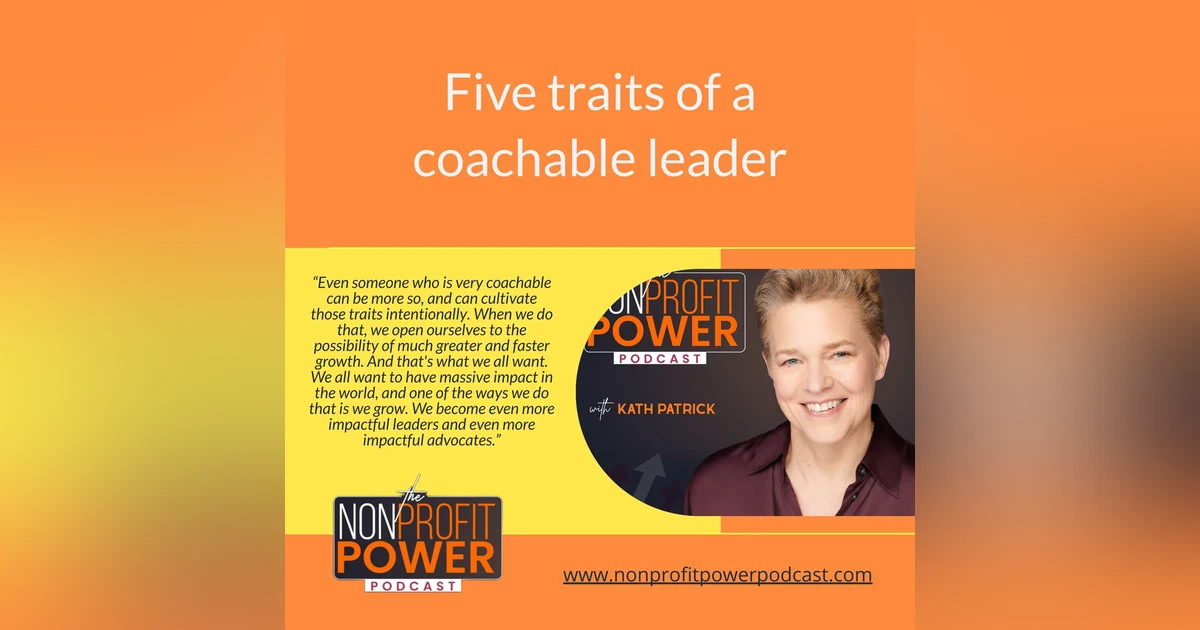
These are traits that anyone can cultivate. It's not that you're born with this and you either are coachable or you're not. Even someone who is very coachable can be more so, and can cultivate those traits even more intentionally.
When we do that, we open ourselves to the possibility of much greater and faster growth. And that's what we all want. We all want to have massive impact in the world, and one of the ways we do that is we grow. We become even more impactful leaders and even more impactful advocates.
In this episode, we reveal:
· The common “default mode” that may be blocking your ability to receive the greatest benefits of coaching
· What’s really going on when you get stuck while pursuing a big goal, and what to do about it
· How inaudible “noise” may be sabotaging your creativity and your ability to “be in the zone”
· Why we fall into the trap of arguing for our limitations, and how to escape that trap
· The difference between productive impatience and self-defeating impatience
· How to stay open to the gifts the universe is trying to give you
If you found value in this episode, please share it with other progressive nonprofit leaders. And I’d be grateful if you would leave a rating and review on Apple podcasts, which will help even more people find out about this podcast.
Thanks!
You're listening to the Nonprofit Power Podcast. In today's episode, we share five traits of a coachable leader. So, stay tuned. If you want to have real and powerful influence over the money and policy decisions that impact your organization and the people you serve, then you're in the right place. I'm Kath Patrick, and I've helped dozens of progressive nonprofit leaders take their organizations to new and higher levels of impact and success by building powerful influence with the decision makers that matter. It is possible to get a critical mass of the money and policy decision makers in your world to be as invested in your success as you are, to have them seeking you out as an equal partner, and to have them bringing opportunities and resources to you. This podcast will help you do just that. Welcome to the Nonprofit Power Podcast. Hey there, folks. Welcome to the Nonprofit Power Podcast. I'm your host, Kath Patrick. I'm so glad you're here for today's episode. If you've ever thought about working with a coach, today's episode is designed to help you set yourself up for success. In the many years I've been coaching nonprofit leaders, I've learned a lot of things. One of the things that really interests me is how some leaders are super coachable and they make giant leaps when they get great coaching. And others, even when they have great coaching, don't tend to make the same kind of progress. And what I've realized over time is that there are certain traits or aspects of a leader that actually cause them to be more coachable. I wanna share those with you because I'll tell you, I get so much value from the coaching that I receive from the many coaches I work with. I have coaches for a lot of different things, and I find tremendous value in all of them. One of the things that I constantly have to be cognizant of is remaining coachable. 'Cause if you've been in the game for a long time, it's easy to start to feel like, "Yeah, been there, done that. I pretty much know the stuff. I got it." And that's true. We do got it. We got a lot. We're good at a lot of stuff. The longer you've been in the game, typically the better you are at more things, more aspects of the game. And yet there's always another level. There's always room for more growth. What I love about most of the people who are drawn to work with me, either in my group coaching programs or in more intensive one-to-one coaching, is that they really wanna grow. They want to make that big leap, and they come to me to help them do that, which is awesome. It is the most fun thing I get to do in the work that I do, and it's fabulous. But I really have observed that there are specific traits that anyone can cultivate. It's not that you're born with this and you either are coachable or you're not. That is not it at all. I've also noticed that some people are really coachable in one area and not in another, and there's usually something significant going on there. That just underscores for me how important it is to be aware of those traits and to cultivate them and to actively pursue them. Even someone who is very coachable can be more so, and can cultivate those traits even more intentionally. Because when we do that, we open ourselves to the possibility of much greater and faster growth. And that's what we all want. We all want to have massive impact in the world, and one of the ways we do that is we grow. We become even more impactful leaders and even more impactful advocates. So let's talk about those five traits. There are others. These aren't the only five traits, but they're the ones that consistently stand out to me as being particularly important. The very first one is the ability to receive. Here's the thing, if you're closed off and always in push mode, you're not gonna be able to receive. You won't be able to receive insight or wisdom or a better idea or a new idea. And that's kind of the opposite of growth. Here's how this tends to present, and we all do this from time to time. I'm not saying that if you ever do this, then you're not coachable. That's not it at all. The goal here is always to be more coachable, more able to take advantage of good coaching, to be able to grow bigger and faster. So when we're in the mode of, "Yeah, I already know how to do that, just get out of my way so I can get it done," there are times when that's how we need to operate. When we're under extreme pressure of one form or another that's temporary and situational, it may be that we just need to put our heads down and get the thing done We're not looking for receiving. We're just looking to get the thing done. Okay, fair enough. But there's a hazard there because a lot of nonprofit leaders operate under constant pressures of limited time, limited money, limited staff, and there can be a tendency to default to that MO and to come to believe that being in receiving mode is a luxury you can't afford. Because you're always under pressure. You're always gotta keep your nose down and just get her done. That is dangerous for a lot of different reasons. But certainly, it closes you off to growth opportunity. It closes you off to being able to receive. So just be aware of if you have a tendency to go there. Because here's what I'll say about that. Pressures that are constant, like time, money, staff, those are ever present pretty much. That's not a reason for choosing a method of operating, because that then closes you off to all the other ways that might actually reduce the pressure, might make things work better, might make your team happier and more productive. All that boils down to consciously putting yourself in the frame of mind of receiving and in the energetic state of receiving. The second trait of a coachable leader is a willingness to look at what's in your way. Here's how this comes up. Maybe you identify a thing you wanna pursue and the path you wanna take to get there. So you're clear on that, but you find yourself not taking the necessary aligned action to make that thing happen. If that's happening consistently, something's in the way, and it's usually something internal. Once again, the external things that are in the way are the constants. There's never enough time, there's never enough money, et cetera, et cetera. That's true for everybody. But the coachable leader learns to ask themselves what's in the way when they find themselves not taking the aligned action that's gonna get them where they need to go. And typically, it isn't just one thing. It's typically a bunch of things that are kind of layered together. And it takes a bit of work to uncover those and untangle them and resolve them in a way that allows you to begin taking the aligned action you wanna take. That's one of the things for which coaches are incredibly valuable. It's what I go to my coaches for most often. It's when I feel like I've hit a block. I know where I'm trying to go, but I just can't seem to get past a particular stage of the process. If I've done the preliminary work of identifying as best I can what's in the way, and I'm still not able to get it out of the way, that's when I call one of the coaches and say, "Help me out with this. Help me figure this out. Ask me some good questions because there's clearly something I'm not seeing." It's incredibly valuable to have someone else who doesn't have all your stuff going on and who doesn't have your level of investment in the thing. It's much easier for a coach in that situation to be able to see the whole picture and say, "Ah, I see the spot here. Let me ask you about this. Let me ask you about this other thing." And pretty soon you're realizing, oh, I see. That's what's going on. That's where I'm getting stuck. That's why I'm blocked. Aha. Now let me think about how can I get past that. We can do a lot of that work ourselves. We can train ourselves to look for whenever we run into a block, what's in the way? What's going on? Why is this a block? And look internally, not reflexively just say, "Oh, it's all the external things." The third trait or capacity of a coachable leader is the ability to identify and manage noise. This one is particularly resonant for me right now because I'm finding that what's keeping me from taking aligned action on a lot of things right now is the amount of noise in my world. So I'm really having to focus on noise reduction and noise management strategies to help clear that stuff and make it possible for me to take that aligned action. This is definitely related to the thing I just talked about, about looking at what's in your way. A lot of times, part of what's in the way is noise. Now, by noise, I don't just mean sound. Noise can be inaudible, but still very distracting. An example of inaudible noise is clutter in your workspace that's bad enough to get in your way. It's bad enough that it's distracting you, it's occupying a little space in your brain and it's affecting your mood. Or it can be something problematic going on in your personal life that's constantly tugging at your attention and occupying significant brain space. It doesn't pull your whole attention away necessarily, but it's pulling a piece of you away. If you're in a conversation with a coach and the noise in your head is pulling so much of your attention that mostly what you're paying attention to is the noise, that is not gonna be a particularly productive coaching conversation for you. What we have to do is say, "Okay, I recognize that there is some noise here that is pulling my attention and is diminishing my ability to be in the zone. So I'm going to take some action to mitigate and manage that noise." Where we get in trouble is when we don't notice that's what's happening, and so we don't take the action, and then it just keeps pulling a little piece of our attention, or maybe a big piece of our attention, away from the thing we really wanna be focused on. It sounds so minor, but it can be tremendously important. Because noise that goes unaddressed can be corrosive, and that goes well beyond the coaching environment. It's corrosive to creativity, it's corrosive to focus, it's corrosive to your ability to be in the zone and really do your best work. So that is a critical self-management technique that allows you to be more effective and more coachable. The fourth trait of a coachable leader is a willingness to operate from a place of curiosity and exploration. The opposite of that, which I see all the time, is arguing for your limitations. "Well, that won't work because da, da, da, da, da. no, I couldn't do... Maybe somebody else could do that, but I can't do that because blah, blah, blah, blah, blah." All of that, all those kind of maybe that's great for somebody else, but that won't work for me because, because, because. Everything that comes after the because is basically arguing for your limitations. Instead of saying, "Huh, well, that's interesting. Let me try that on for a minute. Yeah, I know there's a voice in the back of my head saying, 'I don't think that'll work,' but let me just shove that voice aside for a minute and say, 'But what if it did? What if it could? What if it could work? What if, we really could do that? What if I really could make that thing happen? Or what if I really could do that thing?' Then what? What would be possible if we were able to do that? And if that thing became possible, then what else would become possible?" It's that willingness to open up all the possibility and embrace it and step into it wholeheartedly without getting involved in second-guessing and saying to yourself, that's not practical. We don't have the bandwidth for that. We don't have the staff for that. We don't have the money for that. No, no, no, no, no, no, no." All the things, right? And once again, we all do this from time to time. This is the human condition. That's your subconscious trying to keep you safe, trying to keep you stuck in the safe and familiar, 'cause that's where it likes to live. But that's not compatible with your big, bold vision and your desire to make the biggest impact possible. You can't do both. You can't stay small and safe and do those big things. And great leaders are looking to do those big things. And I know that for most of my listeners, that's you. That's what you're about. So the willingness and the ability to operate from that place of curiosity and possibility and exploration. And instead of saying, No, because," instead say, "Yeah, but what if? What if?" Let's just step into that and play for a little bit and wander around in that space of possibility. What would that look like, and what could we do then? And the more you embrace that, the more it starts to feel possible. And the more your brain starts to go to, "Well, what would that take? What would we need to do? How could we do that? Hmm. Well, whose help would we need? What else would we need to do? Huh. Well, let's see. If we got this one involved and that one involved, and maybe if we did this other thing, that... Well, yeah. Actually, we might just be able to pull that off, and wouldn't that be amazing?" But you can't go there if you stay in that small, safe, and familiar, arguing for your limitations. And then the last thing on today's list. Like I said, there are more, but these are the five that really leap out to me as being particularly important. Is the willingness to be present for the journey And by that I mean, you know, I love me a good plan. Plans are awesome. I love action plans and clear objectives and outcomes, and I love all that stuff. So don't get me wrong, I love that. But I also know, that plans tend to get rearranged. Because none of us is omniscient. We don't know everything when we make the plan. We make the plan based on the best information available at the time. But one of the things we know or should know is that we're gonna learn new information along the way, along the journey to the thing we're trying to get to, whatever that outcome is that we've set our sights on. And when we can embrace the idea that it is a journey. It's a journey of discovery, it's a journey of learning, it's a journey of discovering additional opportunities along the way that we didn't even know existed. But as we make our way along usually a pretty winding path. We always think it's gonna be this nice linear journey. Our little yellow brick road is gonna go straight from point A to point B. Shortest distance between the two points. Here we go. But, you know, those yellow brick roads tend to wind around a lot, and that's just how life is. And it can be very frustrating sometimes when you're focused on that outcome and you just wanna get there. But if you're able to embrace the journey and understand that with that journey is going to come new wisdom, new insight, new opportunities that you can't see from where you're standing now. They're out there, but you can't see them yet because they're around one of those corners, one of those bends in that yellow brick road. And so the more we can keep that in our mind and embrace it and say, yes, I wanna get to the outcome. I wanna be chugging down that yellow brick road. But I'm not gonna insist that it be linear. And I'm gonna acknowledge that actually those bends and winds in the road very often are gifts if we are able to notice them and able to receive them. So we're back to operating in the mode of receiving always. It's good to be focused on the outcome because that's what helps you take aligned action and keeps you from being too distracted and getting derailed. But also recognize that it is a winding journey, and the more you can embrace that, the more good stuff is gonna come your way along the path to getting to the outcome. So go ahead and be impatient. Impatience for things to get better, to be great, that's a good impatience. It's a driving force. It keeps leaders going and helps them inspire others. That's awesome. But there's also a self-defeating form of impatience that regards any little side journeys or bends in the road, or God forbid, work that one needs to do internally That's a waste of time 'cause it's not directly obviously connected to the desired outcome of the thing we're trying to do. Versus the leader you're trying to become. By now you've probably noticed that these things are all connected. That a state of receiving is not just valuable when you're being coached. It's valuable when you're operating in the world as a leader. It makes you more open to your team, it makes you more open to opportunity, it makes you more open to insight and wisdom that you otherwise would not receive. And everything starts from there. My wish for you is that you have only the very best coaches ever, always. And that you think about receiving coaching in a broader sense as well. I can't overstate the benefit of great coaching. I have lots of coaches myself, and it's kind of mind-boggling to me how much less I would've been able to accomplish if I hadn't had great coaching. But also, all these traits of a coachable leader apply as you're moving through the world. Because there's coaching to be had from the universe, from the experiences you have, from those winding bends on that yellow brick road. All of that is an opportunity to be coached in a sense, because it's an opportunity to receive additional wisdom, additional guidance, and additional insight that's gonna help you be an even more impactful leader, and it's going to help you make a bigger, more powerful impact in the world. Thanks for listening, and I'll see you in the next episode right here on the Nonprofit Power Podcast.