
When Professionalism Can Become a Liability


 Apple Podcasts

 Spotify

 Pandora

 Amazon Music
One of the most problematic tropes that gets emphasized over and over again for nonprofit leaders can wind up absolutely wrecking your ability to really connect with decision makers. That’s the belief that you must be ultra-professional in your approach when dealing with decision-makers, especially the higher up ones. The more powerful and influential the decision maker, the more you're supposed to show up in your super-professional approach.
There's a big problem with that. Because what that does, when we come in all buttoned up and professional, is that we strip most – or all – of the emotion out of our voice. And it's that emotion that actually causes connection. So when we take it out, what do you think happens? Nothing good.
But we've been told so many times, over and over, by bosses and higher ups and maybe other people in our lives. We've been told you’ve got to be professional. The problem is nobody took the time to kind of take that apart and say, what does that mean? And what does that specifically mean in the context of trying to engage a decision maker? So we're taking all that apart, and putting it back together again in a way that's actually going to work for you.
In this episode, we share:
- How professionalism has been used against many of us, and caused us to walk a much narrower path
- The roots of self-suppression, and why it can be difficult to break free of that
- Two critical shifts away from “professionalism” that will cause you to be much more effective in engaging decisionmakers
- How to avoid excessively technical language, while still demonstrating your mastery of technical details
- How to begin to bring a fuller range of self-expression into interactions with decisionmakers, without it getting too scary
If you found value in this episode, please share it with other progressive nonprofit leaders. And I’d be grateful if you would leave a rating and review on Apple podcasts, which will help even more people find out about this podcast.
Thanks!
0:00 You're listening to the Nonprofit Power Podcast. In today's episode, we share some revealing information about when professionalism can become a liability. So stay tuned. If you want to have real and powerful influence over the money and policy decisions that impact your organization and the people you serve, then you're in the right place. I'm Kath Patrick and I've helped dozens of progressive nonprofit leaders take their organizations to new and higher levels of impact and success by building powerful influence with the decision makers that matter.
0:40 It is possible to get a critical mass of the money and policy decision makers in your world to be as invested in your success as you are. To have them seeking you out as an equal partner. And to have them Bringing opportunities and resources to you. This podcast will help you do just that. Welcome to the Nonprofit Power Podcast. Hey there folks. Welcome to the Nonprofit Power podcast. I'm your host, Kath Patrick. I'm so glad you're here for today's episode, because we're going to blow up one of the most problematic tropes that get emphasized over and over again for nonprofit leaders.
1:23 And it is absolutely wrecking your ability to really connect with decision makers. And that is that belief that you must be the most professional in your approach, especially when dealing with decision-makers and especially the higher up they are. The more Poobah-ness of the decision maker the more you're supposed to show up in your super professional approach. And there's a problem with that. Because what that does, when we come in all buttoned up and professional. Is that we strip most or all of the emotion out of our voice.
2:04 And it's that emotion that actually causes connection. So when we take it out, What do you think happens? Nothing good. But we've been told so many times over and over, by bosses and higher ups and maybe other people in our lives. We've been told you gotta be professional. The problem is nobody took the time to kind of take that apart and say, What does that mean? And what does that specifically mean in the context of trying to engage a decision maker? So we're going to take all that apart, and put it back together again in a way that's actually going to work for you. So let's get to it.
2:46 Raise your hand if you're one of the people that has heard this over and over again. I certainly did. Now I was lucky because when I first got started in advocacy work, that was not being pushed at me. I started out in the women's movement, working on women's economic justice issues among other things. When I was starting out at the local and state level, it wasn't about, you know, let's find the most professional person. It was about let's find the people who can get this done. Let's find people who have the energy and some baseline talent that we can teach and mentor and turn into really powerfully effective advocates. And I was really lucky to come into the advocacy world that way.
3:29 So I had a good 10 years of doing advocacy work without having somebody. standing behind me saying you've got to be more professional. But I know that now, almost everybody hears this all the time. And certainly when I got to Washington and started working for a national organization that was all I heard. About all the rules, about how you got to behave and what you got to do. I was new in town, so I just kind of sat back and watched. And I studied a bunch of different colleagues that I regarded as skilled at their craft and who were very effective. And I watched what they did. I went on Hill visits with them. And I just watched.
4:10 And I saw something very powerful. Which is the people who were able to allow the full range of emotional expression into their voices and who didn't show up all buttoned down and tightly professional and just speaking the tightly professional language the way they think it's supposed to sound. But they let themselves be authentically present. Those were the people that got decision makers engaged. And I saw it happen over and over again. I also saw that the leaders who were telling me, oh, no, you gotta be all buttoned down and super professional. This is Washington. This is the big leagues. You don't mess around. You know what I saw? It was really interesting.
4:52 It didn't surprise me because of the background that I had had and how I was brought up as a baby advocate. But what I noticed was those leaders that were advocating for this very buttoned down approach. They didn't connect with decision makers at the same level. And because of that, they didn't get the kind of stellar results that the folks who were allowing themselves to be fully expressive were getting. And I took a lesson from that. And I thought, you know what? All that stuff I learned back at the state and local level. That's true here too. I'm not sure how it got all squirreled up where now you've got half the leaders saying you got to do it this other very professional way.
5:35 And the other half showing up fully authentically with full emotional expression. And I thought. Well, the full expression way Is what I know how to do. I'm really good at it. I'm going to give that a try. And I bet you can guess where that ended up. I wasn't real surprised when that really worked. Here's what I would like you to think about. If you've been someone who tends strongly toward being the very buttoned up professional. Especially with the more powerful decision makers that you're engaging with, or when it's a decision maker where the stakes are really high and you got to make sure you get this deal and you get it right.
6:18 If where you tend to go is the super professional, not demonstrative, very tightly under control. If that's where you've gravitated, where you've been tending to go. I'd like you to consider the possibility that whatever results you're getting with that. That you could get vastly better results if you allow your full range of emotions to be expressed when you're engaging the decision maker. I already know that the answer to that is you absolutely can. But if you've never operated that way, it can feel super scary and super risky.
7:01 So I want to take this apart a little bit and show you some ways you can work with this. And see what it can do for you. Get a little curious about it. You don't have to go wild. But I'm going to ask you to play with it and see what you notice. There's a bunch of different things that come under the heading of professionalism. And some have more impact than others on how successfully you're able to engage decision makers. There's manner of dress, the costume. There's behavior. How you move your body in space. There's the language that you use.
7:44 There's the tone that you use. There's the emotional range you bring to your voice. There's the focus of your content of what you're actually saying. And there's probably more, but those are the ones that I think are probably the most critical. Of all of those, the one that is the most critical, that will determine whether you get engagement or not. Whether you yet deep engagement or just surface engagement. Is the full expression of emotion. And close second to that is being willing to vary your language patterns. So that you are not always in professional language mode.
8:26 And we'll talk about how you do that. But those two are the most critical pieces. If you can get those working for you even a little more than they're working now. It's going to produce dramatically better results. I want to say a little bit more about this focus on professionalism in quotes and why it gets so freighted and wielded like a cudgel against a lot of us. That is part of the problem here. And I want to acknowledge this right upfront. If you're pretty much anyone other than a cisgendered straight white man. And you know, Hats off to y'all, but most of us are not that.
9:10 Yet in many corners of the business world, that's still considered sort of the standard, the norm. And so if you're not that then you're constantly trying to fit in and figure out how to be taken seriously. And the more categories of difference you tick off from that list of cisgendered straight white male. The more of those things you are not, the harder it is to fit in. And the harder it is to get taken seriously. And if we express any strong emotion, we're instantly labeled and marginalized. In certain environments, not all. But a lot of times you don't know what you're walking into.
9:51 And so that's part of the fear and the trepidation. I've been there. And it can be quite the minefield for sure. There's a lot of ways in which we have been forced to walk a narrower path, to occupy a smaller narrower space in order to thread our way through that minefield. I fully acknowledge that. And I wanna respect that if you are in a space where some piece of that is going to be an issue, then obviously you navigate accordingly. But what I worry about. for myself and for all nonprofit leaders is what if we've taken that narrow path of professionalism too much to heart?
10:38 What if we've adopted too much of that? And so suppressed who we truly are, and what we can truly bring to the conversation and to whatever it is we're working on. That we actually cheat ourselves and the decision-maker we're engaging with. We cheat them out of the full experience of us. And what that can do for each of us. Because if we're both fully engaged, truly engaging with one another in a positive energetic frequency, a high frequency. And we're really working together.
11:19 You can just accomplish so much more in that energetic state. The problem is you can't simultaneously function in that high-frequency energetic space while shutting down your personality and your emotions. They can't coexist. So I want us to talk about how we can break the doors off that cage. And get all of us back out into the world, expressing ourselves more fully. And reaping the benefits that come with that. The first most important step is to do two things. One, to recognize whether, and to what extent you've been kind of shutting yourself down or walking a really narrow path with your emotions, with your language, when you're in conversations with decision makers.
12:10 For whatever reasons. But just notice if you've been doing that. And have kind of a little conversation with yourself about, huh. How often do I do that? Is it a lot? Is it only with these one or two decision makers that I have a track record with and I know their deal and that's really the only path there is with them. That's one thing. But if we've taken that and we've just sort of put on that professional mask. And walked forward with it into all conversations with decision makers, where we don't know what's going to be possible. Then that's when I start to worry that we might be cheating ourselves. There can be a lot of different reasons that we adopt this professional mask and this narrowed way of expressing ourselves with decision-makers.
12:59 We often are not conscious of them. They happened a while back. Maybe they happened really early on in life. But we took them to heart. And we started adjusting our behavior. Somewhere along the way someone somewhere told us we were too much in some kind of way. And in that context, that was dangerous for us. We do all these adaptations at a very young age because our goal is survival. Our child brain is very focused on just staying safe and having our parents affection and approval because our crocodile brain associates that with survival. So from the very earliest age it just gets added.
13:42 We get the general message of that's too much. It's too loud. It's too something. Too expressive. So we gotta rein it in. And that happens repeatedly throughout life. And eventually when we go into the work world, it happens some more. Only when we get to the work world, it gets labeled as you gotta be professional. And if you're not being a certain set of ways, and if you're not dialing back your expressiveness, then you're not being professional. And so we internalize that. And we modify our behavior accordingly. And like I said, a lot of times we don't realize we're doing it. While I did not dial back my expressiveness in dealing with decision makers because I knew what worked.
14:28 I was surprised to realize at one point that I had dialed it back in working with other organizations in Washington, and working with think tanks. Because they were very buttoned up. I didn't realize how much that had affected me until I stepped away from that, and realized how much I had been self restraining. And how much it had compromised my effectiveness. After I went out on my own as a consultant, I found myself in a meeting one day with some coalition colleagues. And I caught myself reining myself in. I had a moment where I just thought.
15:09 I'm not going to run my business the way I operated as an employee. I'll be respectful of course, but I'm not going to hold back. I'm going to fully express myself. So I just let her rip. I hadn't felt that good in one of those meetings in years. And the only difference was that I was allowing myself to simply fully express what I was feeling. And, lo and behold, the people in the meeting responded very positively. And were more engaged because of that. That was when I decided the cage had to go. It really was not serving me. The biggest point of that story is to invite you to get curious about the nature of your cage.
15:57 And to maybe ask yourself, when's the last time you checked the dimensions of your cage? And how's that feeling? And maybe? Maybe? You could crack the door open a little, and just see what's out there and what might happen if you inched your way out of there a little bit. And tested the waters. I'm mixing metaphors all over the place here, but that'll happen. I want to share one other thing that I also noticed during the period where I was unknowingly building my own cage. We build them ourselves, by the way. No one builds them for us. We build them ourselves.
16:38 We express ourselves, we get a reaction, we make it mean something. And then we start building the cage. And we start saying, Nope, we got to bring that in. We got to make that smaller. Got to make that less dramatic, less emotional, less whatever. We got to just rein it in. And we keep reining it in and reining it in. And every time we do that we're adding another bar to that cage. And sometimes we're actually shrinking the cage. We built that cage ourselves. So we're in charge of it. We built it. We can break it. Now you don't have to break it. You could just crack the door open or take a bar out here and there. And stick your hand out of there a little bit and see how the, how the weather is out there.
17:21 Now there are some professionalism customs that we do need to pay attention to. When we're seeking to be effective at whatever it is we're doing, whether it's engaging a decision-maker or influencing someone, or even just being able to work with a group of colleagues on a particular project. We have to be sensitive to the culture of the group. We know that. If we have reasonable amount of emotional intelligence, we realize that each group of people, whether it's a formally organized group or an informal group, that each group has its own little group culture. So if we're smart and strategic, we make ourselves aware of that culture. To borrow the example I was using earlier, Capitol Hill is definitely its own culture.
18:07 There are some rules that you don't break if you want to be taken seriously. And there's some other rules that are more like suggestions. One of the rules you don't break, if you want to be taken seriously, is the costume. If you've ever been to Capitol Hill for any reason, I'm sure you've noticed that there appears to be this widely varying dress code. You'll see a lot of people in suits, very professionally dressed. And then you'll see other people in sort of business casual. And then you'll see a bunch of people running around in like jeans and polo shirts. It's understandable why you might be confused by that, but here's what's going on. The elected officials are always dressed in business attire if they're in public on the Hill.
18:49 Usually the senior staff are either in full-on business attire or they are in upscale business casual. And then the junior staffers are the ones you might very well see running around in khakis or jeans and polo shirts and stuff like that. They're not dressed up. They're not wearing business attire. And that has a lot to do with their work environment. Space is so tight on the Hill, especially on the House side. There's just not enough room for all the people who work there. It's not uncommon for two or three staffers to be sharing a desk. Some of them might wind up working their laptop sitting on the floor or out in the hallway or wherever they can find a spot. So it's understandable that they're wearing clothing that is gonna make sense in that environment.
19:33 But the boss is the boss. And so the rule is when you go to meet with anybody on the Hill, whether you're meeting with the junior staffer or the senior staffer or the member themselves, you always dress like the boss. You show up in business attire. Because anything else is considered disrespectful. So that's what you do. That's the culture of that place. You want to be alert to the organizational culture that you're stepping into, and kind of operate within that. And that extends to the pieces we're talking about specifically in this episode, which is your level and degree and range of emotional expression. And your use of language.
20:13 Those are the two biggest fattest bars on the cage. And the ones that I see getting in the way most often for a lot of leaders who are trying to engage decision makers. We've gotten these vague, but very stern messages from various people throughout our lives and careers that have said you've got to be professional. And the implication is that means that you strip the emotion out. Just the facts, ma'am. That's how you do when you're in a professional setting. So that's what we do. That's what we learned to do. Problem is it's not effective. It doesn't engage anybody. It's boring. People have such limited attention spans. And if you're just going on with no variety, nothing happening in your voice, they're gonna tune out really fast.
21:04 It doesn't matter how compelling the content is. If your voice is not engaging them, they're gonna not be listening. They're going to zone out. Even if they don't mean to. And they're certainly not going to be leaning in and really actively engaging with you. And getting excited with you about the cool things that you're proposing or the great ideas that you're bringing. So to give this a try, there's a couple things you can do. Let's start with language. There's the range of emotional expression, and then there's the use of language and making sure that your language varies. What do I mean by that? If we are speaking to a decision maker about a subject that is quite technical, or very complex or involves complex systems.
21:52 It doesn't matter whether it's in medicine or science or engineering or infrastructure or whatever it is. Almost everything that we're engaging around is going to be complicated on some level, and highly technical in certain aspects. So there's a couple things that are at work here that we want to be in charge of, instead of letting those things be in charge of us. Again, if it has been our experience that we've been in a number of rooms where there was already some baseline skepticism about whether you know your stuff, whether you're really qualified to have these deeply technical conversations, whether you really know all that, whether you have that level of mastery.
22:37 There is a tendency to want to respond to that by coming at them with all your technical know-how. And basically your mission is I'm going to show you. I'm going to show you that I know this inside and out, and I'm going to technical your head off here. .The problem with that is there's no variety in it. It's not engaging. So what to do instead, because you still have to deal with this problem. You still have to deal with the possibility that whoever you're dealing with may not quite be sure whether you have the level of knowledge, mastery, expertise, whatever, to be advocating for the thing you're advocating for. Whether you have standing.
23:18 But there's a way to do it that allows you to be very engaging, and use a lot of variety of language. But still let them know that you absolutely have mastery over this. And the way you do that is with little breadcrumbs. You just sprinkle it throughout. And this takes practice. But it's a really valuable practice to begin. And what you want to do is mostly, you just want to talk to them like they're another human being. Not like they're the big Poobah decision-maker, but like, Hey, you've come to help them solve this problem. And you're here to talk about it and you're bringing a bunch of stuff to the table that's going to help you be able to help them.
24:00 And you have some thoughts about how you can work together and all of that. You want to bring as plain and practical language to that as humanly possible. Because think about how you would talk to a friend. Unless it's a friend where both of you have bonded over nerding out over a specific technical topic, in which case maybe you do do that. But mostly, your circle of friends that you hang out with. When you get together with your friends you're not talking like that. You're talking like normal people. And you're asking questions. You're not just talking at them the whole time. You're like, how's your week been? What's the most exciting thing you're working on? What's cool in your world? All those kinds of things that show that you really want to know what's going on with them.
24:46 That you're interested in their perspective, their thoughts, their opinions. And you want to share yours too. And that part of what makes the conversation fun is that back and forth, the sharing, the bouncing off of each other. All of that amazing high-frequency energy that happens when friends are really vibing together and just talking about all kinds of stuff. Now, obviously you're not being quite so random in your conversation with a decision maker. You've come there to accomplish something. You've come there to help them get a concept, to engage them to work on something, whatever. You have a strategic objective for your conversation with your decision-maker, which is different than with your friends. But I want you to get curious and play with how can you bring that same variety of ways of talking about things.
25:34 And that plainspoken, regular, daily conversation kind of way of talking. How can you bring more of that into your conversations with decision makers? Because that's what's gonna resonate with them. Now, again, always sensitive to the culture of the place. If you're going to meet with a CEO of a massive corporation that you've never met before, you don't say dude, how was your weekend? Obviously we don't go there. I not only trust, I know absolutely that if you have been operating with even a hint of a professionalism cage or mask.
26:17 That there's no way on earth you would do that. You're not going to blow it. You're not going to go so overboard that you alienate the person. Because it would take months, if not years, of practice of bringing in more of your social, engaging self to conversations with decision makers before you ever got near risking saying something that kind of outrageous. You might have it in you, but right now, the risk of you doing that with a decision maker, if you've dealt with any of these feelings of needing to button down. You're good. Don't worry about it. Go through the bars of that cage a little bit, and kind of get out there and give this a little bit of a try.
26:58 And just think about that most of your conversation with the decision maker should be like you would talk to any other normal human being. You just came to talk about a specific thing. And then here and there, where it's appropriate, you drop in some technical language that indicates that you have subject matter expertise that you can talk that talk. If it turns out that they're like a super technical nerd and nothing would engage them more than going down a technical rabbit hole. Then go with them. Absolutely. Then you can go technical all day. But you're going there for a reason. You're going there because that's what's going to engage them.
27:39 But if they're not super technical nerd out people, and instead they're more typical. Which is they got a lot of different things on their plate and a lot of different things they're worried about. And they're just trying to solve problems as easily as possible. They're trying to get to the nugget of it as quickly as they can, but they also want this to be not painful. They don't want this to be a conversation where they have to work hard just to even stay focused on you, and even take in what you're saying. The more you make that easy, the more you make that interesting and engaging and varied. Because variety in language and in tone and in emotional expression is what keeps the attention focused.
28:23 If it's all the same and you're just doing the Charlie Brown teacher and a wah, wah, wah, wah. Any human being zones out really fast. You got to have that variety happening. One of the easiest ways you can do that. You just simply talk to them like they're human being. The way you would talk to a friend, the way you would talk to an acquaintance you see on the street. There would be tons of variety there. You'd be, hey, how are you? Oh, that's great news. I'm excited to hear that. Oh, congratulations. That is so cool that you were able to do that. Awesome. You can talk to a decision maker like that. And not only can you, you should. Because it engages them.
29:03 And engagement is a hundred percent the name of the game. If you can't engage them, they're not coming with you. They're not coming with you to get to the yes that you want them to get to. So play with that. Even just a little. And definitely play with stripping out a lot of, if you're inclined to use a lot of technical language, where it's not absolutely required. Now, if you are negotiating with an engineering team about the specifications for machinery or infrastructure or something like that. Well, yeah, then you probably should be talking technical stuff. Definitely. But if it's not that. Then back off on that need to prove.
29:44 And trust that you can prove your point about your mastery and technical knowledge with a few well-placed, sprinkled in bits of technical talk on your thing, whatever it is. And then the rest of the time, you can talk to them like a normal human being. Just try that one thing and see what it does for you. Now the next level that's probably going to feel harder and more challenging is the emotional expression and bringing that in. And again, there's some incremental ways that you can just start to bring this in, that I really encourage you to try it. And see what it does for you. Get curious about it. Play with it.
30:25 This doesn't have to feel like hard work. This is opening the cage, at least making it bigger. And eventually getting rid of it, but let's at least push the boundaries back a little bit and make there be a little more room for you in that professionalism cage. And be willing to just go ahead and let emotion show up in your voice. That's all it is. You automatically do this with friends. If you go to tell a work story to a friend. Let's say there's a program you launched recently and it's having these incredible results. And it's really helping people in super amazing ways. And it's exceeding your expectations and you are so excited about it.
31:09 If you go to talk to a friend about that, all your feelings about that are going to show up in your words. It's all going to be there. You'll be talking about, well, you know, we weren't sure when we first started, it felt like a big risk. But we knew it had strong potential. So we went ahead. We bit the bullet, we committed, we raised the money, we got it going. We got this pilot going. We thought well, okay, it won't be too scary if we do it like a pilot. And hopefully it'll do what we think it will, but you know, could go sideways. We don't know. Well, we got the funding. And we've been running it now for two months and. It's it's unbelievable. Like, I can't even totally believe it myself, even though I so believed in this project.
31:52 Ah, wow. I just couldn't have imagined that it would be so successful. People are only two months in and it's already transforming X Y and Z about their life. And then you say a little bit about what X, Y, and Z are. But you hear in my voice all of the feelings that you have about this amazing experience that you've been through. But what do we do when we go talk to a decision maker? We say. Well, we'd like to share some outcomes from our pilot project. We conducted a pilot. We had an N of 37 and we retained 36, which was excellent. We were very pleased about the retention rate.
32:34 The three things we were testing with this project were a, B and C. And we are happy to report that a, B and C have all been successful and the outcomes are very promising. And we hope to be able to replicate those results on a larger scale. How would you like to invest in that? I mean. That's kind of what we do, right. There's no emotion in there. There's nothing. There's facts. It's facts. But facts on their own rarely engage, and often they don't even land. We have to give them life. There's two ways to give life to facts. One is to weave a story around them that helps make it clear what they mean.
33:16 Which I always advocate. Story is great. And the other way you bring facts to life and give them meaning and make a decision maker or anyone else excited to hear about it. Is how you let your emotions show up in your voice. Because if you are insanely excited about the results that you got and it's not in your voice. Why would they know that you are excited? It is not enough to say,"and we are very excited about these results." Really? I'm not hearing that. The sound of your voice is not matching the words you are saying.
33:59 And here's a very important thing to know. People are listening more for the sounds then they are for the words. And so if they hear words and the sounds don't match. What they'll retain are the sounds. So, if you said this has been incredibly successful and we are very excited about it." What they will retain from that is that you are neutral about that. You don't have any particular feelings about it. Which I know is not true. Of course it's not. You're bonkers excited over this. But somebody told you that that's not professional.
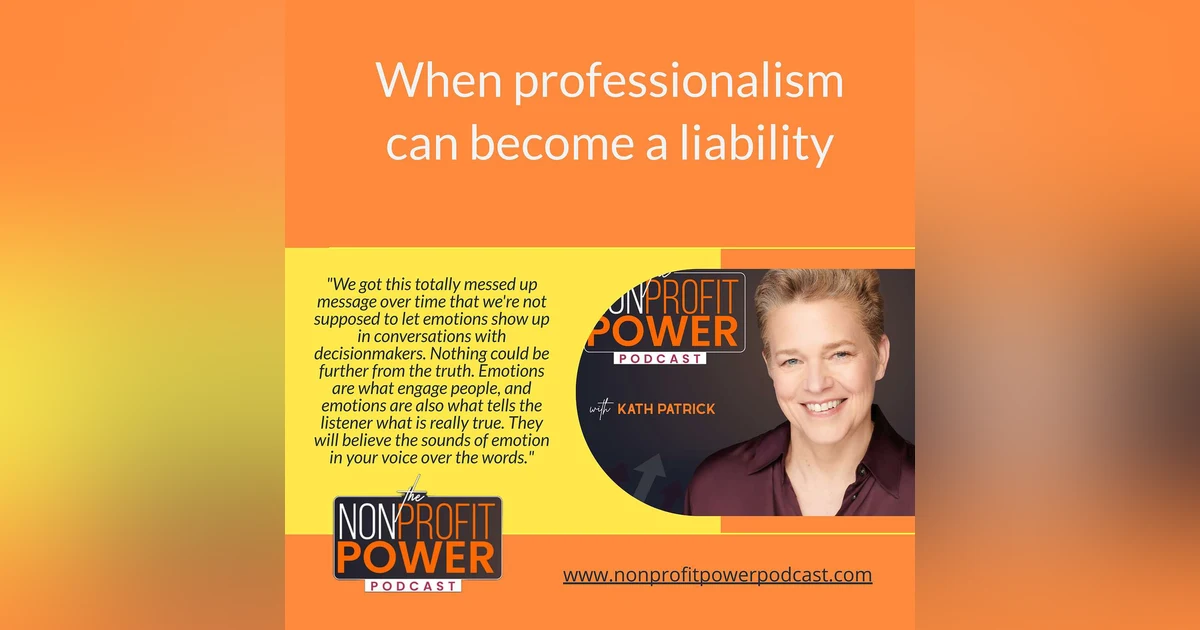
34:40 You got this message, this totally messed up message over time. That you're not supposed to let emotions show up in conversations with decision makers. And the fact is nothing could be further from the truth. Emotions are what engage people and emotions are also what tell the listener what's really true. They will believe the sound over the words. What all of this boils down to is trusting that showing up as your true, authentic self. And letting decision makers experience that. Is going to be vastly more effective than trying to fit into a professionalism cage of whatever type.
35:26 It might feel scary when you first do it. But just focus on the two main things we talked about. Start working on letting your full range of emotions show up in your voice. Let it be heard. And work on creating variety in your language. So that much of the time you're talking to decision makers like they're regular human beings. The same way you'd talk to the other regular human beings in your life. But be sure to sprinkle in enough of the technical know-how or other kinds of expertise establishing nuggets that make it clear that you do know what you're talking about. You are a hundred percent qualified to be here in this room with whoever this decision maker is no matter how high up they are.
36:13 You can do all that, but still show up fully and authentically as your whole human self. That's what creates engagement. And the huge bonus side effect of that. Is that it also feels better. You get to be your whole self. You get to be a whole human engaging with decision makers. Give those things, a try. I promise you, they are going to work well for you. And, if. at first, it feels uncomfortable and awkward, don't worry about it. Just keep at it. With practice and frankly, with actual experience of trying these things and having the sky not fall in.
36:53 That's really the only way that you will begin to trust that that's going to be okay. And bit by bit you can start to take some of those bars off of that cage. And spread your wings just a little bit further. Thanks for listening. And I'll see you in the next episode right here on the Nonprofit Power Podcast.