
The Most Undervalued Skill that Could be Your Key to Engaging Decisionmakers


 Apple Podcasts

 Spotify

 Pandora

 Amazon Music
Let me ask you this: When you’re in meetings with decisionmakers, what are you most focused on? If you’re like most advocates, you got a lot going on in your head. You’re thinking about your framing, and making sure it resonates with that decisionmaker. You're wanting to make sure you get your messaging delivered, that you cover the things you want to cover.
All of that’s important. But it carries the potential danger of creating a huge blind spot that can cost you. We can get so busy in our head with what we're going to say, that listening kind of gets shoved to the background.
So I want to ask you to think about maybe doing a reset on that. And try on the idea that maybe, even more important than telling them what you have to tell them, is listening for what they're telling you.
The truth is, every time a decision-maker opens their mouth, they’re telling you something of value that you can use to make your engagement of them more effective and more powerful. Which in turn, will move you towards your goal faster.
In any encounter with a decision maker, no matter what's going on. One of the most valuable and effective things you can do is become a next-level, ninja-level listener.
In this episode, we share:
- What makes deep listening so powerful as a tool to engage decisionmakers
- The three things that get in the way of deep listening
- Three mindset shifts that will empower you to listen more deeply
- Practical techniques you can start using today that will take your listening skills to the next level
- How to open a conversation to get immediate engagement from a decisionmaker
- How to avoid misinterpreting tone and body language
Give these mindset shifts and strategies a try, and let me know how it goes! Reach out to me on the podcast website, or on LinkedIn. I look forward to hearing about your results!
0:00 You're listening to the Nonprofit Power Podcast. In this episode, we share the most undervalued skill that can be your key to engaging decision makers. So stay tuned. If you want to have real and powerful influence over the money and policy decisions that impact your organization and the people you serve, then you're in the right place. I'm Kath Patrick and I've helped dozens of progressive nonprofit leaders take their organizations to new and higher levels of impact and success by building powerful influence with the decision makers that matter.
0:41 It is possible to get a critical mass of the money and policy decision makers in your world to be as invested in your success as you are. To have them seeking you out as an equal partner. And to have them Bringing opportunities and resources to you. This podcast will help you do just that. Welcome to the Nonprofit Power Podcast. Hey there folks. Welcome to the Nonprofit Power podcast. I'm your host, Kath Patrick. I'm so glad you're here for today's episode, because we're going to tackle a common problem that's costing a lot of people all kinds of lost opportunity.
1:23 Let me ask you this. When you're in meetings with decision makers, what are you most focused on? If you're like most advocates, you got a lot going on in your head. You're thinking about your framing and making sure it resonates with that decision maker. You're wanting to make sure you get all your messaging delivered. That you cover the things you want to cover. And all of that's important. But it carries the potential danger of creating a huge blind spot that can cost you. We can get so busy in our head with what we're going to say, that listening kind of gets shoved to the background. So I want you to think about maybe doing a reset on that.
2:05 And try this on. Try on the idea that maybe, even more important than telling them what you have to tell them. Is listening. For what they're telling you. The truth is every time a decision-maker opens their mouth, they're telling you something of value. That you can use to make your engagement of them more effective and more powerful. Which in turn will move you towards your goal faster. So if we think about that, what that means is that in any encounter with a decision maker, no matter what's going on. One of the most valuable and effective things you can do is to become a next level ninja level listener.
2:52 The reality is that most people, particularly in meetings with decision makers, have trouble listening deeply. A few days ago, I was in a meeting with a client and a group of decision makers. And when we debriefed the meeting, the client was feeling kind of disappointed and I was all excited. And the reason was I'd heard several things that indicated significant progress toward agreement. And the client didn't hear that. They had been focused on the final outcome that they wanted, and when they didn't get that they felt like there hadn't been really much progress. But the fact was that the decision maker said multiple things that indicated incremental movement in the right direction.
3:34 If you don't notice that, you can't do anything with it. And if you fail to do something with it, then you risk the decision-maker feeling like, well, I made movement in their direction and they didn't acknowledge that. They're acting like we're in the same place we were before. What's up with that. So you have to really be alert to that. I was in another meeting where it was with a colleague and a decision maker. And again, I heard a whole bunch of things that my colleague didn't hear because they were focused solely on the substance of the issue that we had come to discuss. And so they missed a bunch of cues from the decision maker that were telling us key details about what was in the way for that decision-maker.
4:20 That would have to be resolved before they could really engage on the substance. And my colleagues going on with the substance, and what I'm picking up is all these cues that say I'm not ready to go there. I got things in the way. I got to get my things resolved before I can go there with you. And so, because I picked up on those cues, I was able to ask some questions of the decision maker to bring out their concerns so that we could address them. And once we did that, then the decision maker relaxed a little bit and was open to having the conversation about substance. I'm offering up these couple of examples because they're reflective of stuff I see a lot.
5:05 And it's not that you can't be effective. It's not that you can't get a decision maker engaged if you don't do this. But what is pretty guaranteed is that it will be slower. There will be more bumps in the road. And you may get derailed from time to time by a decision maker who, because you're not listening deeply, gets off track. They stop listening, they stop engaging. And once that happens, you can't really do anything until you get them back. You got to get them back with you, engaged and talking in a conversation with you. It's so much better if you don't have to go retrieve them from somewhere they've wandered off to.
5:49 You want them with you the whole time. And the absolute number one best way to do that is to listen deeply all the time. And like all the other things we talk about, that's a skill that you develop over time. But what's kind of cool is that you can practice it in every conversation you have. You don't have to just practice it with decision-makers. And I would submit that there's almost no human who doesn't appreciate being deeply listened to. So it's a win-win. Anybody you practice this on or with is going to notice, and they're going to like it.
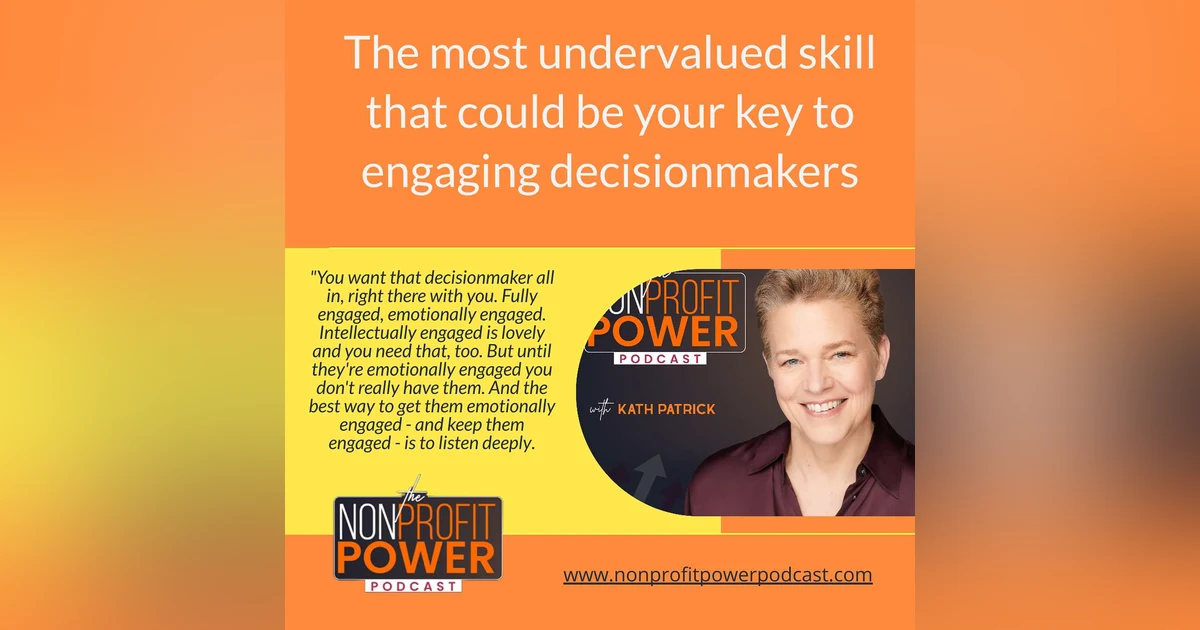
6:29 They're going to be happy, like, wow. They're such a good listener. They really, they really heard me. That's awesome. And part of what happens when people feel heard is they share more. When people don't feel heard they create distance. They create emotional distance from the other person. And you don't want that. You want that decision maker all in, right there with you. Fully engaged, emotionally engaged. Intellectually engaged is lovely and I'm all for that. You need that too. But until they're emotionally engaged, you don't really have them. And the best way to get them emotionally engaged and keep them engaged is to listen deeply. And work with what you're hearing as you listen deeply.
7:12 Don't just file it away and go, that's cool. I listened and I heard these things. Now. I know these things. It's like, well, then use them. Right. That's the next part. You do got to use them. But you can't use them if you didn't hear them. If you didn't pick up on them. So, how do you become a next level listener who's able to notice and take in all the valuable nuggets that are being shared all the time? But that right now, you're probably missing a lot of them. The core secret, if you will to that skill is to always listen to understand. When you just need information, you're skimming. You're just looking for the thing you're looking for.
7:55 And that, when you're doing research, Is really a useful skill. It becomes very problematic if you then do that same thing in a conversation with a decision maker. Because then what happens is you're listening for the stuff you think is important. And you've already decided ahead of time what's important. And that is a really bad plan when what you're doing is building a relationship and creating a conversation where both of you are fully engaged. You got to listen differently in that context. If you're listening to a podcast, And, you know, maybe you've got this on double speed right now, as you rip through it, looking for the one or two nuggets that you hope are going to be useful to you, and you want to get through it quickly because you've only got 15 minutes to listen and it's a 30 minute podcast or whatever.
8:46 That's fine if you're listening in that way, where it's not a conversation. If I say something you're like, oh wait, what was that? You can just click, click on that little 15 second rewind button on the app. And you go right back and you hear it again and go, oh yeah, I thought that might be important. Let me really take that in. So that's cool when you're listening to podcasts. That's great. I do it all the time. But in a conversation there's no rewind button. If something slips by you, it's gone. And there's no getting it back. So in real-time conversation, listening deeply, listening to understand, is your best strategy. And if you're listening to understand, rather than to just pluck information or pluck key points, then you will automatically listen more deeply.
9:34 Cause instead of saying, I'm just looking for the bits that I need. You're coming to it with the understanding that anything they say could turn out to be a really important bit that you can make use of. But you don't know going in what those really important bits are going to be. It's a surprise. It's the mystery package. You don't know. And here's the other thing. They could drone on for like five minutes. Wah, wah, wah, wah. They're talking and it's like, Not interesting. They're not saying anything useful. And then all of a sudden they'll drop something that you're like, wait, what? What did they just say? Wait a minute. That was important.
10:15 So you have my sympathy if you're in a conversation with somebody who's kind of boring. That can be tough to maintain your listening focus when that's going on. But it's a practice. And you won't be perfect at it. But just, you want to be listening for understanding, and be alert to not just factual information or promises. We're all trained to listen for if they say anything that sounds like a promise or an offer to do something. We're all really good at being alert to that and picking up on that. But a lot of the other things that they're going to drop that are equally useful are going to be things that are about what lights them up?
10:58 What pushes them away? What makes them not happy. What puzzles them, what confuses them? What gets them really excited? And all of that is not so much in the words they say, but in the tone that they say it with. They will also say it with body language, but you have to be careful with body language because it can be misinterpreted. So if you're not sure, it's not a bad idea to ask. And I often will pause, if I've been talking and a decision-maker has a look on their face that might indicate confusion. Or it might indicate deep thought. Might indicate something else. I don't know.
11:38 Maybe they have to pee. I don't know. So if I see a look that I'm not sure about, I'll ask. I'll just say, let me just pause. It looks like you maybe have a thought or a question about that. And then just sit quietly in silence and wait to see what they say. And they might say, well, yeah, actually you lost me about three sentences ago and I really don't know where you're going. I don't understand what you're saying. Or they might say, well, I kind of get what you're saying, but I'm not sure I agree with it. Or something else. But if you ignore that information coming to you and you don't check in with it.
12:20 Then you've missed an opportunity. Whenever we're in conversation with decision makers, there are really three major factors that tend to work against deep listening and listening to understand. And number one is just a universal issue that's plaguing all of us right now, which is bandwidth and attention span. It's just hard to focus. It's hard for us to focus. It's hard for the decision makers to focus. We're all kind of struggling with that. The second thing that gets in the way is that we get focused on our goal. We get focused on our end result that we're looking for. And so we're listening for the things that connect to that.
13:01 But we're not listening for everything else they're telling us. That if we only paid attention might actually help create a shortcut to the thing we want. And the third thing is that you may be extra focused on making sure you make all your points and that you get your messaging delivered to this particular decision-maker. And that's especially likely to happen if you don't get a lot of opportunities to be in the room with that person. And you feel like you got to do it all at once. So, what I want to do is give you one strategy for dealing with each of these common things that gets in the way. Cause that will be plenty.
13:42 Developing a practice of deep listening. Of consistently listening to understand and really taking in all that's coming towards you. Is a skill that takes a while to develop and it's a practice. So I don't want to give you 10 things that then you can't remember. And, then you don't do any of them. So I've flagged three big things that tend to get in the way. And then I'm going to just talk about one strategy for each of those things that you can try. That I know will immediately improve the amount of valuable information you're taking in. So the first thing I mentioned was bandwidth and focus problem. Right. attention span issues.
14:22 And I'm going to say this, and then I'm going to defend it. Right. Cause I can hear the objections in the back already. Cause it's kind of slash simplistic. But it's also really profound and important. The most effective thing you can do to deal with the focus and bandwidth issue. And those go together by the way. You know, we have so much on our plate all the time that we're pinging from one thing to the next, trying to make sure that we keep all the balls in the air and it's just really tough. So the number one thing you can do to combat that in a conversation with a decision maker, is to simply practice being fully present.
15:04 Be fully present. Don't be jumping into the future. Don't be jumping into the past in your mind. Don't be thinking about the 529 other things that you've got to do once you get back to the office or the 10 things at home that've got to get done. All the stuff. You got all these balls in the air, and they're all clamoring for your attention. But when you're in a conversation with the decision maker, all of that just needs to go away. And just be 100% fully present. In that space. This will take time and practice to be able to do that, to sustain that for an extended period of time.
15:45 Initially, you might find that you can only do it for 30 seconds. And then your mind wants to go somewhere else. The monkey mind is always very, very busy. And all we can do with the monkey mind is to just bring it back to the present. Say no, we're right here right now. We're not thinking about that. We're just paying attention. We're just being present. And we're listening. Listening deeply. Because we really want to know what this person has to say. And there's nowhere more important for us to be right this minute than right here in this conversation. And you just keep hauling it back. Every time it goes running around, you just haul it back. And with practice, the intervals of focused attention will get longer.
16:27 The intervals of being fully present will get longer until you become able to be fully present for an hour. If that's how long the conversation goes. Usually it's not that long, but you would like to be able to be fully present in a conversation with a decision maker for a full hour. That's the goal. I'll tell you what. There is a massive added bonus when you get good at this. When you become a fully present, fully focused listener, that is a rare phenomenon. And people notice it. People are accustomed to not really being listened to. If you think about it. Because everybody's dealing with focus and bandwidth issues.
17:07 Everybody's being hauled around by their monkey mind all the time. So, you know, it's most of our experience that even in conversation with people that we're close to, you could tell by the look on their face when they go somewhere else in their head. Right. Even if it's for just a couple of seconds. But you could see it happen because you know them well and you, you know, that look. But we all do it. So people are accustomed to not being listened to and to not really being heard. And decision-makers are as subject to this as anyone else. A universal human desire is to be heard, to be listened to and to be understood. And if you develop the capacity to do that, your ability to truly engage a decision maker or anyone else will increase exponentially.
17:56 It's a huge ninja skill to have that. So work on that. It will be an incremental practice. Be patient with yourself about that. If you're already pretty good at it, see if you can extend the time during which you can be fully present. Aim for a full hour of a conversation. Aim for a full hour of a boring conversation. It's easy to stay fully present in a conversation that's dynamic and exciting and you're clicking off each other and, having great ideas together. That's easy, very easy to be fully present in that. But when that's not what's happening, it's harder. So there's always a next level. Work on practicing that.
18:36 Okay. So the second thing in the way is we're being focused on the end result, and just listening selectively for the stuff that we think is connected to that. The answer for that is stop doing that. Stop listening selectively. Listen instead to understand. And operate from the mindset that everything they say matters. It's up to you to discern how each nugget they share can be useful to you. Some nuggets will be more useful than others. But there's always a lot there. If you're able to stay fully present. And to stop listening selectively.
19:16 And instead adopt the mindset that everything they say is significant. It matters in some way. And then of course in addition to listening for the words, you're also listening for tone. The other caveat here is don't make assumptions about what that tone means. If you're not a hundred percent sure ask about it. You can always ask. And again, one of the bonus effects of this, is that if you're listening fully, you're listening to understand, and they say something that either confuses you or they say it in a tone that you're like, I can't tell if they were just being sarcastic right there.
19:59 Or I can't tell if they were expressing disbelief, or confusion. So when there's an appropriate pause, you can say, you know, a second ago you said such and such. And I was struck by that. I wonder if you could say a little more. Cause you don't want to say, so were you being sarcastic just now,. Unless you have enough of a relationship there that you can say that. I mean, I do have decision makers where our relationship is strong enough that I can say stuff like that. But I also am in a lot of meetings where that would be really inappropriate. Because we haven't developed that level of rapport yet. So that's a judgment call, obviously, if you feel like you can say that and it's going to land like it would with a friend, then go for it.
20:46 But if you're not there, but you still want to, like, I really need to know whether they were being snarky. Or whether they're maybe confused. Or do they actually believe the thing they said. I need to know. Then you can just say, you know, a second ago you mentioned blah, blah. I'd like to understand your thinking a little bit better on that. Could you share a little more. And then ask a couple follow ups if you need to. But typically if they throw out like a one-liner in a tone that you're not sure how to interpret. There's always a way to follow up. You might need to wait a couple of beats or a couple of sentences to do it. But go back and double-check. And again, it tells them you were really listening.
21:28 And you get bonus points just for that. The last thing in the way that we talked about is being super focused on making all your points. Making sure you get all your messaging delivered to this decision maker. And as we said, that tends to come up particularly when you feel like you're not going to get a lot of opportunities to be in the room with this person. The best technique I can give you to deal with that, to reign in your need to get it all out. Is to treat every encounter as a conversation. And not as a situation in which you are presenting something and then waiting for their response.
22:08 And there are a lot of different techniques for how to do that. But as a guiding principle, if you just change your framing and your thinking about how you're approaching this encounter, to this is a conversation. So I will have my little notes or whatever about the bullet points that I ought to make sure that I try to talk about. But I'm not going to worry about what order they happen in. I'm not going to worry about when we talk about what. I'm going to let it happen organically. As it would in normal conversational flow. And I'm going to have a good opener. I'm going to have some kind of an opening that engages.
22:50 Maybe it's a question. Maybe it's a surprising fact. Maybe it's something else that's attention grabbing and immediately engages their brain. And ideally also engages their emotions. And always remember that surprise is an emotion. So if you can ask a surprising question or provide a surprising piece of information, that is a great way to open. Instead of what we tend to do. Which is, we have to get rid of this. This presenting our points in the order that makes the logical flow sense, uh, blah, blah. Here's the problem. Here's the solution. Here's the supporting information. Here's the buh buh ba. And here's what we need you to do. That is okay for a policy paper.
23:34 But it's a really lousy way to have a conversation. If you think about the most interesting conversations that you've been in, did they go that way? Did the other person in the conversation, if they had something to tell you or something they wanted you to know. Are you more likely to listen to them if they have a cool story that they wrap it all in. Or if they say. Oh, my God. You'll never believe what happened. Let me tell you about this thing that just happened. I'm not suggesting you open with a decision maker that way. But just think about what kinds of openings engage the other person's brain and interest. And then think about how you've been opening your conversations with decision makers.
24:17 There's probably room for some leveling up of your engagement capacity at that beginning opener. In my coaching programs, we work a lot just on the opening. On how you can engage instantly and in a way that pulls the decision maker in. There's tons of techniques for that. But the core mindset that goes with it is, it's a conversation. It's a two way conversation. And you don't want to dominate that conversation. You want to be the interesting person, who's also a great listener, that they love having a conversation with.
24:58 So try those three things. Got three things in the way. Three, basically, at their core mindset shifts. With some tips around how to actually accomplish that and put it into action. But three basic mindset shifts that will make a huge difference in how much you're able to take in. And it will allow you to pick up all these amazing gold nuggets that are getting thrown around all the time by decision makers. That you haven't been picking up on. And the more you pick up on those, the more you can use them. If you're quick on your feet, you can use them immediately. If you need time to think about them, that's fine.
25:40 You just pull them together. And debrief them so that you retain them somewhere. And then in the next conversation or in your followup or all of the above, you're making use of what you learned, all the little things you learned. Every time you do that, what you're doing is you're acknowledging them. You're acknowledging that you noticed. You're acknowledging that you get them. And that is relationship building gold. And that's what we're all about. The stronger the relationship, the greater the influence. And that's what I want for you is powerfully influential relationships with all the decision makers in your world.
26:20 So give these three strategies a try. And let me know how it goes. You can reach out to me on the podcast website. And I'll link that up in the show notes, or you can also find me on LinkedIn. And I'll put that link in there as well. Thanks for listening. And I'll see you in the next episode right here on the Nonprofit Power Podcast.