
The Most Powerful Thing Nonprofit Leaders Can Do Right Now to Preserve Medicaid and SNAP


 Apple Podcasts

 Spotify

 Pandora

 Amazon Music
The potential for massive cuts to Medicaid and SNAP moved one step closer to reality when the Senate voted its version of the big ugly bill out of committee. The good news is there are still quite a few hurdles to clear before those terrible policies have a chance of becoming law. Which means there are that many more opportunities to defeat them.
Nonprofit leaders have a critical role to play in defeating these proposals. We are definitely not alone in this work. But we do have some unique abilities and opportunities to have a significant impact on the outcome.
We’ve also learned more over the last few months about what works in this particular environment. Our challenge now is to take those lessons and apply them to our advocacy work going forward, so that we can prevail in this fight.
In this episode, we share:
- The two keys to defeating the big ugly bills that would slash Medicaid and SNAP
- What our opponents are counting on, and how we can wreck their core strategy
- The top tactical maneuver we must anticipate and be ready to counter
- The biggest mistake we’re likely to make, and how to prevent it
- How to create a steady stream of high-impact advocacy messaging without devoting tons of time to it
- How to leverage the unique advantages you have as a nonprofit leader to build vocal opposition to these bills
Help spread the word! If you found value in this episode, I’d be grateful if you would leave a review on iTunes or wherever you listen. Your reviews help other nonprofit leaders find the podcast. Thanks!!
0:00 You're listening to the Nonprofit Power Podcast. In today's episode, we share the most powerful thing Nonprofit leaders can do right now to preserve Medicaid and SNAP. So stay tuned. If you wanna have real and powerful influence over the money and policy decisions that impact your organization and the people you serve, then you're in the right place. I. I'm Kath Patrick, and I've helped dozens of progressive Nonprofit leaders take their organizations to new and higher levels of impact and success by building powerful influence with the decision makers that matter.
0:41 It is possible to get a critical mass of the money and policy decision makers in your world to be as invested in your success as you are, to have them seeking you out as an equal partner and to have them. Bringing opportunities and resources to you. This podcast will help you do just that. Welcome to the Nonprofit Power Podcast. Hey there folks. Welcome to another episode of the Nonprofit Power Podcast. I'm your host, Kath Patrick. I'm so glad you're here for today's episode, which just happens to be the 100th episode.
1:23 That's a milestone I envisioned hitting someday, but it felt really far away when I first started this podcast. It's been an extraordinary journey, and I'm so grateful for all of the Nonprofit leaders who've been part of this, who have shared with me the insights and ahas that they've gotten from different episodes and who've been so kind in sharing their appreciation. I'm super excited to have you here and I hope you'll keep listening for the next hundred episodes. And now I have to segue into the serious thing that is very much on my mind this week, which is that I feel like we're at a turning point.
2:04 It may not be the only one. I'm sure it's not the only one along this bizarre journey that we seem to be on. But I think it's one of those points where the choices we make and the actions we take could make an outsized difference in how things turn out. I think that there is a lot to be excited about. I got a huge boost out of showing up for the local No Kings Day event in my community. And I hope you had the same fantastic experience and that you were able to not only be there yourself, but to have all of your friends and community members, and perhaps even supporters and clients of your organization showing up.
2:48 It was incredibly powerful to be standing with several thousand neighbors, friends, fellow community members who were all there for fundamentally the same reason, which is that we reject what this administration is doing. We reject the cruelty. We reject the hostility to working people. We reject the mean spiritedness, the lying, and the plundering of critical functions of federal government that we all benefit from and that we all depend on. I so appreciated a sign that I saw at our local No Kings rally. A guy had a really big sign and on it, he had written, there's no sign big enough to list all the reasons why I am here.
3:33 And I think that's how we all felt. That there's just so much to be concerned about and so much that we're pushing back against. That to be gathered together with other folks who are doing that same work and who are energized and ready to fight and continuing to fight was powerful and inspiring and made me even more certain that we will prevail in this process. It's not gonna be easy. It's probably gonna be ugly. But we will prevail. But not without taking action. One of the things that was so exciting to me on No King's Day was how many more people are realizing that and are stepping out into a visible role to stand and be counted.
4:20 And to push back visibly, loudly and effectively. Cause that's what it's gonna take. It's gonna take more and more of us out there every day pushing back. Because what we know is that pressure works against this administration and we just gotta keep it up. So that was a wonderful experience. Very heartening on a lot of levels. At the same time, i'm also unnerved by a dynamic that's happening right now with 47 and the Republicans in Congress who continue to line up behind these horrible priorities. Even with all the vocal opposition, the Rs in Congress still seem to feel safer voting with him than voting against him.
5:07 If we don't change that, we've got real trouble ahead. Because if they actually start legislating some of this. You know, 47's been doing a lot of illegal stuff through executive orders. And the vast majority of it is being struck down in court. He's being told that's illegal. You gotta stop. It's not legit. But if Congress starts codifying some of this craziness in legislation, that's a whole other ball game and will be much harder to undo. So I'm concerned. I'm very concerned that even as we are in the street and it is abundantly clear that more and more and more people every day are saying no.
5:47 This is enough. We've had it. It's not okay. And we feel so strongly about it that we are willing to turn out in the street. But apparently it's not quite enough yet because the Rs are still going along with this stuff. Now what's interesting is that there's no question that 47 had a really bad couple of weeks where his failures and incompetence were on full display, and there was a lot of bad press for him. Part of it most recently was that big ill-conceived military parade thing. And the image of those two squeaking tanks crawling by, squeaky squeak, past nearly empty reviewing stands.
6:32 That was pretty devastating. But even before that, the spotlight was on 47's falling poll numbers and the rising vocal opposition to the big ugly bill that they're trying to move through that would shred the social safety net. And do a huge transfer of wealth from the lowest income to the highest income in a giant reverse Robinhood move. When that bill first passed the House, it took a little while for everybody to deconstruct and analyze what was in it. And in fact, you heard a bunch of Republican members of Congress saying, oh, whoa, I didn't know this or that was in there when I voted for it. Wait a minute, that might not be so good.
7:13 So there was some of that going on. That was getting coverage. All of the advocacy groups and the press were able to burrow in really analyze everything it was gonna do. There was tons of media attention on how it would devastate Medicaid, and that was beginning to dominate the conversation. And it was bad. People don't support this. People don't support tearing apart the safety net. And so the spotlight had been on the falling poll numbers and the rising opposition to that deeply unpopular bill In response, he did what he always does, which is do something dramatic to change where the spotlight is aimed. He did some things that were virtually guaranteed to move the spotlight.
7:55 To generate dramatic made for tv, made for viral social media images. Big dramatic ICE raids on communities, especially in California. Deploying the National Guard and then the Marines over the governor's objections to do who knows what. And then what the big follow on was supposed to be was a big military parade to show what a big, tough, strong man he is. But it didn't work out quite the way he planned. First, a lot of people were very unhappy about the way ICE was chasing down hardworking immigrants who were well liked in their communities. And then the parade had hardly any spectators. We had those images of a sparse parade crowd, juxtaposed with the incredible images of millions of people peacefully protesting in the streets, in virtually every community across the country.
8:48 In red states and blue, in big cities and small towns, and on rural highways. So that didn't totally work out. And I will just note that it was shortly after that day that 47 started saber rattling with Iran. Once again, shifting the focus away from stuff that is showing his weakness. Now, part of what worries me is how easily the press takes the bait. And how willing they are to drop the coverage of this unbelievably bad House bill, and now emerging Senate bill that would devastate the safety net and execute a stunning transfer of wealth in a reverse Robinhood move.
9:29 They were all over that until something else shiny went by. And unfortunately they haven't really learned how to recognize and resist the way 47 manipulates them. So if we can't count on traditional media to stay on top of this, we're gonna have to do it ourselves. And here's the thing. Nonprofits are in the best possible position to shine a very particular type of spotlight on what the House bill and this proposed Senate bill would do. The Senate bill just got outta committee. So this is a really good time to be talking about it. And believe it or not, it is actually worse on Medicaid than even the House bill.
10:10 Also alarming is that it's really unclear whether there will be four Republican senators who will have the spine to vote against it. That is not a given at all. And so far what we've seen on other bad legislation is there's a handful of Rs in the Senate who will say they're very troubled. This is very concerning. I don't know if I can vote for this. And then when it comes time to actually vote, they cave and they vote the way 47 wants them to. We really can't have that on the Senate bill. We need to peel away four Republican senators. And the only way that's gonna happen is if we have the spotlight relentlessly on the damage that bill would do, how devastating it would be for the people who live in the states that these senators supposedly represent.
11:00 We cannot let them off the hook on this. They have to have this tied around their ankles and put under tremendous pressure to reject it. Because it will hurt the people in their state. Which they know, by the way, but they're hoping that we don't know. They're hoping their constituents don't know. The way we help them get the message that, yeah, their constituents do know. They are aware and they're not happy, is two things. One, we make sure the spotlight is on the details of the damage that bill would do. Constantly. Constant spotlight on that. And we have people visibly, vocally, showing up to express their opposition.
11:44 And those two things go hand in hand. Now, at some point I think we're gonna hit a tipping point with the level of incompetence and unhinged ness and possibly dementia addled state that this president is in. There could come a time when that is so undeniably bad, and he's so undeniably incompetent that maybe the Republicans in Congress decide to start reassessing whether they need to be afraid of him. And whether maybe it would be better for their careers if they opposed him. But it would be naive to count on that happening on any particular timeline.
12:25 And who knows, maybe it won't happen at all. There are a lot of dynamics of that arrangement that defy logic. It wouldn't be surprising if that eventually happened, but we can't count on it. And for sure timing matters in this case. We don't have months and months and months to work on this. We certainly don't have the luxury to hope that the relationship will start to break down enough that the Rs in Congress start going against him before this bill plays out in the process. Now the fact remains that there are still quite a few very difficult hurdles for both houses to get over before they can turn this bill into law.
13:08 So that works to our advantage that this is not gonna be an easy process for them. Remember that the House bill passed by just one vote and they had to do a lot of special carve outs and giveaways to buy those votes among the Republicans in the House. And now the Senate has created a bill with a lot of provisions that are very different from what's in the House bill. It's not at all gonna be an easy thing to convince the members of the House that they should go along with a bunch of new stuff that's in the Senate bill that the House members didn't get anything in trade for. So there's a long way to go. And remember that ultimately in order for this to become law, both houses have to pass an identical bill at some point.
13:54 The House has passed theirs, the Senate just pushed theirs out of committee, and it has yet to be voted on by the full Senate. And there's not a clear timeline for when that's gonna happen. And then there's a period, probably a long period of negotiation between the two houses, to get it to something that both can agree on. But here's where this could go sideways for us. If the spotlight stays off what those bills would actually do to people in communities, it will pass. What they're hoping to do is to just get this through. 'Cause the entire point of it is a wealth transfer. The whole point of it is the reverse Robinhood move to even further gut the middle class.
14:39 To take resources away from low income people and move it all up to the wealthiest few and corporations. That is the entire game. And they're willing to load massive additional debt on future generations of taxpayers in the process. They don't care. They just want to move the goodies to the top. That is their sum total of their agenda. And while they're at it, let's stick it to people on the lower end of the income spectrum too. If they can do that in the dark, they will gladly do it. But it becomes a different equation for them if there is a bright spotlight shining on what these bills will do. Because then they've gotta defend that.
15:20 They've gotta go out and answer to angry constituents, to inquiring members of the press about how come you're supporting something that will hurt so many people? What is up with that? So they have a real interest in letting this go through quietly in the dark with nobody looking, nothing to see here, folks. Let's just slide this through and negotiate it quietly. We'll work it all out amongst ourselves, between the House and the Senate. We'll horse trade back and forth till we get something everybody can agree on. But the fundamental contours aren't gonna change. There is not a scenario in which they're gonna voluntarily say, oh, we were just kidding.
16:03 We don't wanna take anything away from Medicaid. We'll fully fund that and we'll fully fund SNAP. That is not something they're gonna do on their own under any circumstances. The only way we stop this is if we create so much public pressure and so much awareness and shine such a giant spotlight on all of it, that it becomes more uncomfortable for at least four Republican members of the Senate to vote for it than it does to vote against it. 'Cause the discomfort in voting against it is they'll make 47 mad and he'll mean tweet them or whatever. Or really what they're afraid of is that he'll primary them. So we know what we have to do. But we also need to be aware, because we've now been given clear evidence over the last few weeks of just how this is gonna roll.
16:50 We have a significant opportunity to make an impact as this process plays out in the House and the Senate. And a key piece is shining that spotlight and generating opposition. But we also have clear evidence that as soon as the spotlight is on all those bad things, 47 will generate something dramatic to take the media's attention off of it. We should expect that and we should plan our own strategies for keeping the spotlight relentlessly on the damage that those bills would do, no matter what else 47 gets up to. And here's what we can't afford. We can't afford to do some messaging, do a little street action, do a little thing here and there, and then go, okay, great, we've done that.
17:36 Check. Now we're gonna move on to all the other things on our plate. That won't work. This has got to be continuous. It's gotta be steady action. We're gonna talk about how to do that without it taking all your bandwidth. But remember that when all the mainstream media was starting to really focus on how bad the House bill was right after it passed, there were a lot of people who said, oh, good. Now the spotlight's on all those bad provisions, people will start to realize how bad it is, and that'll grow the opposition. And we can get on to other things. 47 understands that too, which is why he does everything in his power to take the spotlight off whenever that attention starts to focus.
18:18 So if we weren't clear about it before, we now know that in addition to our job of putting major pressure on every single senator and every single member of the house to vote against these things. We also have to keep the incredibly damaging effects of these proposals in the spotlight constantly. And we can't do that without a plan. This can't be a one-off when we think of it. There needs to be a steady stream of stories and messaging that are keeping public awareness at the highest possible level. Because remember, people did not vote for this. People did not vote for massive cuts to Medicaid.
18:59 People did not vote for totally disrupting the Social Security Administration and threatening seniors' benefits. They did not vote for masked ICE agents grabbing people up in Home Depot parking lots and tearing communities apart. They didn't vote for any of that, and they don't like it. They hate it. But people's attention spans are short. They got a lot on their mind, and if it's not right in front of'em, they lose focus. So whether your issue is Medicaid or SNAP or whether it's immigration or all of the above, it's now clear that a key piece of our strategy has to be constantly refocusing that spotlight.
19:40 Alright, so how do you do that without it taking all your time and all your bandwidth? You create a plan and you do things as efficiently as possible. And this is gonna take a page from probably how you do your grant writing. You don't start every grant proposal from scratch. Right? You have entire bodies of text and messaging and backup information that you pull from. And then you kind of paste that together in a way that will respond to what that particular RFP is asking for. But you don't sit down with a blank screen and start saying, gee, how shall I propose this work?
20:20 You already know what your messaging is around 90% of it. You already know your supporting facts and figures. You have all your budget stuff more or less worked out. You just massage it a little bit for the thing that you're asking for. A lot of what you're putting together in a new grant proposal isn't new to you. It's just a new way of structuring the same broad pieces of information. And then you build a narrative that is specifically responsive to the RFP. But a lot of that core content, you're not generating new every time. You wanna take the same approach to the work of keeping the spotlight on the worst of the things that these bills will do to harm particularly vulnerable members of the community.
21:03 So there's some basic components to this. You're gonna create three or four messaging points that speak to what's wrong with the bills, with respect to Medicaid, and to SNAP in particular. And the profoundly negative impact that those pieces would have. And then you're gonna build a bank of content that you can drip feed on social media, in op-eds, and anywhere else you want to, or that you have access to. And then you're gonna push that out on a schedule so that it's constant. Now, obviously, if you had to start from scratch to generate a story and a message and all the supporting content, every time there's a new development on one of these bills attacking the safety net, you would be expending a lot of energy that you don't need to expend, and that you frankly can't afford to expend.
21:53 So the first thing is to identify your key messaging points. And then come up with a combination of facts and data, plus stories of individuals and families and communities and how they would be harmed. You lay out what their life is like now with the support of Medicaid and/or SNAP, and what it would mean if those were taken away. Or if they were messed with severely, which is on the subject of the work reporting requirements. You specifically want to attack the lies that underpin the work requirement language. And you wanna go after some of the myths around who's receiving Medicaid. It's important to remember that you've got two audiences with this.
22:35 And I've talked about this before in other episodes. One of your audiences is members of Congress, obviously, who are gonna vote on this. And Republican members specifically because the Dems are solid on this, they are gonna vote the right way for the most part. There are one or two exceptions, and those of you who live in those districts, you know who they are. And you know that I'm talking to you too. But the other audience is the general public. Because the more the general public knows about what's in these bills and the harm it will do, the more they oppose it. We have seen this over and over again. People didn't vote for this. They hate it. And the simple fact that the number of people who turned out for the No Kings Day protests vastly outnumbered the coordinated protest day that had happened just a few weeks before that.
23:26 That's telling us that the opposition is growing and people are becoming more aware and more upset. But on these specific bills, if we want to shift the outcome, we've gotta shine the spotlight on the specific harm that these bills will do. And the thing is, when the media falls down on the job and gets distracted by the shiny objects, they stop creating that awareness. So it's on us. And it might feel like this is a lot extra to your normal job, but I believe that it in fact is essential to the work that we do. If those key elements of the safety net are torn out from under people, every single person just about who accesses services through nonprofits is going to be harmed.
24:12 Most certainly many of the people you serve will be harmed. And it will make it that much harder for them to get to a place where they can thrive. We want to talk about the impact on the individual, the impact on the family, and the impact on the community. And include in your messaging what the current reality of those folks is, including the fact that overwhelmingly, in the case of both Medicaid and SNAP recipients, overwhelmingly they are either working for pay, often in multiple jobs, and/or they're working as caregivers or they're disabled. You make it clear who these folks are to begin with. And then lean into some outrage on this.
24:55 Because demonizing hardworking members of our community is wrong. And we are here to tell the truth. Same goes for immigration. It's incredibly heartening that huge swaths of communities have immediately mobilized in protests when valued members of the community are swept up in these outrageous ICE raids. A lot of people might have voted for the promise of rounding up violent criminals who are here without legal documentation, but nobody voted for sweeping up law abiding members of the community who are hardworking and who are fully integrated into the community and are part of people's churches and PTAs, they're running businesses.
25:37 Their kids are going to school with everybody else's kids. They're woven into the fabric of the community. So it's very heartening that when ICE goes after valued members of the community in that way, the communities are rising up immediately and demanding their release and fighting back hard. The truth is, every time the cruelty of this administration is exposed, people show their vehement opposition to it and they rise up and they fight back. And we can help mobilize that opposition. But it's critical that we keep the spotlight on. Because the other side knows that their stuff is deeply unpopular, and they're hoping to slide it through anyway in the dark.
26:24 Because once it's in place, it's gonna be much harder to undo it. They know that the spotlight is absolutely their enemy. And in the same vein, it's the most powerful tool we have. And the good news is there are a lot of ways to generate that spotlight. A lot of it is consistent, regular messaging that is going out that raises awareness. Another is to show up in numbers for town halls, for protests, for rallies. Every time there's an opportunity to gather to voice opposition to what's in these bills, be part of that. And help your supporters and your clients be part of it too. And the last thing is to help your supporters and clients communicate directly with their members of Congress.
27:10 Their US Senators, plural, and their US House of Representative member. Basically, be visible all the time in every way. But have a plan for how you're gonna do that so it doesn't become such a labor intensive exercise. Plan, your key messaging points. Plan your supporting content. Map out your strategy for where you'll publish your content. It should ideally be a combination of stuff going out on social media, and every platform you're on, this messaging should be there too. And then at the same time, you also want to be alert to creating traditional media coverage, taking advantage of op-eds, letters to the editor, things like that.
27:52 I know it's old school, but it still reaches people. And you wanna reach people everywhere they are. If you have a social media manager, making this happen should become part of their regular work. The messaging is gonna be your advocacy team that puts that together, but your social media team is gonna be in charge of scheduling and publishing. If you have a social media team, they already know this. But if you don't, I will share that it is very helpful to batch your content. You don't want to be creating a new post every week or every three days or whatever your schedule is gonna be. You want to take your several messaging points, Let's say you have four main messaging points.
28:35 It is more helpful to do a separate post on each of the points rather than a longer post that covers all four. Depends on the platform, but most of them favor short form content. Images are good, videos even better. Depends on what you've got to work with. Even if all you do is put together a post with your message point using Canva, and put that out there on all the different platforms. That is better than nothing. You're looking to build awareness, and keep the spotlight on. Some of your posts can be short and pithy. Some can be a little bit longer and more expository.
29:16 But sit down and put together five or 10 posts at a time and have them ready to go. And then just schedule them to go out. Some of them will go out on a fixed schedule. Others may go out in response to the events of the day. But if you batch that content, you produce 10 or 15 posts in an afternoon, then that's done. And now if you're publishing on an every three day schedule or whatever it is, you've got content for two or three weeks. Obviously create a schedule for releasing your content. And then the last thing, this goes to organizing people, is have a plan for how you'll rapidly contact your supporters when it makes sense to show up as a group at a town hall, or a rally, or a protest.
30:01 Have a way to quickly let them know. And of course you can always use social media for that too. You can just put together a post that says, Hey, everybody. And everybody who's connected to you on the socials has a decent chance of seeing that, especially if you've encouraged them to follow you so that they're gonna get that in their feed. You can also connect them to larger organizing efforts that are underway. Just this week, several of the national organizing groups, including moveon.org and Indivisible, put together a joint organizing effort where they've put out a call for volunteers who will phone bank to Medicaid recipients themselves. And talk the Medicaid recipients through how they can reach out directly to their members of Congress and make their voice heard on this super important issue.
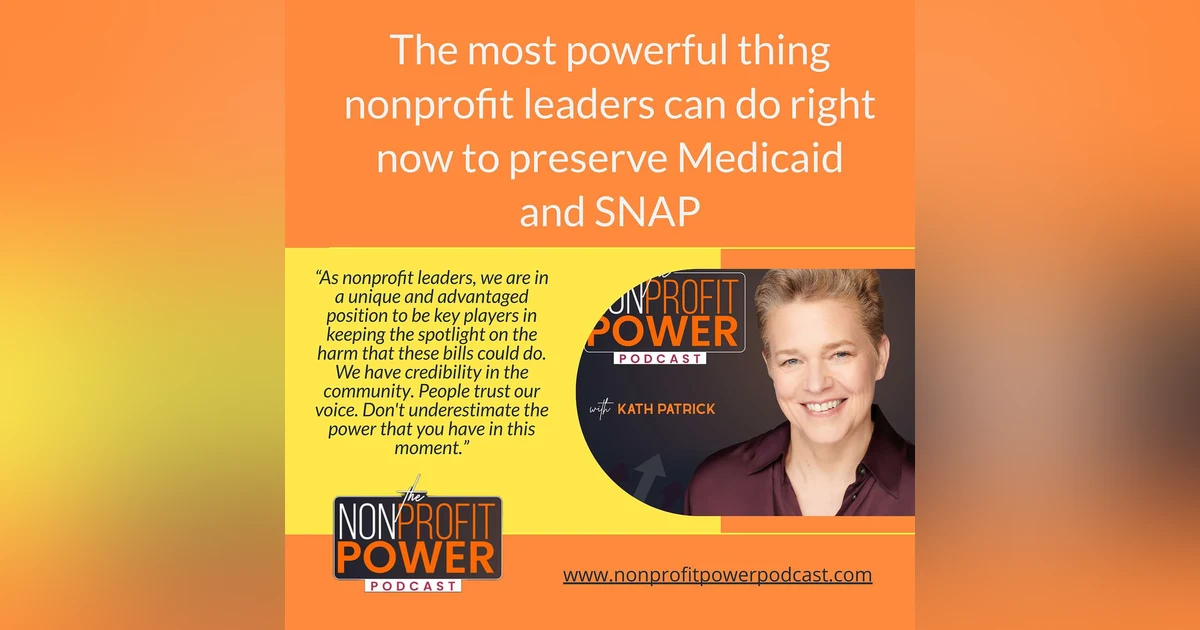
30:47 So you can do things like that too. You can connect your folks to national organizations that are doing that work. The bottom line is as Nonprofit leaders, we are in a really unique and advantaged position to be key players in keeping the spotlight on the harm that these bills could do to the people we serve, and to much broader sections of our communities. We have credibility in the community. People listen. They wanna know what you think. They trust your voice. So if you're out there saying, this is bad, this is harmful, this is what this will do. This is how this will play out in people's lives if this goes forward. It can't be allowed to happen.
31:29 That's very powerful and carries a lot of weight. Similarly, whenever you put out a call to action to your folks, whether it's your own action or you're sharing an action organized by some national groups. In both of those cases, your voice urging them to take action is what matters. Don't underestimate the power that you have in this moment. It's substantial. And if we all do this together, it will have an enormous impact. Thanks for listening, and I'll see you in the next episode right here on the Nonprofit Power Podcast.