
The Best Way to Help Your Supporters Become Valuable Advocates for Your Work and Funding

 Apple Podcasts

 Spotify

 Pandora

 Amazon Music
This is a time when we need all hands on deck. There's so much need for nonprofits to advocate aggressively for the work that we do, and specifically for the government funding that supports our work. And nowhere is that more true than at the federal level.
I’ve shared a lot of thoughts recently about the number of ways that federal funding for safety net services is under attack, and the importance of engaging members of Congress to get them to do the right thing.
I'm also hearing from a lot of regular podcast listeners and the folks in my coaching programs that they're feeling pretty overwhelmed. And like, could you just keep it really short and simple? Gimme some tips. Tell me what I can do that will help me be more effective right now.
So I am answering the call. Today's quick tips are around how you can most efficiently, with a minimum of work, and a maximum of benefit and impact, engage your existing supporters to help them become effective and powerful advocates on your behalf.
In this episode, we share:
- The most effective ways to engage your supporters and ask for their help
- The simple messaging framework you can use to craft a short script for your supporters when they call their members of Congress
- The most important fact to understand about how members of Congress receive constituent calls
- The two things you must get right when engaging your supporters via text message
- How to ensure your supporters take the action you requested
- How to build your cadre of supporters who are excited about taking action
Links:
A Comprehensive Guide to Texting for Nonprofits
This article is a very useful source of information for how to run an effective texting campaign as a nonprofit, as well as the rules that govern texting campaigns. Note: this article was created by a third-party vendor that facilitates texting campaigns.
Help spread the word! If you found value in this episode, please share it with other progressive nonprofit leaders. Thanks!
0:00 You're listening to the Nonprofit Power Podcast. In today's episode we share the best way to help your supporters become effective and powerful advocates on your behalf. So stay tuned. If you want to have real and powerful influence over the money and policy decisions that impact your organization and the people you serve, then you're in the right place. I'm Cath Patrick, and I've helped dozens of progressive non profit leaders take their organizations to new and higher levels of impact and success by building powerful influence with the decision makers that matter.
0:41 It is possible to get a critical mass of the money and policy decision makers in your world to be as invested in your success as you are, to have them seeking you out as an equal partner, Bringing opportunities and resources to you. This podcast Will help you do just that. Welcome to the nonprofit power podcast. Hey there folks. Welcome to another episode of the Nonprofit Power Podcast. I'm your host, Kath Patrick. I'm so glad you're here for today's episode because this is a time when we need all hands on deck. There's so much need to advocate aggressively for the work that we do, and specifically for the government funding that supports our work.
1:31 And nowhere is that more true than at the federal level. We've talked a lot in recent episodes about the number of ways that federal funding for safety net services is under attack, and the importance of engaging members of Congress to get them to do the right thing. I'm also hearing from a lot of regular listeners and the folks in my coaching programs that they're feeling pretty overwhelmed and like, could you just keep it really short and simple? Gimme some tips. Tell me what I can do that will help me be more effective right now. So I am answering the call. Today's quick tips are around how you can most efficiently, with a minimum of work, and a maximum of benefit and impact, engage your existing supporters to help them become effective and powerful advocates on your behalf.
2:21 So here we go. Mhm. With all the threats to federal funding, what we absolutely know is that we have got to get every single member of Congress on our side that we possibly can. And so for each direct service Nonprofit, that means taking a look at your congressional delegation. For most of you, that is one member of the US House representatives and your two US senators. In some cases, if you have a pretty large geographic area that you serve, or if you are in a densely populated urban area, you may find that you have multiple members of Congress whose districts overlap with your service area. In those situations, you want to engage all the members of Congress whose districts touch on your service area.
3:08 So you may have a longer list. For many Nonprofit leaders it's gonna be three. Whatever the number is, the good news is that organizing your supporters to engage those members of Congress is the same. And it can be really simple, really efficient, and that's the goal. You haven't got a lot of extra time or bandwidth. I know you don't, so I want to make this as streamlined as it possibly can be, and still be super effective.. When you're organizing large numbers of people to convey a message to their member of Congress, simple is better. We're not trying to make it super complicated and explain all the nuances.
3:48 You're just trying to say, please do this, please don't do that. Here's the action we want you to take. Here's why. And that's it. And the thing to understand about how constituent calls to Congress are received, is that basically, all they're doing on the receiving end is they're counting, they're just making check marks in the for and the against column of the thing that you're calling about. They're not sitting there taking detailed notes on all the points you made, and your very well crafted explanation of why they should do the thing they should do. That's not what they're doing. They're just saying, yep, that one's a for. That one's an against Boopty, boop. We count'em up at the end of the day, and that's that.
4:31 That's the environment you're working in. That works for you when you're trying to organize your supporters. Because for maximum benefit for everyone concerned, for you in terms of conserving your time and energy, for your supporters in terms of conserving their time and energy and making this as easy as possible for them to do. The mantra is keep it simple. So our job is to give our supporters simple messaging that they can use, and easy instructions for how to use it. The easier we make this, the more people will do it. Here's your simple messaging framework. And because mostly what we're advocating on at the federal level right now is around funding.
5:14 I'm gonna focus the messaging there. But you could adapt this for any other circumstance. The concept is the same. What you're doing is you're calling out by name, the piece of policy that you care about. You're calling out by name, the services that are involved. And you're asking for an action from the member of Congress. So it would go like this. Protect ABC program slash funding that allows XYZ services to be provided to the members of our community, right here in name of town or name of state. Please oppose any cuts to ABC federal funding. That simple. It's two sentences.
5:54 That's it. Very brief and simple message that's to the point. And then here's how you make it easy for your supporters to take action. Your ask to them is also simple. Basically, please make three phone calls. And with your supporters, it's always gonna be three because no individual person lives in more than one congressional district, and we want them calling their own US House of Representatives member. We don't want them calling somebody whose district they're not in. 'cause that really gets paid close attention to. If somebody's calling from outside the district, it's like, yeah, well thanks for sharing, but they don't really want to hear about it.
6:35 So they wanna identify themselves as being in that district. So any given supporter is only gonna need to make three calls. Please make three phone calls, one to your rep, one to each of your senators. And then you give them the phone number for each of the three offices, and you give them the message you want them to convey. Two sentence script typically. And pretty much you use the same core message with all three. Then what you're gonna do, you got your two sentence message. You're gonna probably add one tailored line for each member of Congress that is being called, based on their recent actions with respect to your federal funding or whatever else you're advocating on.
7:20 So in this case it might be their vote on the House budget bill that just passed. In the case of the budget bill, a vote for it was a bad thing and a vote against it was a good thing, because it contained terrible provisions that would slash safety net programs. So if they voted for it, express your displeasure. I'm very disappointed that you voted in favor of the House budget Bill. Cutting funding for XYZ services will have devastating consequences for our neighbors in name of district or state. These services are vital to our community. I'm counting on you to protect them. Now if they voted against it, you thank them. And then you ask them to do more.
8:02 Thank you for voting against the budget bill. Please do everything in your power to protect the vital ABC funding our community depends on. And you're done. That's it. That's your messaging. For phone calls, you are keeping it really short and sweet. Now, if somebody really wants to tell their personal story, then that's gonna be a letter or an email. But that's not really what you want them to do. What you really want them to do is just make those phone calls. So now how are you gonna tell your supporters to do this? We wanna organize all the people who support our work in the community. So that's our donors, that's our volunteers, that's our board members.
8:44 Anybody who has raised their hand in support of our work in some kind of way, they are a candidate to be organized. And all we need is to have their email address or their phone number so that we can either email them or text them. That's it. That's all we need. Well, almost, there's some extra stuff involved in setting up a texting campaign, which I'll talk about in a minute. But in general, for the supporters that you've got contact information for, you're gonna send a direct communication to them, either text or email. And in that communication, you explain the situation in a short paragraph or two.
9:24 Cause the bottom line is nobody reads. If it's too long, they're not gonna read it. You want to give them the TLDR version of it from the jump. So it might say, dear so-and-so, you know how important our services are. You've seen it firsthand. These vital services are under direct threat right now in the congressional budget process. And then you can add a couple of specific sentences about what that threat looks like. And then, we need your help. We need you to make three phone calls. This will only take five minutes of your time, but it is so important and it will really help. Please make these three phone calls by, and then you give a deadline and the deadline should be soon.
10:07 Don't give'em two weeks to do this. Give them like, please make these phone calls by, and then like two or three days from now, max. Cause if you give them too much time, they just will never get to it and the email or text is gonna get lost. It's better to give them a short deadline of two or three days and then follow up to ask them again if they haven't yet done it. Please make these three calls by the deadline, and then reply to this text slash email to let us know you made the calls. And that's how you're gonna know that they did it. Now, ideally text is best because emails get lost and texts tend to get paid better attention to. But you do what you can, and you do what you have for a contact list.
10:48 Typically, you can just embed the names of the three members of Congress, the phone numbers, and the messaging script right there in the body of the text or the email. If for any reason that doesn't work or you've gotten feedback that that's not what people like, you can always provide an attachment, or a link to basically a PDF that would have that same information on it. So some important caveats about using text messages for your campaign. You have to have permission to text the person. Do not include anyone in a mass text campaign whose permission you've not obtained. And you also have to include an optout option at the bottom of your texts.
11:29 You see these all the time. When you get a text message, it just says to opt out, reply stop. Something simple like that. If you happen to have a bunch of mobile numbers for your supporters, but there's never been a process to gather their permission for you to text them as a group, or to text them at all, then you'll wanna put in place something that will allow you to do that going forward. So if you're not already doing so on your website forms and other places where you gather contact information, add a line where the person can indicate that they agree to receive occasional texts about important issues. And then include a reassurance that you will never spam them. It's always good.
12:11 If you've never done a texting campaign before, and this is all sounding like a lot, don't worry about it. Just go with email. But I wanna steer you to a really helpful article. 'cause I think text messaging campaigns are awesome and they work really well when they're done well. So if you're interested in learning more about that and how to be more effective at it, there's a great article that's on the interwebs that will walk you through all of the basics of how to do this well and the rules about getting permission and all of that. So I'm gonna link that up in the show notes and you can check that out. Now, one disclosure about that is that article is put out by, a company that provides text messaging campaign services.
12:52 But you can just ignore that part and read the content'cause it's really quite helpful. And honestly, it is pretty typical for nonprofits to use a third party app to facilitate mass texting campaigns. You get an app that will work with your CRM, whatever you're using, whether it's Salesforce or something else. If you're not already set up to do this, that will be a really good thing to explore when you've got time. But in the meantime, just go with email. And certainly if you haven't obtained texting permissions from most of your supporters, then go with email for now. But if you're going for email, be sure your subject line says something like Urgent action needed, or something like that.
13:33 It can't be oblique or it won't get opened. And then also building for the future. In your email include a message along the lines of, would you like to receive these occasional alerts via text instead? If so, please reply to this email with your mobile number and the phrase"yes to text alerts", or something like that. And then that way you'll begin to build those permissions when you're ready to do texting campaigns, if you're not there yet. Here's a thing to know. Expect that you'll need to follow up. So anyone who hasn't texted or emailed you back by the deadline, send a reminder. And it's probably gonna be a good chunk of those people. Not because they don't care.
14:15 If they didn't take action right away, what it probably means is that they're like everybody else, which is they're completely overwhelmed. Half the time they don't even see half of their emails or maybe even their texts'cause there's just too much of it. But remember that everyone who cares about the work that you do and about all of safety net program services in general, about all of this vital work. Everyone who cares about this stuff is looking for what they can do to make a difference. Folks are universally horrified at what's happening and they're feeling helpless and powerless. When you reach out with something they can actually do that will be meaningful, that will matter in the larger scheme, but also right there in their community to help their neighbors and help protect services their neighbors depend on.
15:08 That's a huge gift that you're giving them. To create that opportunity for empowered action. So never ever feel like you're imposing, or that you're asking too much, or whatever stories you've got going on in your head. You're giving them a gift. And similarly, when you follow up, when they haven't had a chance to do it. If you haven't heard back from them and you follow up, don't feel bad about that either. You're not nagging them, you're not harassing them. You're saying, Hey. Not sure you saw my first note, but really wanted to check in with you. This is super important. We'd really love your help. Can you please do this? The more constituent voices that are being raised with members of Congress to say, Hey, we're paying attention.
15:51 We don't like this. We want you to do this differently. You need to do X, Y, and Z to protect the people in our community. The more impact it has. Pressure is working, and the more of it we can generate, the more impact we can have. And the exciting thing is that. Well, there's a couple of exciting things. One, things are shifting. We gotta do a lot more to get them to shift more in the direction they need to go. But this is huge. And if you think about the collective power of all of the nonprofits in this country and all of the supporters that rally around the work that you do, collectively we have an enormous power as constituents.
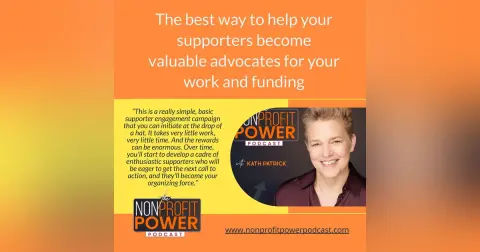
16:36 To move our members of Congress and to shift their thinking and to get them doing the right thing. Now, what's cool is that you can use this basic formula that I just gave. And anytime you want to get a lot of voices saying the same thing to your members of Congress, just change the messaging details to fit the situation, and you're good to go. This is a really simple, basic supporter engagement campaign that you can initiate at the drop of a hat. It takes very little preparation, very little work, very little time. And the rewards can be enormous. When you do this on a somewhat regular basis, there will be some folks on your supporter list who will not engage for one reason or another.
17:17 And if you want to, you can follow up with them and see if there's something you could have done differently that would've engaged them more. But for the most part, with limited bandwidth, focus on the ones who are engaging and ask them to engage more. Because what's really cool is that you'll start to develop a cadre of enthusiastic supporters who will be eager to get the next call to action, and they're gonna become your organizing force. And eventually you can ask them to start pulling in other friends and neighbors of theirs, to have them bring their own network in and to help build the campaign. There are ripple effects that will happen that you can't see right now, but they're out there waiting.
18:00 But you gotta take the first step and start organizing your supporters to make their voices heard. Thanks for listening, and I'll see you in the next episode right here on the Nonprofit Power Podcast.