
Setting Powerful Intentions that Will Serve You Well in the New Year


 Apple Podcasts

 Spotify

 Pandora

 Amazon Music
What makes intention setting so powerful is that it is more about the being than about the doing. If we fail to attend to our intentions, we risk not only missing our goals, but missing out on the experience we want to have while we pursue them.
I'm sure that your organization has plans and goals for the year. And I expect you to have some for yourself as well. We need those things. We need goals. We need plans. Or stuff would have trouble getting done.
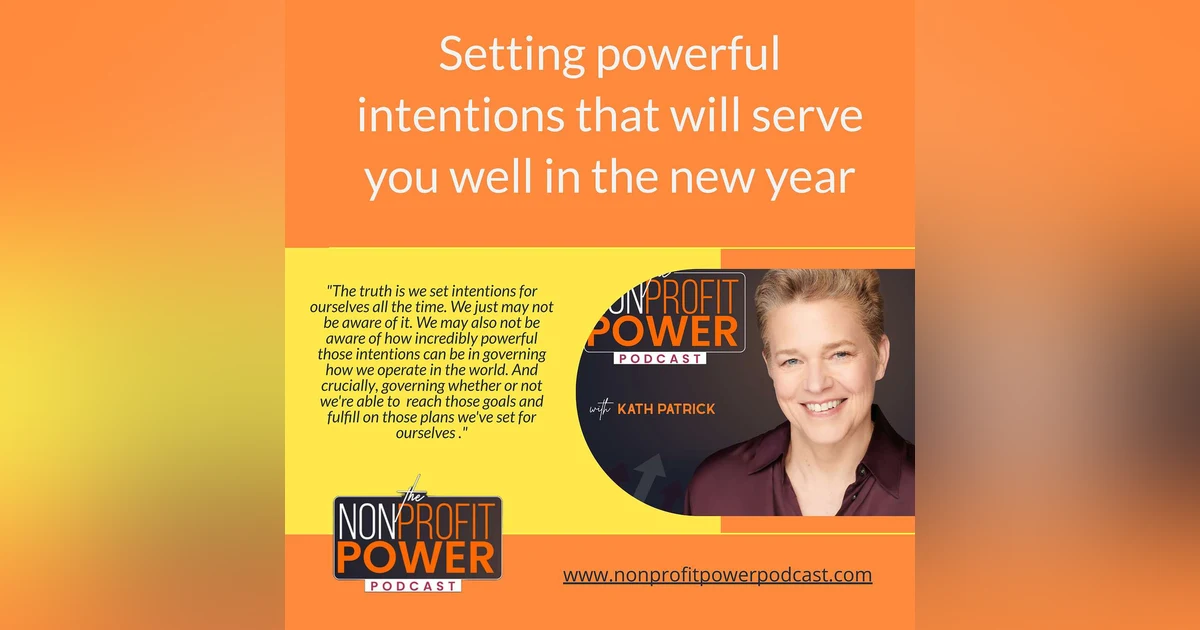
But the piece that we often overlook or don't give enough attention to is the idea of setting intentions. The truth is we set intentions all the time. We just may not be aware of it. We may also not be aware of how incredibly powerful those intentions can be in governing how we operate in the world. And crucially, governing whether or not we're able to reach those goals and fulfill on those plans that we set for ourselves.
In this episode, we share:
- How the intentions we set (consciously or unconsciously) affect how we show up and the actions we take
- The key to setting powerful intentions that will serve you well
- How to avoid the hazard of setting unconscious intentions that do not serve you
- The difference between resolutions and intentions, and why it matters
- How to set intentions that will support new habits you’re trying to develop
- How to keep your actions aligned with the intentions you’ve set
If you found value in this episode, please share it with other progressive nonprofit leaders. And I’d be grateful if you would leave a rating and review on Apple podcasts, which will help even more people find out about this podcast.
Thanks!
0:00 You're listening to the Nonprofit Power Podcast. In today's episode we're focusing on setting powerful intentions that will serve you well in the new year. So stay tuned. If you want to have real and powerful influence over the money and policy decisions that impact your organization and the people you serve, then you're in the right place. I'm Kath Patrick and I've helped dozens of progressive nonprofit leaders take their organizations to new and higher levels of impact and success by building powerful influence with the decision makers that matter.
0:40 It is possible to get a critical mass of the money and policy decision makers in your world to be as invested in your success as you are. To have them seeking you out as an equal partner. And to have them Bringing opportunities and resources to you. This podcast will help you do just that. Welcome to the Nonprofit Power Podcast. Hey there, folks. Welcome to the Nonprofit Power podcast. I'm your host, Kath. Patrick. I'm so glad you're here for today's episode. First of all happy new year. I took a week off from the podcast last week to spend time with family and friends over the holidays and had an absolutely wonderful time.
1:25 However you were celebrating I hope you had a lovely time as well. And now it's time to greet the new year. There's a lot of different ways that we can prepare for a new year and that we can set ourselves up for success in many different senses of the word. I'm sure that your organization has plans and goals for the year. And that is awesome. And I expect you to have some for yourself as well. Also awesome. We need those things. We need goals. We need plans. Or stuff would have trouble getting done. But there's a piece that we often overlook or don't give enough attention to. And that's the idea of setting intentions. And the truth is we set intentions all the time.
2:08 We just may not be aware of it. We may also not be aware of how incredibly powerful those intentions can be in governing how we operate in the world. And in fact, whether or not we're able to reach those goals and fulfill on those plans that we set for ourselves. What makes intention setting so powerful is that it is more about the being than about the doing. Goals and plans and action steps, and all of that are very much about the doing. You have a specific goal and a plan of action. And you're going to do steps one through 17 to get to the next thing on your plan.
2:51 And don't get me wrong. I love goals and action plans and all of that. I am all about that. They're highly valuable. They create the necessary structure to help us get the work done and to communicate clearly with other members of our team about where we are in that process and all of that. That stuff is awesome. And I'm for it. Please understand that I'm not saying it's one or the other. Not at all. But at a personal level, both as a leader and as a team member. As we're helping to get those goals done, how we show up and how we go about the doing of those things has a great deal to do with how we're being.
3:33 We talk about that quite a bit on the podcast. And it sometimes, I think, gets dismissed as well, the doing is what's important. They're both important. And we talk a lot about how, how you show up, for example, in interactions with decision makers and how you're being and the identity you're occupying when you are engaging decision makers, has an enormous impact on the outcome of those encounters. And the degree of success you have engaging them. So the being is hugely important. It's also hugely important for all of us personally. How we choose to be in our daily life, how we choose to operate.
4:15 Has an enormous impact on how we interact with others. And how well we serve ourselves. I probably don't have to tell you, because I'm sure you're aware that we all have experiences from time to time where we're operating from a place that does not serve us. We've all been there. It doesn't feel good and it doesn't cause us to show up as our best selves. When we're operating from a place of anger or resentment or disappointment or any of those kinds of things. Or just even operating from a place of expecting things to go lousy and not go our way.
4:57 That that affects lots of other things. It definitely affects how we are perceived by other people. It impactss how effective we are in engaging other people. It also just affects our own mood and how we feel about our day and our life and how things are going for us. So the being is really important. And setting intentions really is about the being. I think that one of the things that's really important to understand is that we are constantly setting intentions. I would be willing to bet that the majority of the time, the intentions that you're setting are ones that you're not conscious about.
5:38 So if we're going around setting powerful intentions all over the place without being aware of it. You could see how that might tend to land us in some unhelpful places. Let me give you an example of how we set small unconscious intentions all the time that probably don't serve us. Let's say you have a problem for which you've got to go to the customer support department at some company. Maybe it's an airline. Maybe it's one of the platforms that you use in your work or personally, maybe it's an online retailer. And you've got to deal with this customer support. And you're dreading it. You're like this is gonna be a disaster.
6:19 It's going to take all this time out of my day. They're not going to be helpful. I'm going to have to either spend 20 minutes interacting with some useless chat bot that doesn't have the answer, but it won't let me chat with a real person until I've jumped through 27 hoops. Or I'm going to be on hold with some telephonic customer service system. All the different ways that interacting with customer support at most companies triggers just all sorts of negative expectations going in. Because your past experience probably tells you that a lot of times that does not go well, and it is a time suck. This is a perfect low stakes example of how an unconscious intention setting can affect how this goes,and how a conscious intention setting can affect it.
7:08 If you allow the unconscious intention to take hold, which is the voice of past experience. It's not wrong. That is your past experience, right? It was terrible. It's probably going to be terrible again. But if you don't make a conscious choice about that, the default intention will come with you and will guide your actions. And the thing to understand about intentions that's what makes them so powerful. Is that intentions that we set, consciously or unconsciously, subtly influence our actions in ways that we don't even perceive. How we're being affects the doing.
7:49 If we allow an unconscious intention to be set. An expectation that something is going to go very poorly and be very aggravating. Well, how do you think we show up for that? We show up ready for battle. We show up ready to be irritated, ready to be pissed off. And then if we do actually interact with another human somewhere along the way. Typically it's going to be an online interaction, but we're still interacting with the human being at the other end of it. And how do we show up with that? How do we frame our request? How do we frame what the problem is that we'd like solved? How big is the chip on your shoulder by the time you've been irritated for 20 minutes, interacting with the useless chat bot.
8:33 By the time you get to that live human, the chip on your shoulder has grown to a rather impressive size. When you're operating from the intention that it's going to go poorly. And it's going to be frustrating and it's going to be aggravating. But what if you approached the whole process by first, consciously setting an intention that this is going to go great. It's going to be quick. They're going to have the answer. They're going to solve it for me. I'm going to be a hundred percent satisfied with the outcome. It's going to be resolved. This is going to be easy. And then I can check it off my list and move on with my day. How you show up to the entire process changes dramatically when you change the intention, when you set the intention consciously.
9:19 And don't allow default intention setting to run your interaction, to run your day, to run your life That's a really small, simple thing. But those small, simple things add up. And the truth is that our days are mostly made up of small, simple things. We're not typically going out and doing monumental things five times a day. Occasionally, but mostly, most of us, even when we're doing the work of changing the world and making a huge impact and changing people's lives. The day-to-day work of that is often the small stuff.
10:00 It's made up of a thousand small things. So how we set our intention about how we're going to be in that process has a massive impact. A much more serious example of conscious or of semi-conscious intention setting. Is one that I've seen in a number of different people in my life. Who in one way or another set an intention uh, about just about the most serious thing there is, which is how long they would live. There've been a number of people in different parts of my world who essentially set an intention with an expiration date on their life.
10:43 And in every one of those instances that expiration date became real. With some of them, they were well into their eighties. So you could say, well, it was a lucky guess, whatever. But others were not. One of them was 48 when they passed. And had set an unfortunate intention they didn't expect to live to 50. And they didn't. That's how powerful and how consequential intention setting can be. It ranges from everything from how the interaction with customer service is going to go, to when you're going to leave the planet. So what that says to me is, it's a good idea to be mindful about the intentions we set.
11:29 And to choose to deliberately set intentions that are going to serve us. So here we are in January. The time of new year's resolutions. What's the difference between a resolution and an intention? Resolutions are about doing. They're about actions. I'm going to work out five times a week. I'm gonna go on a diet and lose 10 pounds. Very often new year's resolutions are targeted at creating new habits. Which is cool. But changing habits, developing new habits is not easy. Part of the reason it's so challenging is that they involve repeat action. And you need to repeat those actions consistently for at least nine to 10 weeks for them to become a new habit.
12:16 There's brain science behind that, but that's about what it takes. And while you are in the process of changing that habit, you're forced into the situation of having to do the new thing and stop doing the old thing by sheer force of will. If you've declared, I'm going to work out five days a week, or I'm going to work out an hour a day or whatever it's going to be. Every single day, you got to get yourself to the gym or get yourself to the pool, grab the kettlebells in your bedroom, however you're working out. It's really easy to have other stuff get in the way and for you to first put it off.
12:58 And then say, well, I didn't get it done today, but I'll do it tomorrow. And then pretty soon a couple of weeks have gone by and you haven't gotten to it or you haven't been consistent about it. And now you're demoralized. And you're feeling like, aah, what's the point? And the truth is most new year's resolutions fall apart within a matter of three to four weeks. Some disappear a lot sooner. When I was teaching jujitsu regularly our dojo was housed at the local Y. We would see a whole crop of folks come in every January 2nd all fired up and ready to work out, and the place would be packed. You couldn't get to a weight machine. Couldn't do anything because people were all over them doing their thing. And then by week three, it was no problem getting access to the equipment again.
13:42 That was fine. You just knew that you had to wait about two, two and a half weeks, and then pretty soon you'd have your gym back because they'd all be gone. That's not to say that you can't change habits. Of course you can. But it's a lot of work. And the difference between that and setting an intention, is setting the intention is about how you want to be and how you want to feel. That's a lot easier to get clear about. And it doesn't necessarily require a specific set of actions. It simply requires that you operate from that intention. If you're determined to have the resolutions go for it. Or if you're determined to have a new workout plan, go for it.
14:23 I don't want to rain on that parade. But while you're at it, set one or more intentions that will support that. That will help guide and inspire daily action to move you toward the thing that you want. Because there's nothing magic about the 10 pounds. Or the five days a week workout. Those are arbitrary targets that we set, that are in service of something larger that is what we really want. We want to feel better in our body. We want to feel stronger. We want to feel more agile. We want to feel healthy. We want to be healthy, but we also want to feel healthy.
15:05 So a lot of those things that we want, we want because of how we're going to feel when we have them. The problem with these arbitrary targets of I'm going to lose 10 pounds or 20 pounds, or I'm going to work out five days a week or whatever. Is that we don't know, actually, if that's the exact right target. We might achieve those goals and still not have the feeling that we were chasing that we wanted. So to help you if you want to pursue those kinds of resolutions. If you want something that is going to constantly guide your decision-making and your actions in very subtle ways Set some intentions that are centered on the feeling that you want to achieve.
15:49 If you have set an intention that you want to cultivate gratitude. Or that you want to cultivate kindness. Or that you want to experience more joy in your life. There's a lot of ways to experience and express gratitude. To experience and express joy, to experience and express kindness. There are many paths to that. And so it's freeing because it's a guide saying, this is my beacon. This is how I want to operate. And then you almost have, if you want to look at it this way. You almost have a little binary thing to check when you're about to say something or do something. To ask yourself, does that serve that intention?
16:31 And if it does, go for it If it doesn't then take a second. Say, Hmm. Is that really where I want to go? What might I want to do or say instead? And that's a process and a practice. Don't expect perfection. Perfection is not the goal. The goal is to be mindful about the intentions we set. And to in that process ensure that we are only setting intentions that do serve us. Because what happens a lot of the time is that we might set one or two grand intentions. Like, I'm going to cultivate kindness and gratitude and joY.
17:11 But then with all the unconscious intentions that we set on a daily basis, we undermine that. And it's easy to think of ways in which we do that. But we can develop the practice of asking yourself the question, does this serve that intention or not. And just be aware. What will come along with that is awareness of, oh, wait a second. Did I set another intention unconsciously or without my awareness that, oh, wait. I just set this intention that this was going to be a mess, and this is going to be a terrible experience. How does that align? How does that work with the intention that I've consciously set to operate in gratitude and to have more joy in my life?
17:56 Huh. Well, it kind of doesn't, does it. So is there perhaps another intention, a small intention that I want to set about this specific thing I'm about to go do. This situation I'm about to enter. Is there a small intention I can set about that that will align with these larger intentions that I've set about gratitude and joy? I'm picking on those because those are ones that are often central to where I'm operating from. But it can also be about how you want to be in relationships. Maybe it's that you want to set an intention about being more present in your relationships. That's a great one. You can not go wrong setting that intention.
18:39 Except that the fact is we set little intentions all the time that fight against that, that make that harder. That don't align. So we want to catch ourselves. And, no judgment here, because this is the human condition. We are all working on this. It is a process for all of us. It's a journey. Nobody's got it nailed. Nobody's perfect at it. It's just your own personal practice of conscious setting of intentions that serve you. And checking regularly to make sure that your actions are aligning with those intentions and are not going in a direction that doesn't serve you. And when you catch something going in a direction that doesn't serve you.
19:21 It's worth also asking the question, did I inadvertently set a small intention over here about this, that is leading me toward ways of being and ways of acting that don't serve me. Simply cultivating that awareness is worth a ton. So back to the being present in relationships. That could be your relationships with family and friends, that could also be relationships with coworkers. If your intention is about being more fully present in relationships. And you find that when you're in conversation with a friend or a coworker, that your attention is wandering, that you are thinking about other things. Perhaps you're looking at your phone, you're multitasking.
20:03 Maybe you're on zoom with them, but you've got your camera turned off and you're doing five other things. You're answering your emails. You're checking your texts. You're watching a couple of cat videos. Whatever you're doing that is the complete opposite of being fully present in that relationship in that moment. Is a great time to check in and say, Wow. Do I feel present? Am I present? Hmm. Well kind of not. And in the moment it's a simple binary decision. Okay, now that I've noticed that I'm not aligned. Do I want to now be more present? Shall I do that? Generally speaking, when you pose the question to yourself that way.
20:44 And you were sincere in setting that intention in the first place. It would be an odd situation where your response to your own question would be, yeah, no. Eh, I'd rather, you know, multitask over here and too bad for the relationship. I didn't really mean that about being present. If you set that intention because you wanted what it would buy you in your life, that would bring you greater closeness, greater joy, greater feeling of love or caring. Or if it's coworkers just greater feeling of comradery and working together and feeling like you're a team. If you wanted all those things. And you meant it. Then, if you catch yourself doing something that's not aligned with that, then it's a pretty easy thing to say to yourself.
21:30 Oops. Those are old habits coming in. I'm going to choose differently right now. In this moment, I have a chance to make a choice. I'm going to choose to be aligned with my intention. I'm going to get rid of all those other screens that are distracting me. I'm going to turn my camera on and I'm going to be fully present with this other person or this group of people. I'm just going to be here and this is all I'm doing right now. And I'm good with that. Even though, probably in a corner of your mind, you're thinking oh my God, I got 150 things to do. Aaah. Being fully present means that we say, yes 150 things, you will get your turn. But right now you need to sit down. Because I'm focused on being present with this person or with these people.
22:12 And that's what I'm doing right now. You see how having set the intention operates as a guidepost. It allows you to check yourself and say, I set the intention. Am I aligned or am I not? And if I'm not, what do I want to do about it? And it makes instantaneous decision-making really quite easy. Once you catch yourself, it's really easy. The trick, the hard part, is catching yourself. And that's a practice and a process, but with practice, you get better at it. It becomes a habit to check yourself, to check yourself against the intentions you've set. And I promise you two things.
22:53 One, when you check in, you're going to find the decision making to be pretty easy. To say, yes, I want to align with that intention. I'm going to do that now. But the other thing that I'm going to promise you is that it's going to be a bumpy road. There'll be times when you are not aligned with the intentions you've set. And you don't notice it in the moment because there are habits that you have. And possibly some unconscious intentions that you have set. Little ones, because most of us don't go around setting big ugly intentions that really don't serve us. Except the one about I'm not going to live long, those kinds of things, please don't set those intentions. They have a lot of power.
23:34 But mostly we don't do that. Mostly we don't go around setting big, hairy intentions that don't serve us. The ones that don't serve us tend to be these little ones that get set unconsciously or with minimal awareness. Maybe out of habit, maybe out of repeat past experience that just say, well, that's just how that's going to be. We know that already. So we'll just act accordingly. Those are the ones that will sneak up on you. And it will take time to build the habit of checking in. But if you haven't set those larger, positive intentions that do serve you. That take you somewhere that you really want to live internally.
24:16 The way you really want to be, the way you really want to feel in your life. If you haven't set those clearly for yourself, then it's harder to check in to say, am I aligned with that or not? There's nothing to check in with. And then what happens is we're just trying to get through the day. We're just surviving. And we never get any closer to the ways we really want to be, and the way we really want to feel, because we haven't set ourselves up to succeed in doing that. We all, all us humans, we want more joy. We want more love. We want more companionship. We want more caring and kindness in our lives.
24:57 We want more connection to the things that we love. Whether it's nature or music or whatever it is. We all feel a strong pull toward those ways of being and those ways of feeling that fill us up and energize us and make us feel great. We all have that capacity and we all have a set of feelings and things that we want in our life.. But without clearly set intentions it becomes much harder to get to those things. So my hope for you as you are planning and getting ready for all the doing for 2025.
25:43 That you will also take the time to think about the being and the feeling and how you want to experience your life and your work in this new year. And to set one or two, maybe more. One or two intentions that you're really clear about. About how you want to be and how you want to feel. And then let that be your guide for your actions, for your conversations, for how you show up. And develop the habit of checking in. There's a hundred ways to do that. I'll leave that up to you. If you want to set a reminder on your phone. If you want to create a practice of I'm going to ground myself in those intentions every morning when I get up.
26:27 And I'm going to review at the end of every day. Was I aligned? Was I not aligned? Those are two simple times in the day when you can check in and say, how'd I do? And the goal is not judgment. The goal is information. If you weren't aligned that day. You were totally not aligned the whole day. I hope that doesn't happen, but it, days can be like that. And if that happens, then what not to do is don't beat yourself up about it. Don't say, oh, that was terrible. I was unaligned all day. What's the matter with me? That's not the goal. The goal is to come to this, first of all, to, to treat yourself with love and compassion. And just say, wow, I was really unaligned today.
27:08 What was going on, what was up with that? What was happening that caused me to allow myself to be so unaligned? And were there points in the day where I could have made a different choice, made a different decision about what to do next, what to say next? How to operate that maybe could have turned that around a little bit. And brought it closer to being in alignment with my intentions. And then if you want to go a layer deeper and say, and by the way, were there any unconscious intentions that I had set that maybe pulled me out of alignment? And what were those? Hmm.
27:49 Worth noting. Let's try not to do that again. This is a process. Treat yourself with kindness and compassion and love as you go through it. But I hope you'll give yourself this gift going into the new year. Thanks for listening. And I'll see you in the next episode right here on the Nonprofit Power Podcast.