
How to Maintain Your Personal Power when the Ish Hits the Fan - Episode 49


 Apple Podcasts

 Spotify

 Pandora

 Amazon Music
As advocates and leaders, a big part of our job is to successfully engage both decisionmakers and members of our own teams to join us in pursuit of a goal. And when we’re at our most effective, we can feel that we’re operating from a place of strength and assuredness and confidence that others can feel and respond to.
But sometimes events happen that can undercut all of that in an instant. We get pulled into reactive emotions, and suddenly we’re no longer operating from that place of assuredness and confidence. What’s helpful to know is that it happens to everyone. Even the most powerful and impactful leaders experience this from time to time. But part of their secret sauce is that they know how to restore and return to their personal power very quickly. The good news is, that involves a skill set and a practice that anyone can develop.
In this episode, we share:
- What is personal power and why does it matter
- The most common ways we get pulled out of our personal power
- How to re-regulate your emotions when you experience an “emotional hijacking”
- How to uncover and shift your default interpretations of negative events
- How to avoid the hidden trap that will keep you from getting the result you want
- The most common way we undermine our own personal power, and how to fix it
If you found value in this episode, please share it with other progressive nonprofit leaders. And I’d be grateful if you would leave a rating and review on Apple podcasts, which will help even more people find out about this podcast.
Thanks!
0:00 You're listening to the Nonprofit Power Podcast. In today's episode, we share. How to maintain your personal power when the issue hits the fan. So stay tuned. If you want to have real and powerful influence over the money and policy decisions that impact your organization and the people you serve, then you're in the right place. I'm Kath Patrick and I've helped dozens of progressive nonprofit leaders take their organizations to new and higher levels of impact and success by building powerful influence with the decision makers that matter. It is possible to get a critical mass of the money and policy decision makers in your world to be as invested in your success as you are.
0:47 To have them seeking you out as an equal partner. And to have them Bringing opportunities and resources to you. This podcast will help you do just that. Welcome to the Nonprofit Power Podcast. Hey, everybody. Welcome to the Nonprofit Power podcast. I'm your host, Kath. Patrick. I'm so glad you're here for today's episode. As advocates and leaders, a big part of our job is to successfully engaged both decision makers and members of our own team to join us in pursuit of a goal. And when we're at our most effective, we can feel that we're operating from a place of strength and assuredness and confidence that others can feel and respond to.
1:32 But sometimes events happen that can undercut all of that in an instant. We get pulled into reactive emotions and suddenly we're no longer operating from that place of assuredness and confidence. What's helpful to know is that it happens to everyone. Even the most powerful and impactful leaders experience this from time to time. But part of their secret sauce is they know how to restore and return to their personal power very quickly. The good news is that involves a skillset and a practice that anyone can develop. So let's get right into it. There are lots of different kinds of power. Certainly the money and policy decision makers in your world who have decision-making authority over rules for how things will work and for how resources are going to be distributed and what the priorities are going to be for all of those.
2:22 That is certainly power. And when you successfully influence those decisions through advocacy, that's power too. So we could have a very long possibly endless conversation about all the different sources of power, and how power is acquired, where it gets concentrated, how inequitable that often is, and so on. But in the context of advocacy, a key source of your power is your ability to influence a decision maker to take a particular action. Where that power comes from is about several things. It's most definitely about helping them see why taking the action you want them to take is a good idea for them.
3:06 When you do that through engagement and aligning your stuff with their interests and priorities, that's what would be called soft power. Using pressure in whatever form. Say, organizing to create a groundswell of public support and pressure from that. Engaging a handful of influential people to apply pressure selectively. Those are all forms of hard power. But either way what's happening is you're helping the decision makers see that taking the action is a good idea for them. Either because it will help them. Or it will prevent them from experiencing something they don't want. Like negative public pressure. As you influence them and their decision-making, you are utilizing one form or another of power.
3:52 But ultimately there is a second key. Which is that you must also be operating from your personal power. And what do I mean by operating from your personal power? It's operating from a place of being fully centered. Certain that the thing you're advocating for is the right thing. That it's going to help people, that it's important to do. It is 100% the right course of action, and you are committed to making it happen. There's no question about that for you. You're not wondering if it's the right answer. You're not wondering if maybe this would be a good idea. You're certain of it. And it's that solid centered assurance that is a key piece of the essence of personal power.
4:36 It's a belief that this will happen and there will be a way to bring this about. You may not know exactly how or exactly when, but you know that it will be. And when you operate from that solid, centered assuredness and certainty and faith, that the thing you are seeking is going to happen. That is a very powerful place to operate from. Leaders who are able to consistently operate from that place are far more effective advocates than leaders who slip in and out of that personal power. So I have no doubt that you are rock solid with your stuff that you want from your advocacy agenda. So you've got that covered. But there's also a piece of personal power that is about just having your energy centered.
5:22 Being focused. Being calm. Through that combination of passion for the thing that you care about, and the calm centeredness of your being, makes you a compelling leader to your team. And a deeply engaging, influential partner with the decision makers in your world. You need both. But what is often not talked about is that even the most effective leaders who very consistently operate from all aspects of their personal power, experience moments where that is severely tested and challenged. Where they're pulled out of their personal power for a moment or longer. All of us humans experience this. There are moments when we get our chain yanked.
6:04 When we get triggered. However you want to phrase it. Where we get pulled into an emotionally reactive state where we are not in our personal power. We all have our emotions get hijacked from time to time. Powerful leaders have that happen to them too. The difference is that they have become highly skilled at returning to their personal power as quickly as possible. That is a set of skills that can be learned and a practice that can be developed. We're going to talk about how you can more consistently stay in your personal power so that you can be more consistently effective as an advocate, and as a leader. Because just like advocacy, leadership is fundamentally about engaging other people to come along on a joint endeavor and give their best effort and help make a thing happen.
6:50 So leadership skills and advocacy skills are closely intertwined, as you know. As you also probably know, it is very difficult to engage people in a compelling way if you are not operating from your personal power. In fact, it's almost impossible. Partly because when you're in that place, you're not able to deploy effectively the skills and techniques that are needed to be an effective advocate or an effective leader.. But also because the energy, the frequency, the vibration when you're out of your personal power does not draw people to you. It does not pull people in. It does the opposite. It pushes people away. If you're not operating from your personal power, you won't be able to influence anybody about anything.
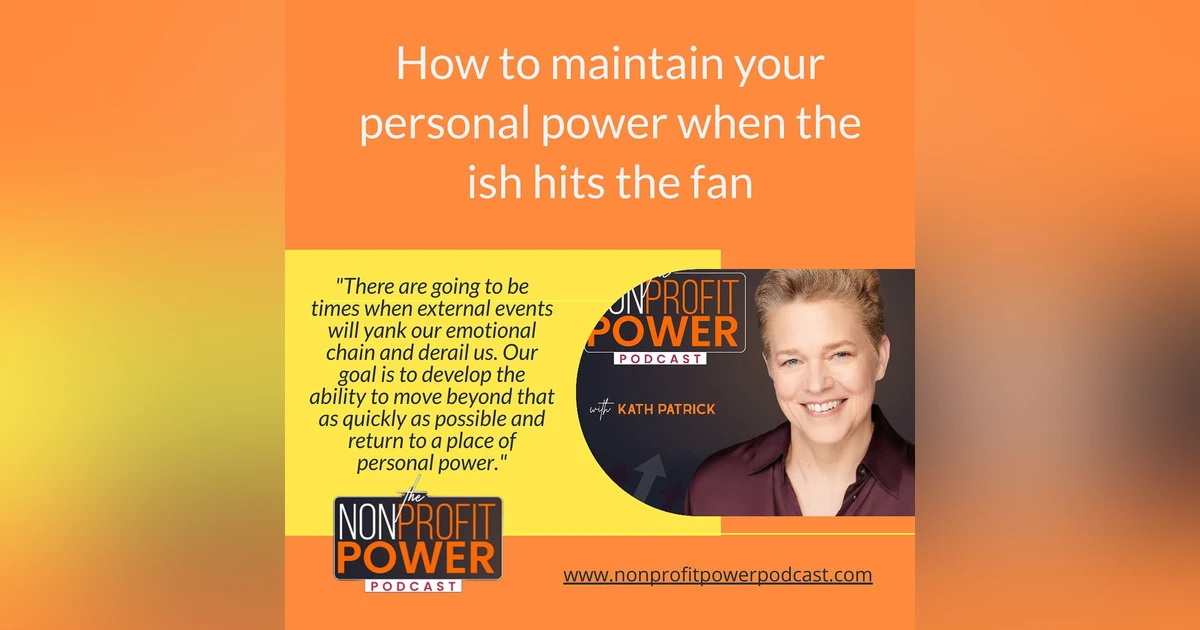
7:35 Now we know that there are going to be times when external events, when actions of other people, words of other people, are going to yank our emotional chain. Our goal is to develop a practice and the skills that go with it, to be able to move beyond it as quickly as possible and to return to a place of personal power. The most common way we get pulled out of our personal power as nonprofit leaders is when unwanted external events happen and cause a crisis or at least a big problem. Things like funding priorities change and a big grant goes away, or a big contract goes away, or a big government revenue source is dramatically reduced.
8:16 Or it could be a harmful policy that has been pushed through that you weren't able to stop. Or it might be the actions or words of an individual who may or may not be a decision maker. Could be a colleague or someone else in your orbit. Uh. Someone does or says something that feels disrespectful or is upsetting in some other way. Uh. In any of these situations, we often have a very strong emotional reaction. In the case of, a crisis, that's a loss for the organization, the reaction might range from annoyance to anger and perhaps fear or even panic, depending on how impactful the loss might be. And that can quickly lead to disempowering self-talk. Especially if you, as the organization's leader, feel personally responsible for fixing the crisis.
9:01 How could they do this to us? How did I let this happen? What am I going to do? There's a lot going on in there. And none of it is operating from your personal power. The same thing can happen when the emotional hijacking is from the actions or words of an individual in your orbit. Maybe a funder pops up with a ridiculous demand at the last minute and implies an expectation that you'll be able to provide them the next day with a product that represents three days work. Maybe a colleague says something that feels disrespectful or dismissive of your talents. And you feel yourself go straight into an emotional response to that. You get hooked by the disrespect and disregard. And your emotions are off to the races.
9:43 You start creating a story about why. About what it means that they would do that to you. That is the definition of being out of your personal power. Allowing other people to hijack your emotions absolutely takes you out of your personal power. So let's talk about how to get yourself out of an emotional hijacking and return to a place of strength and personal power so that you can operate from that. The first thing is to recognize that it has happened. There are certain events and actions from other people, words from other people that can send us into a very heightened emotional state, very quickly. That is going to happen.
10:24 We all go there from time to time. But the key is to recognize it as soon as it happens. To notice yourself, to catch yourself going into that heightened emotional response. And it doesn't really matter what the emotion is. It could be anger. It could be fear. It could be shame. It could be self doubt. Could be anything. But when that happens, notice it. The emotion is there. You can't instantly stop it or banish it. But what you can do is investigate it. First to identify it. What emotions are coming up. There's power in simply naming them. And then to ask where that's coming from.
11:05 Why is that my reaction? What about this is sending me into that emotional state? And while you're there, give yourself the gift of some actions that can help you regulate your emotions right away. And put you back in charge of what's going on. Because when you're in that highly emotional reactive state, you're not in charge of nothing. And you're completely out of your personal power. Take three or more really deep diaphragmatic yoga breaths. Or use another technique that works for you. But the thing I love about diaphragmatic breathing is that it's always available. It doesn't matter what setting you're in, you can always do that.
11:48 But basically what you need to do is to hack your vagus nerve. Take a walk if you can. Go outside, be in nature for 10 minutes, if you can. Something to help you unhook from the reactive state that you're in. And to take a step back from the emotional reaction. Calm your physical body, because when we get into that extreme emotional state, our body chemistry is reacting like crazy. There's all kinds of stuff going on physiologically. And by using physical techniques, we can actually calm both the nervous system and therefore calm the emotional state. And once you can do that, then you can set about evaluating what's going on.
12:29 Another thing that's very useful to do is to notice what your default interpretation is of the event or the action or the remark. Do you go straight into it meaning something about you? That's something to pay attention to. Chances are, whoever the cause of this thing it was not particularly thinking about you when they said or did the thing that so upset you. More likely they were thinking about what was going on in their own world, or thinking about themselves. So then ask yourself. Once you realize, wait a second. I think this isn't about me. This is about them. So ask yourself what might be going on with them that would cause them to act the way they did or say the thing they did.
13:11 So back to the funder example, who pops up with this insanely unreasonable request, that on the face of it feels clueless and disrespectful. And like an abuse of power. So how many triggers are sitting in there? Right. So you're like, rah, crazed with the response to this. But if you stop and think about it, they weren't thinking about you when they made that request. They probably weren't thinking real clearly at all. Because unless they're really not very bright, if they thought about it, they might be aware that the thing they're asking for is not reasonable. So probably what's going on is that they're under pressure from somewhere. To answer a question or provide a product or something. And they're in a state of panic and overwhelm.
13:53 And so they flail around, and ping you and say, Hey, you got to do this. I need this right now. Well that says a lot about them. And their not being in their personal power, them not being in control of their emotional responses. And then not thinking through how to communicate with you in a way that would actually engage your cooperation. And make you want to help them. Obviously, if they had thought about any of that, they would have done that differently. So the chances are very high that they're in some sort of emotional state themselves. And once you realize that you can say, huh. Okay. I'm still annoyed.
14:34 But I can see that this actually didn't have anything to do with me. This is about them. So you notice and investigate the emotion. You take steps to reregulate your emotional state. You consider what may actually be going on, and whether it really has anything to do with you. And then you can ask yourself a couple of additional questions. If you're still feeling some of that emotional response. It may go away. That's something to realize. That sometimes all it takes to dissipate your emotional reaction is to think about what probably was going on there, realize it doesn't have anything to do with you. And now it's just a problem to be solved. It's no longer an emotional experience.
15:16 It's just a problem to be solved. Which you know, is probably annoying, but oh, well. You know, that's the life of a leader. We solve problems. That's what we do all day long. But if you're still feeling some emotion around this and you're like, ungh Yeah, I get it's not about me, but umm that's really irritating. Okay. So then you can ask yourself a couple of additional questions. Is this event or action or person worthy of this level of emotional reaction from me? Does it serve me to invest this intense emotional energy here? Usually those questions will be enough, if you actually consider them and think about it for a minute.
15:59 Nine times out of 10, you're going to come to the conclusion that heck no, that is so not worth my emotional energy. And then you can move on. So now it's time to ask yourself the question, what is it that I want? What is my desired result? Now, a caution. Often where we get tripped up is that we actually want two things and we only acknowledge one of them. We want an end result. We want to solve the problem some way, right? But when we get hooked emotionally by something someone has said or done, sometimes we also want restitution for that perceived wrong. And it's very easy to get focused on that and wind up operating primarily from your desire to do something to undo the wrong.
16:42 Maybe you want them to stop being a jerk. Maybe you want them to respect you. Maybe you want them to apologize. Maybe you want them to be a completely different person. But guess what? There's two problems here. Number one, we can't make anyone else do or say or be anything. And number two, by staying focused on that, you're giving away your personal power to them. But if you're like, no, really they need to apologize. This was so egregious that it will not be okay if I don't get an apology. That's fine. But before you do anything with that, Ask yourself, why you want the apology.
17:23 What is the result that you believe an apology will yield for you? This is very important. Because if the answer is, then I will feel better. You want to take a harder look at that. You are in charge of your emotional state. Don't give anyone else that power over you. Don't give them the power to make you feel good or bad about yourself because of something they said, no matter how offensive it was, or no matter how profuse the apology is at the other end of it. Now if the reason you want the apology is because they're a colleague and the thing they said or did was so offensive that unless they apologize, you're not going to be able to work with them anymore.
18:04 In that case, you're now getting closer to the result that you really want. Your result is I want to be able to still work with them. Or something like, I know I'll have to work with them and I'm not willing to leave this job. I need there to be a resolution of this, so that there's still a way for us to work together. However you frame it. And then that is something you can build a plan around and take action on. There is very likely more than one path to getting that desired result. And in the end, getting that result may or may not involve an apology. But if you get your result, does it really matter? Taking charge of identifying what you actually want and creating a plan to get there puts you back in your personal power.
18:50 Taking action before you've done that risks not getting a result you really want, and it leaves you out of your personal power. Operating from unmanaged emotion. And that includes any immediate verbal responses by the way. It might take a lot of discipline in some situations, but you really don't want to communicate in a way that will impede your ability to ultimately get the thing that you really want. So I know you know this. But. This is why those deep breaths are sometimes super helpful, because if you're focused on your deep breaths, you can't say something that you can't take back. So we've talked a lot about reacting emotionally to others, but the truth is we give up so much personal power without any other humans being involved.
19:39 All the times we second guess ourselves. We engage in negative self-talk. Oh, that was so stupid. Why did I do that? What was I thinking? That was a bad idea. I should do this. I should do that. I can't do this. Whatever. All that chatter steals your personal power. And that's before anybody else even gets involved. So we want to be super mindful of what we are saying to ourselves. Just on our own, going through our day, when little stuff happens. And notice your patterns. Now of course, we can also go there in reaction to an external provocation.
20:21 But bottom line, none of that negative self-talk serves us. So again, the first thing is to notice when we're doing that. Pay attention to your internal dialogue when it takes a negative turn. Notice when it's happening and ask yourself what's prompting that. Do you actually believe it? If so, why? And if not, why are you saying it? And very importantly, what would serve you better? What's a more helpful thing to say to yourself instead? An example would be a big funding loss that you either didn't see coming, or you saw it coming, but you weren't able to stop it. As the responsible leader, you might well feel that it's somehow your fault.
21:02 The internal dialogue of how could I have let this happen? This is terrible. I've let everyone down. This is all my fault. All those things. The underlying emotions in that scenario could be very complex. It could be embarrassment, shame, regret, fear, anger. All of those could be on the menu at the same time. That's fun. So identifying what you're actually feeling is a key first step. Albeit sometimes an uncomfortable one. For example, shame is a very common reactive emotion. And it is often very difficult to acknowledge. It's almost like a shame loop. You realize you're feeling shame, then you're ashamed that you're ashamed.
21:45 It gets ugly. So it's very helpful when doing this uncomfortable work to remember that having an emotion doesn't mean anything, other than that you are experiencing an emotion. It doesn't mean anything about you. Means you're human. But it doesn't say much else about you. So you identify the emotions and investigate where they're coming from. Let's say you did make a big mistake and you missed the signs that this cut was coming. So you do bear some responsibility for what has happened. It's possible, if you'd been more alert to the signs, you could have taken some action that might've prevented or mitigated the cut. It's also possible there was nothing you could have done about the cut, even if you'd been on the case and been aware of it.
22:30 But the organization at least wouldn't have been blindsided and you could have prepared for the impact if you'd been more on the case. So sort out what is actually true. Acknowledge whatever emotions you're feeling around that. Guilt embarrassment, shame, regret. But you don't stop there and dwell in those emotions. You get to work on what you want now. What is the result you want going forward? And what self-talk will serve you in the process of moving toward that desired result. What is not helpful is this is all my fault. So it's on me to fix it. Much more helpful. This is a big problem, and we are going to find a solution.
23:12 I have the responsibility to lead us there. And I trust and rely on my team to help get us there. Together, we're going to identify our best strategic options and make a plan. That's really different. And when you begin to operate from that, your frequency and vibration change. When you get back into your personal power, others notice and respond. Your decision making is better and more sound. Your leadership is more compelling and the tone you set within the organization is positive and exciting and filled with a can-do spirit. You inspire confidence in the people on your team who are looking to you for steady leadership in a time of possibly great upheaval.
23:55 And it inspires confidence in the people you're now approaching for partnerships to do new deals so that you can explore new avenues of revenue and new opportunities to make up for that cut. And maybe going back to see what can be done about restoring some of the funding that was lost from the original source. Maybe that door is not completely closed. Executing on any one of those strategic options will go a whole lot better if you're coming from a place of standing in your personal power as a leader and as an advocate. So one more time. I. Get used to the reality that occasionally something will happen that hijacks your emotions and yanks you out of your personal power.
24:35 Your job is to get back into your personal power with as little disruption as possible. Thanks for listening. And I'll see you in the next episode right here on the Nonprofit Power Podcast.