
How the Power of Community Building Can Help You Fight Back Against Attacks on Your Program and Your Funding


 Apple Podcasts

 Spotify

 Pandora

 Amazon Music
We all know how valuable community building is, but we often don't understand just how powerful it is.
And right now it might just be that nonprofit leaders' superpower as community builders could be one of the keys to making sure that we are able to fight off the right wing attacks on our funding and on the work that we do and the people we serve.
In this episode, we share:
- Understanding the strategic goals of the forces of division
- How to disrupt the forces of division through community building
- How you and your team can develop intentional community building actions
- The secret power of tapping into shared values, and how to weave that into your community building strategy
- How to integrate community building into your advocacy strategy
Help spread the word! If you found value in this episode, please share it with other progressive nonprofit leaders. Thanks!
0:00 You're listening to the Nonprofit Power Podcast. In today's episode, we share how the power of community building can help you fight back against attacks on your program and your funding. So stay tuned. If you want to have real and powerful influence over the money and policy decisions that impact your organization and the people you serve, then you're in the right place. I'm Cath Patrick, and I've helped dozens of progressive non profit leaders take their organizations to new and higher levels of impact and success by building powerful influence with the decision makers that matter.
0:42 It is possible to get a critical mass of the money and policy decision makers in your world to be as invested in your success as you are, to have them seeking you out as an equal partner, Bringing opportunities and resources to you. This podcast will help you do just that. Welcome to the Nonprofit Power Podcast. Hey there folks. Welcome to another episode of the Nonprofit Power Podcast. I'm your host, Kath Patrick. I'm so glad you're here for today's episode because we all know how valuable community building is, but we often don't understand just how powerful it is.
1:26 And right now it might just be that the Nonprofit Leaders' superpower as community builders could be one of the keys to making sure that we are able to fight off the right wing attacks on our funding and on the work that we do and the people we serve. Mhm. It is really clear that there are a lot of forces trying to divide us. What might not be as clear is that they've each got an agenda, they've got a purpose, a desired outcome. Some of them are motivated by profit, others by power, and some are motivated by both. We see evidence of this all around us and we suffer its effects.
2:08 But it's so pervasive that it almost happens without our full awareness, and that's part of what makes it so dangerous and insidious. We know that social media algorithms are designed to promote and reward anger and confrontation. They're built to boost those kinds of engagement, and they downplay civility, connection, people being kind to one another. The motivation for these behaviors by social media companies primarily is profit. They're looking to keep your eyeballs on the screen, and the longer you're engaged, the more they can charge for advertising. So how do they keep you engaged?
2:48 Well, you know, cat videos are awesome, but they don't cause active engagement the way confrontation does, the way anger does, the way fighting back and forth does. So that's what they boost. They boost things that are gonna cause that kind of engagement. And then we've got the right wing whose whole playbook is basically to siphon off as many resources and power as possible for billionaires and corporations, while taking resources and services from those most in need. If they just said, Hey folks, here's what we wanna do.
3:32 We wanna give lots of money to very rich people. And in order to do that, we're gonna take all those resources away from average folks in the community. You don't mind, do you? We'll just be doing that over here. So you just go on about your business while we take all your resources and all your services that you depend on, and we'll just take that money and give it to our friends instead. Obviously if they said that people might not care for it. So in their situation, they need anger and division to distract. The right wing works really hard to do a ton of messaging around the idea that if you were a person who thought you would have a decent life and be able to support your family and get along okay.
4:17 And you feel like you're struggling. Well, we don't want you to look at the fact that the reason you're struggling is we're already siphoning resources away from you in your community. We wanna convince you that the reason you're struggling is those other bad people over there are taking your stuff. They're taking your jobs, they're using up resources, they're getting stuff for free when you had to work hard for it. All the propaganda they use and all the messaging they use to drive wedges between members of the community and to have them fighting with one another and viewing each other as the enemy. As long as that's happening, as long as people are at each other's throats and are divided and convinced that the other person is the enemy, you know what they're not doing.
5:04 They're not looking at who are the real thieves in the room, who are the ones who are really siphoning off the resources, and who are the ones that we ought to be organizing together to fight against. So this is all very intentional. Whether the motive is profit or the motive is power, or some combination of the above. And once you have all these tech bros starting to intertwine with the administration, it's hard to know where one thing ends and the other one begins, and it doesn't really matter. What we know and have a ton of evidence for, is that all of that is bad. .It's bad for individuals, it's bad for communities. And we need a way to counter that.
5:47 Now, we've talked a lot in recent episodes about how you counter the messaging and all of the strategies and tactics you can use as an advocate who is out there doing good work to advocate for your programs and your funding. And those are all awesome. But what I wanna zero in on today is something that's a little more foundational. That goes to the heart, really of what we do in the first place. If you think about it, what we're doing as Nonprofit leaders who provide direct services is that we are all about one way or another, whichever piece of the problem we're working on and whichever angle we take towards solving that problem. Fundamentally, what we're all about is helping to make sure that every member of the community is able to thrive.
6:34 Every member. Not just the ones who started out with a lot of advantage, not just the ones who live on the right side of town, but everyone. And fundamentally, all of us humans need the same basic things in order to thrive. And on some level we all get that. But it does not help the right wing, it does not help the profit drivers of social media engagement, to have us all coming together in dialogue, in real life, actually talking with one another, finding common ground, finding connection, and discovering that in fact, there's far more that we have in common than there is that separates us or makes us different.
7:21 If we were to all discover that, and focus in on that and live our lives around that. That would spell bad news for a lot of these actors who are trying everything they can to keep us divided and in conflict. So there are some very compelling strategic reasons for deliberately building community. There are also some really compelling reasons as a human being who wants to experience joy and connection and community from the perspective that it's part of what we humans crave.
8:03 It is good for us. It's good for our emotional and physical health to be connected to people. We are social beings. Even the most introverted among us need social interaction. We need other humans. And the really cool thing about anything we do to build community is that it accomplishes both things at once. It's an antidote to the forces that divide us. It's a counter. It also lays the groundwork eventually for organizing folks. But initially it's just a really healthy, robust effective antidote and it's good for our health.
8:47 Everybody wins except the people who want us divided. The thing about building community is that it is fundamentally about connection. When we truly connect with people, it's an opportunity to listen and to be heard, to develop appreciation and understanding and empathy for folks whose circumstances may be different than our own. And to realize in the process that there's an awful lot that we share in common. And that fundamentally, most people at their core are kind and caring and they seek connection with others.
9:28 Every once in a while there'll be somebody who will push back on that with me and to say, you're naive. You don't understand, there's all this evil in the world and blah, blah, blah. Yes, there absolutely is. I'm not naive at all. But I have seen firsthand, I've experienced firsthand over and over again the power that happens when you actually connect with other people. Especially when you connect with people who, on the surface, appear to be someone with whom you might have a conflict, whose politics might not totally align with yours, or maybe they don't align at all. But unless they're a person who has some other power or profit driven reason to triple down on their strategies, there's usually a way to connect somewhere somehow.
10:20 Now, is everybody gonna be your best friend and all sing Kumbaya at the end of the day? Perhaps not. Probably not. But every time we make a connection, every time we share humanity with other people. When they are like-minded we often wind up building friendships. When they're not like-minded, at least what we do is we are reminded of one another's humanity and the many, many things we share in common. When you operate from that place of a genuine desire to connect, it completely changes everything about how you operate in the world. It changes how people see you, how they receive you, how they experience your energy.
11:03 And when we bring that energy of a desire to connect, it really tends to generate similar energy. Let me come back to why I want to talk to Nonprofit leaders about this. Which is that building community is one of the superpowers of Nonprofit leaders. It's what we do. First of all, we serve the community. Our mission is to help every member of the community thrive. And we do that through the work that we do to solve a particular problem in a certain way. But fundamentally, we're all doing the same thing. And there are very few members of the community who don't think that's a good thing, right?
11:46 Nobody's against helping every member of the community to thrive. The only way they wind up being against it is if someone feeds them a bunch of lies about how these other people are getting an unfair advantage and they're getting stuff they don't deserve, and you worked hard for that, and how come they get it for free and all that nonsense. But who better to help all the members of our community understand what it is we really do. And what circumstances folks are in when they find themselves needing our help. And helping people understand and get a clear picture of that and have it inspire their empathy, and innate desire to help their neighbor.
12:30 That is one of the core values that remains very strong across communities all over this country, is the belief that we take care of our neighbors. When someone's in need, we lend a hand. And if we can stay focused on that and connect over that, we start pulling people in who might not have thought they would be particularly aligned with our work. And there's so many opportunities because the work that we do invites opportunities to volunteer. It invites opportunities to connect out in the community. Just letting people know what we do and how we operate, what's available. There's all different kinds of ways that we're already communicating with a lot of the members of the community.
13:15 But a question to ask ourselves is, are we doing enough to actually connect with them and to actively be building community? And that's a challenge I would invite you to consider with your team. Is there even one thing, one community building thing that we could be doing to allow people to connect to our work? And allow members of the community to gather together to do something positive. Those are the, basic bricks of building community. Volunteer opportunities are certainly one way to do that. But you could also initiate something for the specific purpose of building community that will also help the people you serve.
14:00 A really classic example of this is food drives, right? Everybody's probably participated in one of these in their community. Where the call is out and either there's collection boxes around town or maybe they're even even a door to door food drive and they bring you a grocery bag one week and then tell you, we'll pick it up next Saturday. Those of you who are in the food pantry, food bank universe, you know that there are a million different ways to conduct community food drives. Now, most folks in that world will tell you that that is not the most efficient way to bring in food that people need to get the best nutrition. But what it does do is it directly taps into that universal instinct to lend a hand to your neighbors.
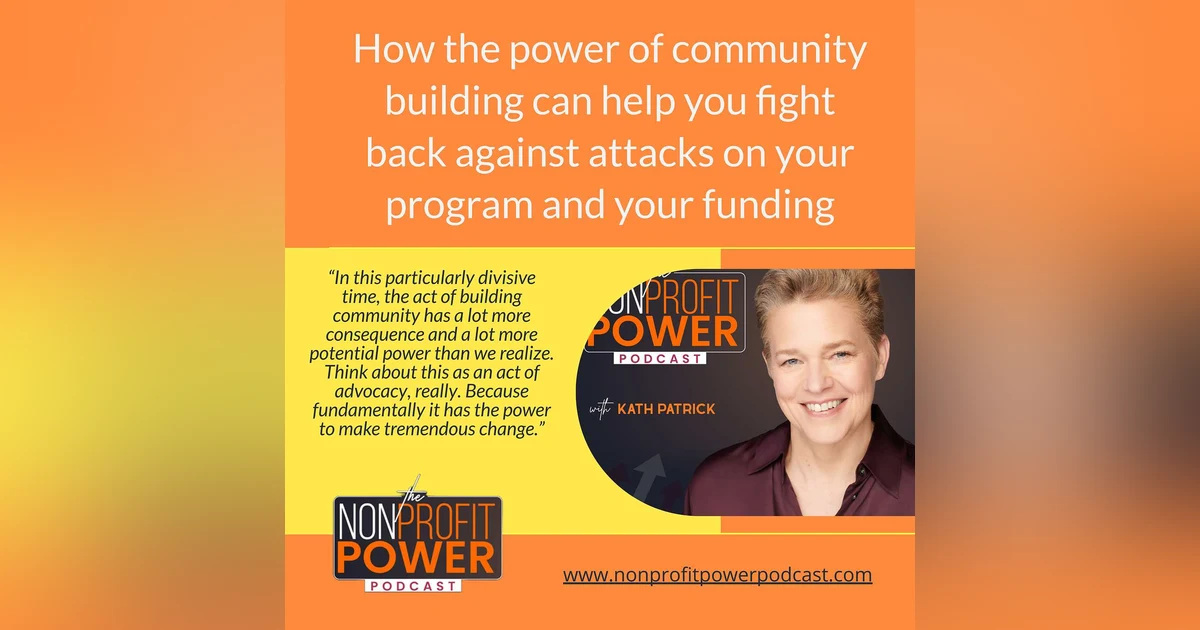
14:45 It's all about engaging members of the community in the work. Helping them feel like they're making a difference, they're helping their neighbors. And they're building connection. So consider the possibility that in this particularly divisive time, the act of building community has a lot more consequence and a lot more potential power than we often think about when we're just engaged in our normal community engagement activities. Think about this as an act of advocacy, really. Because fundamentally it has the power to make tremendous change.
15:27 But we have to be intentional, because the forces of division are being so intentional. They're doing everything they can to keep people divided. So if we wanna throw a wrench in that plan, what do we do? We get busy and we build community. We build connections all over the place, and we build strong connections. We bring people together and give them an opportunity to engage with one another, to discover just how much they have in common. And that honestly, the stuff that divides them is frankly a bit paltry compared to the powerful things that we share and that unite us.
16:07 And those include shared values of kindness and caring and helping your neighbor. Those are powerful values and we wanna be tapping deeply into those right now. Because when we connect over those, it starts to cause people to look around and open their eyes just a little bit more and say, wait a second. You do such wonderful work, why on earth would somebody be trying to cut your funding? Well, that's not right. Wait a minute. And folks you're bringing over to that way of thinking, may not then become your biggest advocates. But at least if you are shifting their thinking and shifting their perspective, you're making it harder for the right wing to keep them divided against you, and that's half the battle.
16:59 There's so much power in this, and the challenge for us is how do we become highly intentional at every turn, both individually, but also as leaders of our nonprofits. How do we and our team become intentional about building community and building connection in as much of the things that we do as possible? Potential for impact is hard to overstate, so let's give it a thought. Thanks for listening, and I'll see you in the next episode right here on the Nonprofit Power Podcast.