
How Do You Decide What to Say Yes to?

Here's something I think we probably all would agree is true: Nonprofit leaders are great at saying yes. We say yes to opportunities. We say yes to those who need our help. It's kind of in our DNA. I know many Nonprofit leaders who see their readiness to say yes as a virtue. But what if some of the things we're saying yes to are not really serving us? What if they're actually getting in the way of us making our greatest impact? The truth is, what you say yes to affects your effectivenes...

 Apple Podcasts

 Spotify

 Pandora

 Amazon Music
Here's something I think we probably all would agree is true: Nonprofit leaders are great at saying yes. We say yes to opportunities. We say yes to those who need our help. It's kind of in our DNA.
I know many Nonprofit leaders who see their readiness to say yes as a virtue. But what if some of the things we're saying yes to are not really serving us? What if they're actually getting in the way of us making our greatest impact?
The truth is, what you say yes to affects your effectiveness and impact in the world. In this week’s episode we get into how that works and why we need to pay attention.
In this episode, we share:
- How busyness interferes with our ability to discern what we should be saying yes to
- The first question to ask yourself before deciding whether to say yes or no
- How the unconscious ‘no’ will undermine your impact
- How one Nonprofit CEO uncovered and reversed an unconscious “no” that was creating serious problems, and the empowering lessons she learned in the process
- An effective 3-part mnemonic you can use to evaluate how to respond to a demand on your time
- How to uncover the hidden blocks that keep you from delegating as much as you probably should
- Three powerful questions to ask yourself to help you dismantle those blocks
Help spread the word! If you found value in this episode, I’d be grateful if you would leave a review on iTunes or wherever you listen. Your reviews help other nonprofit leaders find the podcast. Thanks!!
0:00 You're listening to the Nonprofit Power Podcast. In today's episode, we explore the question of how do you decide what to say yes to. So stay tuned. If you wanna have real and powerful influence over the money and policy decisions that impact your organization and the people you serve, then you're in the right place. I'm Kath Patrick, and I've helped dozens of progressive Nonprofit leaders take their organizations to new and higher levels of impact and success by building powerful influence with the decision makers that matter.
0:40 It is possible to get a critical mass of the money and policy decision makers in your world to be as invested in your success as you are, to have them seeking you out as an equal partner and to have them. Bringing opportunities and resources to you. This podcast will help you do just that. Welcome to the Nonprofit Power Podcast. Hey there folks. Welcome to another episode of the Nonprofit Power Podcast. I'm your host, Kath Patrick. I'm so glad you're here for today's episode. Here's something that I think we probably all would agree is true. Nonprofit leaders are great at saying yes.
1:23 We say yes to opportunities. We say yes to those who need our help. It's kind of in our DNA. And I know many Nonprofit leaders who see their readiness to say yes as a virtue. But what if some of the things we're saying yes to are not actually serving us? What if they're actually getting in the way of us making our greatest impact? Bottom line, what you say yes to affects your effectiveness and impact in the world. And we're gonna get into how that works and why we need to pay attention. A lot of the Nonprofit leaders I work with talk to me about how frequently they feel pretty overwhelmed.
2:07 That's not at all uncommon. But if you find yourself feeling overwhelmed fairly often, that's a flag. Even if you're not feeling overwhelmed, there's still the question of, are you making the greatest impact possible each day? The difference maker is what you're saying yes to. And because saying yes is kind of in our DNA, a lot of the times Nonprofit leaders myself included, will say yes to things before we've really thought through strategically whether that should actually be a yes. Cause here's the thing, everything you say yes to, means you're saying no to something else.
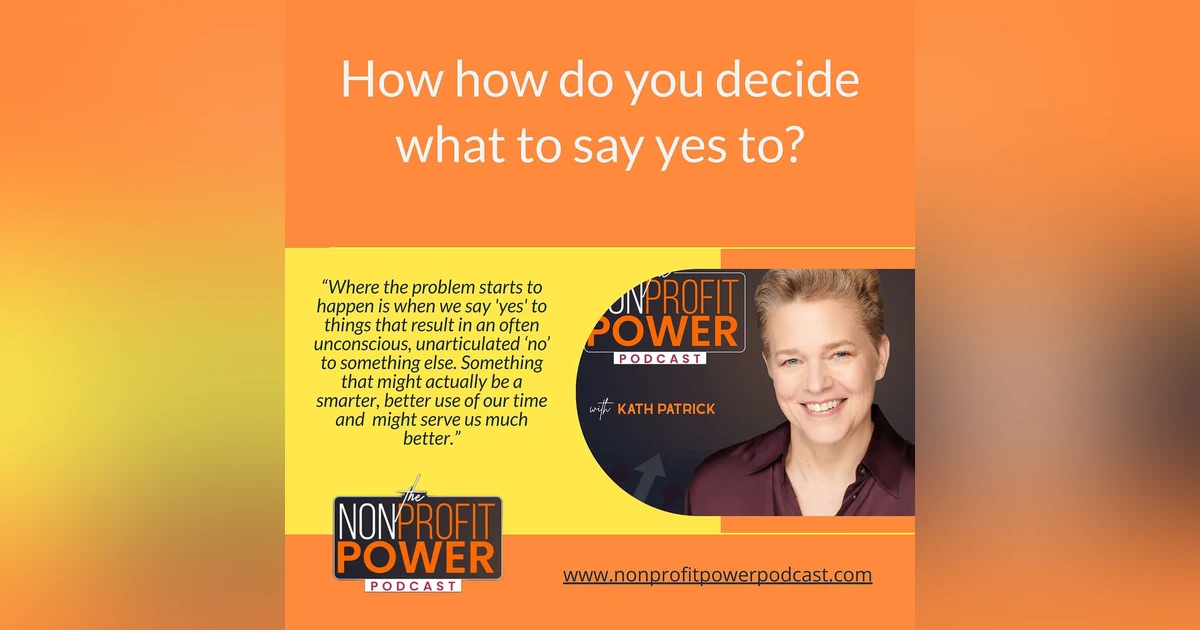
2:49 It's just simple math. You've got 24 hours in the day. And there are some things that are non-negotiable. We do have to sleep, we do have to eat, so time has to be allotted for those things. And other things that we have to take care of during our day that are not to do with our work. We'll focus on work for the purposes of this conversation, but this actually is true in our personal lives as well. It doesn't matter what context we're in. Whatever we're saying yes to, because of limited total time, we're saying no effectively to something else. And where the problem starts to happen is if we're saying yes to things that are resulting in an often unconscious, unarticulated no to something else that might actually be a smarter, better use of our time and that might serve us much better.
3:46 Becoming aware of that and becoming intentional about that has a tremendous amount of value. And that's what I want to take a look at. One of the most common ways this becomes a problem, is the things we're saying yes to, chances are good they're keeping you really busy. So you may or may not have even a moment to pause and assess, are these the right things? Should I have said yes to this? Is this the thing that should be keeping me busy, or should I be busy with something that is a much higher value use of my time? Whenever we say yes to things that keep us busy, but don't move our vision forward, that has a real cost.
4:27 And that applies to the small action items as well as the big items. Often it's the little things that get us in the most trouble. A good question to ask for the big and the little things, for starters, is, is it directly tied to my vision? And I'm deliberately leaving that a little bit open. It could be your vision for your organization, or it could be your vision of the impact you wanna make in the world as a individual human, as a leader. Either way, the further from the vision that this thing is that you've said yes to, the more likely it should have been a no.
5:08 A really simple three mnemonic that I like to use for this is delete, delay, or delegate. We can use this whenever we're finding ourselves overly busy or when we're about to say yes to something. This could be when we're finding ourselves overly busy and we gotta rework it. Or it could be when we're being invited to do something new, a new action item, or a new big thing. First question is, how important is it in the first place? That's also relative, right? You've got a lot of things on the organization's agenda, on your personal agenda as a leader. You've got a lot of things to take care of that you're responsible for.
5:49 So here comes another thing. Relative to all that other stuff, relative to the work you need to do to keep your vision moving forward, how important is this thing in the first place? Can you just delete it? Does it really need to get done? It might not. There's a lot of stuff that lands on our plate that we're like, oh, well this will just take a minute. Here, let me just get this done, da da, da. But we don't necessarily look at, does this even need to be done? So that's the first question. Maybe the answer is no. In which case, goodbye. Can it be delayed? Maybe it's important, but it's not urgent. And I got five other things in front of me that are both important and urgent.
6:30 Well, this one's not urgent. How about we put that off for X period of time, a month, three months, six months, whatever makes sense in the context. And then as a caveat, if you come back to it within that designated time and it's still not that important, then it might be worth looking at, okay, can we just delete it? It wasn't that important a month ago or two months ago. It's still not that important. Eh, maybe we could let that go. Now, if it is really important and it has to get done and it can't be deleted or delayed. Then the question becomes, does it have to get done by you? So ask yourself, is this something that requires my specific skills, knowledge, talents, abilities?
7:17 And even if the answer to all of that is yes, the next question is, am I the only person who can do this? Or could someone else do it, or help with pieces of it? Can I delegate it? Now if this was easy, everybody'd be doing it, right? But I talk with Nonprofit leaders all the time who really have a hard time with this. And full acknowledgement. I struggle with this myself too. There's a lot wrapped up in this. Fact is a lot of times it's not easy. And I want us to take a look at some of the reasons why it tends not to be so easy, because this is where the real work begins. There is a whole lot wrapped up in, is it important?
8:01 Is it not important? Can I delegate it? Can I not delegate it? A lot wrapped up in that, that is not immediately obvious. There is often some ego stuff about, I have to be the one who does this because whatever reason. I'll do it the best. I'll do it the most efficiently. I'll do it the smartest way. Whatever it is. When that comes up, when you're like, no, I need to do this'cause because. Always check to see whether, is it the case that you really are the only only person who could do it? Or is there maybe something going on there that's a little bit about control? If you're the really the only person who can do it, that's different from being the only person who can do it the way you would do it.
8:47 That's not the question. The question is, are you the only person who can do it at all? And if someone else could do it, even if they wouldn't do it exactly the way you would, or exactly as perfectly as you would. Could they still do it? Because not everything has to be done perfectly. I know that's a hard one. Or if it's a fairly complex thing, can you farm out pieces of it and focus your energy and attention on those pieces that only you can do? That's a much more likely scenario, quite honestly. There could be a complicated thing that's got a lot of components, and probably 80 to 90% of it can be delegated, but there may be 10 to 20% that, no, really you do need to be the one who does that.
9:34 But then set it up that way so that you're only doing that 10 to 20%. The other thing that's often in the way, and that I've found I definitely have had to work through myself, is identity issues. There's often an identity issue around one or more pieces of the things you're holding onto. To keep for you and say, no, can't be deleted, can't be delayed. Definitely can't be delegated. So for me, some of the identity issues I've had to work through around delegating is that I have an identity issue around being someone who works hard and who does hard things. There's also an identity issue around not being the sort of person who just hands off their work to other people because that's lazy and entitled.
10:18 And a lot of that comes from stuff I was raised with. Midwestern parents with a major Protestant work ethic going on, and who were raised during the depression. So all that translates to you are self-sufficient to a fare thee well. And that is a core value, a core identity. So I've had a bunch of work to do, first of all, to even discover that those were identities that I was operating from. Those were not at top level awareness for me. But they were driving my behavior. And I also discovered there was a set of beliefs that went with those identities that were also getting in my way and holding me back.
10:59 So with the help of some really awesome coaching, I had to do the work to uncover those and then make decisions about what beliefs I wanted to operate from instead. And to figure out what is a different way to frame the aspects of my identity that are around work that would serve me better. I'm not interested in getting rid of the identity of, I work hard and I do the hard things. That's a pretty important piece of who I am. I don't shy away from the hard things. But that business of, if I ask for help, it means this, that and the other. If I delegate, it means some other things. Those beliefs were totally not serving me and needed to be replaced.
11:44 And I have learned to ask for help and to bring in a team, when that's going to either make the load lighter, allow me to focus on the things that really are in my zone of genius, or sometimes just to make it more fun. And often to make the final product better, because almost always more perspectives and ideas lead to better outcomes. Another aspect of identity that can get in the way is around, well, I'm smart and I can or should be able to figure this out. And while those things are true, I am smart and I'm sure that with enough time and focus I can figure out just about anything. But, once again, the question is, is that the best use of my time and energy?
12:28 So for good or ill, before I discovered all these things, I learned to do a lot of things over the years that, in retrospect, it probably would've been a lot more efficient and a better use of my time and energy to simply hire someone else to do that thing. Because the extra time and energy that I spent in the learning process and the fact that my work progress was slower because I was learning how at the same time I was doing the thing meant it took a lot longer than it would've if I'd simply hired someone who was already skilled at that thing. That said, there's stuff I've learned how to do that i'm really glad I went through that process of learning, even though it was not a ton of fun sometimes during the process.
13:11 But I can wire a house, I can hang drywall, I can lay carpet, I can build a fence, I can lay tile, I can do a lot of stuff. And it's really handy that I now know how to do those things. That said, if I need a fence built today, I'm calling somebody. I'll hire that done. Just because I can do something doesn't mean it's a smart use of my limited time and energy. Even if it's something I would enjoy doing. It just doesn't make sense. Because that means that the list of stuff that I would be saying no to while I went and spent my time and energy on that, that's an unacceptable trade.
13:54 But I've had to learn to look beyond the immediate question of, should I say yes to this thing in front of me? And pause and ask all the questions I just talked about. But also ask the question, what will I need to say no to in order to say yes to this thing? I have gotten very diligent about being careful about what I say yes to, because the list of stuff that I really wanna spend my time and energy on is long. And the list of stuff that is connected to my big vision of how I wanna make an impact in the world is long. And if the thing I'm being asked to do is not on that list, pretty good chance it's gonna be a no.
14:37 It doesn't mean it won't get done, but it does mean it won't get done by me. I will find a team member to do it, or I will delete it or delay it. For you to be giving your greatest value as a Nonprofit leader, you wanna be operating in your zone of genius as close to 100% of the time as possible. And that means not spending time and energy on stuff that is not in your zone of genius. And not spending time on stuff that doesn't move the vision forward. I'm always amazed at how hard a lot of Nonprofit leaders will fight me on this. They'll say things like, oh no, you don't understand. There's nobody else who can do this.
15:18 Our team's not big enough. There's nobody to delegate this to. So the first thing is to examine both of those statements really thoroughly. Nobody else who can do this, nobody to delegate it to. Is that really 100% true? or are there some identity and belief issues lurking in there that are causing you to say that? It's worth checking. If it's really 100% true that you are the only person who can do this thing, then the question is, well, how important is it? Because if there are 20 things on your plate that only you can do, and you've only got time to do 10 of them, something's gotta give.
16:00 Either find 10 things on that list that can be deleted or delayed, or find somebody to help you get them done. Because the alternative is you're gonna exhaust yourself and that serves no one. There's another piece to this, which is reflexively saying yes every time someone asks you to do something. And you know, sometimes it's a really cool something like someone's asking you to present to a big conference or give a training. Something that feels like, wow, that would be an honor to go do that. I could help a lot of people. That would be great. Or maybe they just want you to do something that will help them because they need help. But if it's your nature to reflexively say yes, every time someone asks, that's worth a look.
16:46 What's driving that? Maybe it's because you feel bad saying no. Maybe it's because you have a genuine desire to help, and you always wanna be able to do that whenever remotely possible. Wherever it's coming from, there's an issue that is very likely going unexamined. Which is, when you are saying yes to those things, what else are you saying no to that you're not acknowledging? I had a conversation with one of my CEO clients a while back who told me that she had come to the realization that she'd been effectively saying no to taking time to exercise.
17:26 And it wasn't until her health started to suffer that she took a hard look at what was going on. And she realized that she hadn't even gone outside for a walk in over a month. That was when she realized, oh my goodness, I've been saying yes to all these other things because they feel so important and so urgent, it feels like I don't have a choice. But if my health falls apart, I won't be able to do any of it. And I won't have a choice about that. So she started making a conscious choice to make time for exercise every day. And that meant she had to say no to some other stuff. But what she found pretty quickly was that the benefits of saying yes to that time for exercise were not just benefits to her personal health, although that alone would've been enough.
18:13 Her energy improved, her attitude improved. And she discovered that the things that she said no to, so she could make space for herself and her exercise. It was just fine that she said no to that. Nothing bad happened. The thing either didn't get done or somebody else did it. Or if she was being asked by somebody to do it, they found someone else. And that's when she began to realize that maybe she'd been saying yes to things without fully considering whether they were truly a priority. And whether they were worth the trade with what she was saying no to. Anytime you find yourself saying yes reflexively without actually thinking through, this a priority for me and why is it a priority?
19:00 That's a little flag popping up to say this would benefit from a closer look. Learn to practice the delete, delay, delegate evaluation regularly, especially for the small things that'll eat up your time without you even knowing it. I also wanna point out that this works best for specific action items. It's less reliable for whole areas of work, like advocacy. You can't delay or delete that any more than you can delay or delete development. So it doesn't work with categorical areas of focus. It's more about full projects or action items within projects.
19:40 It's that kind of thing. Because that's where all the time suck happens. And then really embrace wholeheartedly the idea of asking for help. It's amazing what can happen when you actually open yourself up to accepting help, and accepting that it's okay to let others take a piece of this. And in fact, a lot of times the other folks who are gonna take up a piece of it, that thing is more in their zone of genius than it is in yours. And so they're gonna be happier with it. We want everybody operating in their zone of genius as close to a hundred percent of the time as possible. Not just you, but all the members of your team.
20:22 Because when we're working from that, when we're operating in that way, we're all doing our very best work. We're showing up in the very best ways possible. And yeah, sure, we never get a hundred percent. There's always like junk we gotta do that isn't anybody's favorite thing and it's nobody's zone of genius. But to minimize that and have everybody in the right role doing the right things, focusing on the things that are truly priorities. And that are worth the trade of the things you said no to, so you could say yes to those. If you don't do anything else with this conversation, I hope what you'll do is become more aware and more intentional about what you're saying yes to, and what you are by definition saying no to in exchange when you say yes.
21:11 And to be alert to that and become more conscious about each side of that equation. And to focus the things you do say yes to on the things that will move your vision forward and keep you in your zone of genius. Thanks for listening, and I'll see you in the next episode right here on the Nonprofit Power Podcast.