
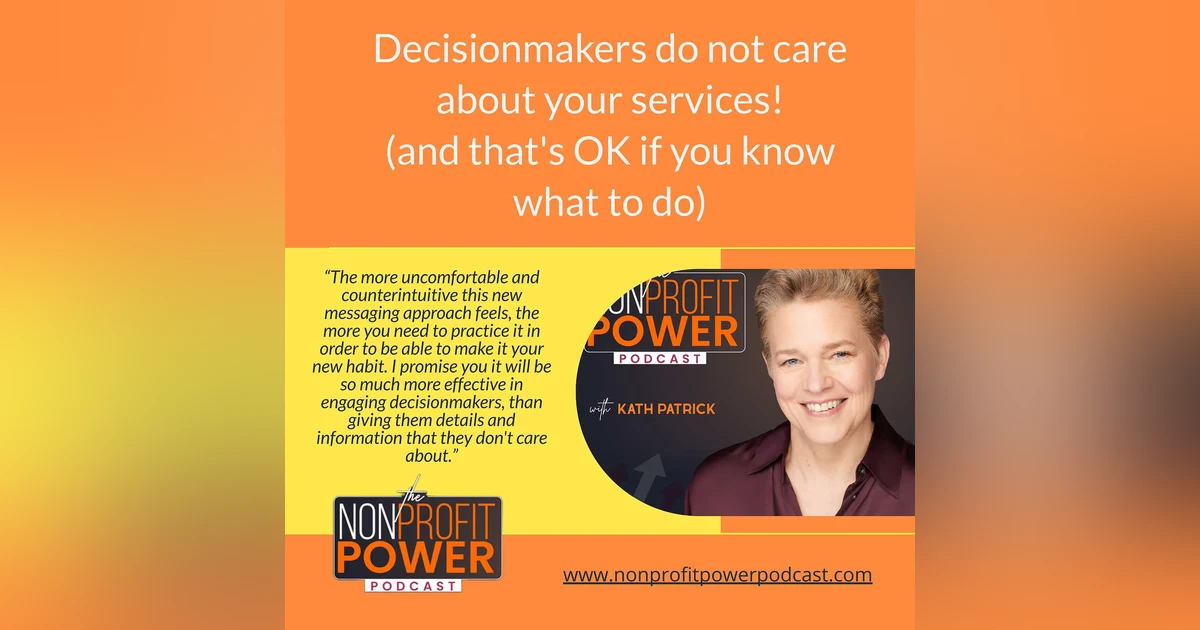
Decisionmakers Do Not Care About Your Services! (and That's OK if You Know What To Do)


 Apple Podcasts

 Spotify

 Pandora

 Amazon Music
Here’s an uncomfortable truth: Money and policy decisionmakers do not care about your services.
This uncomfortable truth is a source of frustration for so many Nonprofit leaders, and it doesn't have to be. But we have to understand it and learn how to work with it in order for it to be okay.
You’ve probably had this experience. You're talking to a decision maker and you get the feeling that they really don't care about your services. It's because they don't. But that doesn't mean they don't care about what you do. It just means that for them, the services themselves are the least important detail.
The secret to engaging messaging is understanding what the important details are, from their perspective. And to focus your messaging on that.
In this episode, we share:
- What decisionmakers really care about with respect to your work
- The biggest messaging mistake we tend to make, other than focusing on our services
- How to break the most problematic messaging habits we’ve all developed
- Two layers of messaging elements that will transform your messaging’s effectiveness
- How to distinguish yourself from the competition (particularly for-profit competitors) in terms that matter to decisionmakers
- How to train your brain to use the new messaging under pressure, without role play
Help spread the word! If you found value in this episode, I’d be grateful if you would leave a review on iTunes or wherever you listen. Your reviews help other nonprofit leaders find the podcast. Thanks!!
0:00 You're listening to the Nonprofit Power Podcast. In today's episode, we share an uncomfortable truth, which is that decision makers do not care about your services, and that's okay. We'll get into why in just a minute. So stay tuned. If you wanna have real and powerful influence over the money and policy decisions that impact your organization and the people you serve, then you're in the right place. I. I'm Kath Patrick, and I've helped dozens of progressive Nonprofit leaders take their organizations to new and higher levels of impact and success by building powerful influence with the decision makers that matter.
0:46 It is possible to get a critical mass of the money and policy decision makers in your world to be as invested in your success as you are, to have them seeking you out as an equal partner and to have them. Bringing opportunities and resources to you. This podcast will help you do just that. Welcome to the Nonprofit Power Podcast. Hey there folks. Welcome to another episode of the Nonprofit Power Podcast. I'm your host, Kath Patrick. I'm so glad you're here for today's episode because this uncomfortable truth is something that is a source of frustration for so many Nonprofit leaders, and it doesn't have to be.
1:30 But we have to understand it and learn how to work with it in order for it to be okay. So you know this feeling. You're talking to a decision maker and you get the feeling that they really don't care about your services. It's because they don't. But that doesn't mean they don't care about what you do. It just means that for them, the services themselves are the least important detail. What they care about is the outcomes you produce. How do you change people's lives for the better in a measurable way? How do you improve things for the community in a measurable way? Fundamentally, they wanna know what's the return on their investment.
2:12 That doesn't have to be just in cost savings or other dollar figure terms, although whenever you can show that, that's very valuable. It's also about the ripple effects of the change you create. They care about that. And this can be really hard for us as Nonprofit leaders because we are all in the details of the services. We know intimately how and why each component, each element, each aspect of the approach that we take in our services. Why every piece of that matters, and how each piece of that is part of the magic that produces the incredible outcomes that we produce.
2:54 We know that. We live and breathe it every day. The money and policy decision makers we're talking to, generally 99% of the time they don't live and breathe that. And it's not relevant to them. Think about it this way. If there's something wrong with your car and you take it to the mechanic, mostly what you wanna know is can they fix it? How much is it gonna cost and how long is it gonna take? You probably don't care about all of the little nuances of well, first I have to do this, and then I have to do this other thing and blah, blah, blah. Mostly, you wanna know what the problem is. You wanna know how they're gonna solve it, broadly speaking.
3:35 So your alternator's bad, you need a new one. Okay. But you don't really care or want to know each step they're gonna take to remove the old alternator, put the new one in, and then whatever other stuff they gotta do around that to make it all work. You just need the basics. So if you think about it from a decision maker's perspective, the equivalent of that is, if you do something with healthcare. It's useful to explain the basics of what you do with healthcare. You run a clinic that provides basic medical, and you recently added dental. Okay, cool. That makes sense. I get that.
4:15 I can envision what that is. I already have a frame of reference for those concepts. No problem. If you start getting into the details of your patient processes and how you do patient intake and triage and all that stuff. Until I'm far more bought into your work and its outcomes, as a decision maker, I don't care about that. That is not important to me. Occasionally you'll run into a decision maker who does have deep knowledge in your sphere, and for them you can go deeper. But unless you're talking to someone who's in that place, the vast majority of decision makers are not there. And for them, for the most part, all those details about your services don't concern them.
5:01 They don't need to know about the how. Think about it this way. If you had a magic pill that produced the exact same results as your services, wouldn't that be just as good? Maybe even better. Because it would produce an instant result. That'd be amazing. Now we know there's no magic pill. That most of the services that nonprofits provide, because we're working with people who have multiple challenges and are dealing with a lot. That to help them get from where they are to a place of thriving, is a process. And it takes usually quite a bit of time and care and intentionality to help them get there.
5:42 So, it'd be awesome if there was a magic pill, but there's not. The point is that if that existed, everyone would choose that. The client would choose that. You would choose that, and the decision maker would choose that. So it's not about the how. It's about the results. And how you get the results is less important than the fact that you get them. So nerd out all you want with other Nonprofit service providers about the details of what you do. That's what conferences are for. But when you're talking to a decision maker and what you want from them is either a monetary investment or a policy shift. Your messaging should be 100% focused on the impact their action will have.
6:29 Which ties directly back to your results. You want them to do something. Invest in your work. Change a policy to make it easier for you to do your work, or easier for your clients to access your services, whatever it is. You want them to do something. Tell them what the impact of that will be. And tell them what the impact will be if they don't take action. And when you're talking about impact, you're always talking about impact on the people you serve. Never about the impact on your organization. Again, they don't care. Your organization and the services you provide are a means to an end from the decision maker's perspective.
7:14 Now, you do want to be able to identify key factors that distinguish you from the competition, especially from for-profit competitors. But that doesn't mean getting into the weeds about the details of how you provide your services. Back it out to the conceptual and talk about how, for example, the way the for-profit is able to provide services at a lower cost is because they use a one size fits all approach. However, that cookie cutter approach produces the least valuable result, the least impactful result. Personalized, tailored service structures produce much higher value results.
7:57 They may cost a little more and take a little bit longer, but the value of the vastly improved result far outweighs the additional upfront cost. And the other thing to consider is the cost of failing to solve the problem or of solving it halfway. And often what is the case with the cookie cutter approaches that the for-profits are inclined to take. Because they make their money on efficiencies and scale. If they start doing what you do, they can't make money. The only way they get their margins is if they find ways to streamline and make super efficient in the sense of reducing cost. So they go with a one size fits all cookie cutter, and that means the problem doesn't get fully solved.
8:40 It's not that the person doesn't get some services, they just don't get the outcomes. So whatever space you're operating in, workforce development, housing, healthcare, nutrition, any of those things. The quick and dirty fix, not surprisingly, leaves limited impact. It's kind of the duct tape of the service delivery universe. We'll patch it up enough to get you on down the road. But we haven't really solved the core problem. When you don't fully solve the problem, it tends to recur. And every time the problem recurs it adds cost somewhere in the system. And that is another piece that we have to help the decision makers get, which is a topic for another episode.
9:24 We've already talked about that quite a bit in some other episodes. I wanna stay focused here on helping you stay super focused on not only not getting in the weeds about your services. But really, truly understanding that for 95% of decision makers, they really don't care about your services at all. They're just about the results. What's it gonna do? How's it gonna make an impact? So teach yourself to talk about that. To lead with impact. If they are blown away by the impact and are inspired to ask the question,"how are you able to do that?" You still don't want to go in the weeds.
10:08 You wanna say, well. Here's what's unique about our approach. Here's what we do that either no one else does, or very few other service providers do. This is our secret sauce. And then it's very high level. A lot of times it's the simple ingredients of, first of all, we are very much about meeting people where they are. We start with where they are, and that means getting to know all the aspects of where they are. And only then can we work with them to come up with a plan to move forward, to take them closer to a place of thriving. And then you frame that in the specific context of what you're doing, whether it's to achieve their best health or achieve safe and stable housing, or achieve a family sustaining wage.
10:59 Whatever your arena is, you have a general one phrase capture of what thriving looks like. What's the, if you got them all the way to thriving, what's that? And then you can say, depending on where people are starting the journey, the path can be pretty short or it can be pretty long. We are not deterred if they have a longer path in front of them. We are there for them because our goal is to get them to a place of thriving. It's not just to slap a little duct tape on'em and get'em out the door and say, you're done. That's not what we're about. We're about really helping people get to a place of thriving.
11:39 And depending on the scope of your services and what you actually do, if it's not your mission to get them all the way to thriving, but on a clear, stable, well-defined pathway to that, that's fine too. Don't overstate what you're gonna get done. But that that's what you do and that the way you do it is by treating each individual as an individual and working closely with them so that they are involved in crafting the solution. Cause that's a key. That's how we do this. And then you can say some version of, but that takes a little more time, that takes a little more effort. Which not surprisingly costs a little more.
12:22 But it's a hundred percent worth it even though the upfront investment is a little higher. The results are so much more impactful, so much bigger that that completely outweighs that difference in upfront cost. In a few cases, I have worked with a handful of service providers over the years who really did have a so unique, literally patentable solution that was highly proprietary. If that's you, then absolutely go ahead and say that, of course. But for a lot of us, that's not really it. It's really that the secret sauce ain't that complicated. And it's okay to say that to a decision maker.
13:04 Say, you know, it's not rocket science what we do. But we know, and we have data to back it up, that the difference in outcomes when you take that extra time and care to work with someone in a highly tailored way, individually creating their own pathway and involving them deeply in the planning of the solution. That's what leads to the big breakthrough outcomes. And if you do a one size fits all, trying to do it at volume and scale and speed for efficiency's sake. What you sacrifice in that process are the quality outcomes. They'll get services, but they may not get results. And that serves no one.
13:45 So that's how we achieve what we achieve. And happy to answer questions about the details of that, but that's essentially the difference. And for a lot of decision makers, that's enough. That's all they need to know. They're like, oh, okay, I get that. That totally makes sense. And you haven't said one thing about the client's experiences that come through the process, blah, blah, blah. Now there's one more thing that you can characterize in that process that I think is very valuable, is to talk about how that approach is far more empowering for the client. And that causes them to feel ownership in the solution. And when people feel ownership and are bought in, they are more committed and their follow through is higher.
14:26 So that's part of the ingredients of this. Again, you can explain that conceptually just like that without getting into the how you make that happen. If they ask, you're ready to go one layer deeper, but just one layer. When you approach it this way, you're accomplishing several things. One, you're feeding the decision maker only the information they need and no more. That in itself is a gift. And I will tell you it requires a lot of discipline because we want to talk. We want to tell'em all the things. Resist that impulse. Give them only what they need in that moment.
15:07 And then the other magical thing that that allows to happen is it lets them say, huh, that's really interesting. Tell me more. How exactly do you do that? What does that look like? If I'm the client, how do I experience that? Any of those kinds of questions tell you that that decision maker is now leaning in. They're now engaging their brain with your work, with your stuff, with what you're talking about. And an engaged decision maker is the goal. An engaged decision maker is 10 times more valuable than an informed decision maker.
15:48 You can inform them all you want. It's not gonna cause emotional investment. It's not gonna cause intellectual investment. And if you don't have those investments, you're never gonna get the dollar investment. Or the policy investment. Bottom line with all of this, less is more. But understanding, and like tattoo this on your forehead if you need to. They don't say it with me now. They don't care about our services. They care about the results. About the impact. About the change that happens and the effects that creates for the individual, for the family, and for the community.
16:28 That's what they care about. That's what we focus on. I had a great conversation with a client the other day who was sharing with me that she'd been working on this. And that interestingly, while she had internalized this, she was having trouble getting her communications person to internalize it. And this is the thing. We have to be alert to the habits we've developed. The things we were taught in other contexts, other frameworks about how you structure messaging, how you have a conversation with a decision maker. And we gotta relearn about 90% of that. Because what is absolutely unproductive is to lead with information they don't care about and to give them information they don't feel they need at that time.
17:20 If you successfully engage them and build a relationship, there will be time eventually to share many more layers of detail about your services, about the work, about your organization, all that. But that comes much, much later. You don't lead with it. Give this a try. Play around with it. For a lot of Nonprofit leaders, this represents a big shift, a mental shift, a shift in practice, a shift in habit. So what I don't want you to do is listen to this and go, yep, yep. Got it. Okay, cool. I'll do that next time. If you don't practice it, you probably won't do that next time.
18:02 You'll do what your default is. If this is already your default, awesome, great. You probably stopped listening after the first five minutes and got on with your day. But if this sparked some thought for you and had you thinking hmm. I wonder if I should try that. Or maybe, gosh, I do that sometimes, but not all the time. Here's the thing. With conversations with decision makers, there's a lot of things that can cause that interaction to sometimes be stressful. When we're under even a little bit of stress, what we do is we go to our defaults. It's not when we start trying new things. So we have to figure out how do we make this very simple shift, become habit.
18:44 The only way to do that is practice. So there's two things to practice here. One and I recommend just doing this for yourself, to create a set of notes on paper somewhere. Get written down the basic impact and outcomes that you want to emphasize with decision makers. And then you can segment those by type of decision maker, if that's appropriate, probably is. But just start with all the outcomes, all the results that you wanna make sure you highlight. Next, make a set of bullets that are the conceptual ingredients that cause you to get those results.
19:27 So that would be things like personalized, tailored, et cetera, and whatever else goes in there. It could be personalized, and then under that it might be personalized assessment, personalized plan. And then the next bullet might be individual counseling. The next bullet might be regular individual follow up. And then client involvement in creation of the plan. Those are ingredients that don't describe the how. It's the what. It's the what are the elements of your secret sauce. With the understanding that they might not be earth shatteringly different than what I just said. Or maybe you have a brilliant proprietary thing that is your secret sauce, in which case you lead with that, obviously.
20:12 We conducted research and came up with a patented process, whatever. If that's true for you, awesome. Lead with that. But just make those bullets. Once you have those bullets, then put together no more than three sentences that capture those bullets in a framework. When you've done that, what you've got are your first two layers of messaging for an encounter with a decision maker. You lead with the impact, the results that you get. And then you shut up for a second and wait for them to react. And if they don't have anything to say, then you say, well, you may be wondering how we're able to do that. Let me tell you. But chances are, they're actually gonna ask you how you do that.
20:54 Especially if you are able to say, and these results are exceptional. Most service providers in this space don't get these results. If that's true. Or that they are 30% better than everybody else's results. Whatever is true. If you can say truthfully that your results are better than some or most or all, then say that. Because otherwise, in their mind, they might think oh, well that's nice. You get these results. I guess everybody who's in your space also gets those results. We don't want'em thinking that. That's not helpful. We need them to understand how you are exceptional. So that's it. You lead with your results and some characterization of the way in which those results are exceptional.
21:40 And then the next layer is the conceptual'what' that you do. Not the detail of the services. Just conceptually, the'what' that you do that are the ingredients that cause those exceptional results. That's all you need. You don't need to say one more word, unless asked, about what your services entail. The more that feels uncomfortable and counterintuitive to you, the more important is that you get this down on paper and that you practice it. Because in a pinch, we will go to the familiar, we will go to habit. So if we want to be effective with this technique, we have to practice it.
22:24 The first part is getting it down on paper. The second part is practice and practice some more. You don't have to have an audience. Just practice this driving in your car. Get comfortable with the language. Figure out how you wanna frame this. Imagine conversations. Imagine a conversation you might be having with a decision maker. You don't have to get somebody else to role play with you for this. This is just work you do in your own head, at least initially. And play around with it, tinker with it. You'll make several attempts and go, mm, that, no, that's not what I wanna say. Uh, okay, lemme try that again. And you'll tinker and tinker until you get something that feels comfortable and like it hangs together really well and it's short and sweet.
23:07 And it keeps you in that first zone of here's the impact of what we do and why it's exceptional. And then the next layer is, here are the conceptual ingredients to those exceptional results. You wanna be capable of stopping there. And then waiting for questions. If you get questions about, well, you said, you have individual counseling. Well, counseling about what? What does that look like? With each of those kinds of things you wanna structure your response with why it's needed and what it does. How it contributes to the end result. So why it's needed. Often clients have stuff in the way, and then you can name a couple of the things that tend to be in the way for your clients.
23:52 If they could have gotten past those things on their own, they would have, but something's in the way. So what the counseling does is helps them identify that and work past it. Conceptually. You can say this however you want, but broadly speaking, that's the kind of level of explanation you're gonna give. And I would recommend having a simple example ready. So in workforce development. A really common issue in workforce development is that people generally aspire only to careers they know about personally. Their world of possibility is based on what they've seen their friends and neighbors and family do for a living. And so if you've grown up where everybody is in a low wage dead end job, in your mind, that's all that's possible.
24:39 Expanding awareness around that isn't just about saying, well, here's a list of 529 possible careers for you. They will reject that because their brain is telling them that's not possible. Maybe somebody has those jobs, but people like me don't get those jobs. So getting them past that and being able to see themselves in a career that has family sustaining wages attached to it. Often it takes quite a bit of work to get people to be able to see that. And so that's part of what we do with the individual counseling. Down the street at the for-profit, all they're gonna do is spit out that list of 529 possible careers. And the client looks at that and goes, well yeah, but you know, that's not for me.
25:22 And they say, no, what I wanna do is do what my sister does or my cousin does or whatever. 'Cause that's what they know. And that's the end of it. And even that was a little too long. Because I just fell victim to what all of us fall victim to, which is I love my subject. I want to talk about it. I worked in that universe for a lot of years and I'm passionate about what works and how you help. So we have to be careful not to go too far in the weeds. So driving around that might've been my first cut. And then I would catch myself and say, that's too long. That's too detailed. Shorten that up. Just say, so for humans, one of the things we do is that our notion of what's possible tends to be defined by what we've already experienced personally.
26:12 Or what we've seen our friends, family and neighbors experience. And that's kind of it. So if you present somebody with something that's far outside that, their brain will reject it because it doesn't feel possible. A practical example of that is if all of your relatives and friends are in low wage jobs or careers that have no prospect of a living wage at the end, then that's what you see for yourself. And if we wanna help people actually get to a family sustaining wage, one of the things we have to help them crack open is that sense of possibility. And that's where counseling comes in. That would be good and concise.
26:53 That would make sense to somebody. And they could say, oh, right. And then they might say, well, how is that different from what the folks down the street do? Well, what the folks down the street do is, the person answers a bunch of questions on a computer, and then the computer spits back out a list of possible careers, 99% of which they're gonna reject in their mind because it's not familiar. It's not something you just say, oh, well of course you can do that. That's not sufficient. We have learned that what you have to do is help them work through their ability to envision themselves in something that's different than what they already know. And there's a process for that. And that's what we lead them on. All you gotta say.
27:34 So work with this'cause it's gonna take practice, it's gonna take tinkering. Like I said, the more uncomfortable and counterintuitive this feels, that's a sign the more you need to practice it in order to be able to make it your new habit. Which I promise you will be so much more effective in engaging decision makers than giving them details and information that they don't care about. And have fun experimenting with this. Play in the sandbox and follow the steps that I gave you. It'll make a world of difference. Thanks for listening, and I'll see you in the next episode right here on the Nonprofit Power Podcast.