
What it Really Means When You Fall Short of Expectations


 Apple Podcasts

 Spotify

 Pandora

 Amazon Music
One of the biggest challenges that we deal with is what happens when we inevitably fall short of expectations. The reality is it's going to happen. It happens to everybody now and again.
It could be expectations set by others for us, or expectations we set for ourselves. Either way, when we fall short of those expectations, that tends to carry a lot of emotional weight. And it's that emotional weight, and the stuff that unfolds from that, that can cause a whole lot of problems for all of us, and for Nonprofit leaders in particular.
It’s usually a combination of external factors and some internal factors that cause us to fall short of an expectation, regardless of whom it was set by. But instead of simply assessing the causes, fixing the problem, and moving on, we often get caught up in judgment about it all. And we beat ourselves up and get tangled up in what all of it means about us.
I bet I don't have to tell you, that only makes the problem worse.
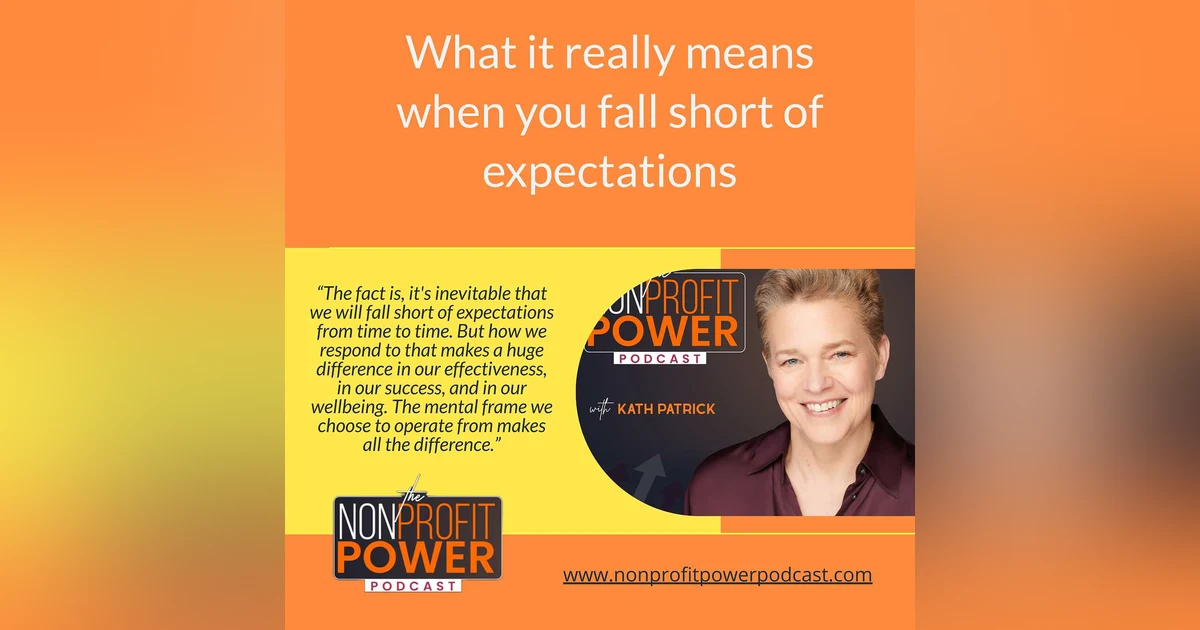
It's inevitable that we will fall short of expectations from time to time. But how we respond to that makes a huge difference in our effectiveness, in our success, and I would argue in our wellbeing.
In this episode, we share:
- How fear of judgement actually makes it harder to fix things when we fall short of expectations
- The essential mental frame that will keep you out of self-judgement and self-recrimination
- What to do first if you find yourself unable to meet an expectation
- Four keys to defanging the experience of falling short
- How to set teams up for success even when one or more members fall short
- The superpower good leaders use to avoid the traps that cause most shortfalls
Help spread the word! If you found value in this episode, I’d be grateful if you would leave a review on iTunes or wherever you listen. Your reviews help other nonprofit leaders find the podcast. Thanks!!
0:00 You're listening to the Nonprofit Power Podcast. In today's episode, we share what it really means when you fall short of expectations. So stay tuned. If you wanna have real and powerful influence over the money and policy decisions that impact your organization and the people you serve, then you're in the right place. I'm Kath Patrick, and I've helped dozens of progressive Nonprofit leaders take their organizations to new and higher levels of impact and success by building powerful influence with the decision makers that matter.
0:40 It is possible to get a critical mass of the money and policy decision makers in your world to be as invested in your success as you are, to have them seeking you out as an equal partner and to have them. Bringing opportunities and resources to you. This podcast will help you do just that. Welcome to the Nonprofit Power Podcast. Hey there folks. Welcome to the Nonprofit Power Podcast. I'm your host, Kath Patrick. I'm so glad you're here for today's episode because one of the biggest challenges that we deal with is what happens when we inevitably fall short of expectations.
1:24 The reality is it's gonna happen. Happens to everybody now and again. And that shows up in a couple different ways. It could be expectations set by others for us, or expectations we set for ourselves. Either way, when we fall short of those expectations, that tends to carry a lot of emotional weight. And it's that emotional weight and the stuff that unfolds from that, that can cause a whole lot of problems for all of us, and for Nonprofit leaders in particular. Now, most of the time it's a combination of external factors and some internal factors that cause you to fall short of an expectation, regardless of whom it was set by.
2:13 But instead of simply assessing the causes, fixing the problem, and moving on, we often get caught up in judgment about it all. And we beat ourselves up and get tangled up in what all of it means about us If we did or didn't do X, Y, Z. And I don't have to tell you, that only makes the problem worse. The fact is, it's inevitable that we will fall short of expectations from time to time. But how we respond to that, makes a huge difference in our effectiveness, in our success, and I would argue in our wellbeing. Whenever we fall short, we tend to feel bad about it.
2:54 And up to a point that's okay. And even a good thing in some ways because it means we care about our own integrity and honoring our commitments to ourselves and to others. Those are good things. Those are values based things that we wanna have in our life. We want to be anchored by those kinds of values and we wanna honor them. But then it can be a little bit of a slippery slope. When we fall short of expectations that have been set for us by others, we might feel guilty, we might feel upset that we disappointed someone who placed their faith in us. We might be mad at ourselves for not showing up the way we wanted to.
3:35 When we fall short of expectations we set for ourselves, maybe we fall short of a goal. We fall short of how we want to be and operate in the world or in a relationship. We might feel disappointed or sad or frustrated with ourselves. The trouble is it's a short trip from there to making it mean something about us. Right? I bet you know what I'm talking about. So maybe we feel disappointed in ourselves that we didn't follow through on something we committed to doing. We made that commitment to ourself. And we didn't completely fulfill on that.
4:16 Okay. So we're a little frustrated, we're a little disappointed that we didn't follow through on that. And that's okay. Nothing wrong with that. But then where that tends to go is folks saying things to themselves like, oh man, I never follow through on anything. What's the matter with me? Why don't I ever do what I say I'm gonna do? Why don't I fill in the blank. And that my friends is judgment. It's making it mean something about us. And that's where all kinds of trouble happens. Same thing happens when we fall short of an expectation that someone else has set for us. Maybe it's a boss, in which case there's a bunch of other stuff tangled up in that.
4:59 But maybe it's in a collegial relationship. Maybe it's in a friendship, maybe it's in some other relationship. But so much of what we do, so many expectations, you know, by definition, if an expectation has been set by someone else, for us, we are in some kind of a relationship with that person. So there's the impact of whatever it was we committed to that didn't fulfill on the expectation. There's the actual consequence of that thing not being fulfilled, whatever that is. Maybe a deadline was missed. Maybe a project or a piece of work was not at the level of excellence that was expected. It could be any number of things.
5:39 It doesn't really matter actually. It's that the expectation was X and our fulfillment on that was X minus something. Maybe it was minus a little, maybe it was minus a lot. So there's the aspect of being in that relationship and what it means in the relationship. And we get all into the judgment around that. And then we start to worry about well, what does that other person think it means about me? Now do they think less of me? Do they think I don't have follow through? Do they think I am a poor performer? They think whatever, whatever, whatever. All these things that again, that we're making it mean about us. I hope that distinction is clear, but I wanna call it out'cause it's really important.
6:23 There is what we do and there's who we are. And what we do is not who we are. The work we do is not who we are. The performance we achieve on any given day is not who we are. It does not define us. And it certainly does not define our worth or our value in the world. But when we get into our feelings about feeling disappointed or frustrated or unhappy, about having fallen short of an expectation. And we start making it mean things about us. Well, I'm this or I'm that.
7:04 I keep missing deadlines. That means I'm unreliable. I'm no good. I'm not worthy of this opportunity, this promotion, this leadership role. And when we get mired in the meaning, we wind up if not paralyzed, at least in a state of diminished effectiveness. Because if we're busy judging all over ourselves and getting into, well, I should have this, I should have that, I should be better, I should, blah, blah, blah, blah, blah, blah. And this means I'm not this, or I'm not that, or I am this or I am that that's not a good thing. All the meaning we start piling on, and all the judgment we start piling on.
7:46 And sometimes we're busy piling on the judgment to get ahead of the person we're afraid is gonna judge us. That happens too. All that meaning and all that judgment is not doing us any favors. And it's actually doing us a fair bit of harm. I want to tell you an important secret, which is that all of that stuff, whatever you did, whatever you didn't do, it doesn't mean anything about you. It doesn't mean anything about you. So much of the time, a big part of the reason that we have low expectations for ourselves is that we're terrified of the judgment we'll feel if we fall short of a bigger expectation.
8:31 And you can see what an incredibly vicious cycle that can create. If I'm worried about falling short and getting judged for that, am I gonna set a big expectation for myself or am I gonna scale it way back? And keep it down to something I'm sure I can hit without any trouble. And we just talked about this in the last episode, in episode 1 37 about the importance and the power of setting expectations that serve us. And that your subconscious will work over time to try to tell you all the 529 reasons why you should set low expectations for yourself. To keep you safe and to keep you playing small and in the familiar sandbox.
9:16 Then we pile on fear of judgment and making it mean all these terrible things about us if we screw up or if we even just fall short. That just feeds the beast that wants to keep the expectations low and keep us playing small. So it becomes really important that we recognize that all that judgment comes from assigning meaning to the fact that you fell short of your own or someone else's expectations of you. That's all it is. And if you don't attach meaning to it. That is an option. If you just choose not to attach any meaning to it and simply treat it as a thing that happened, that now requires a response.
10:06 When you do that, the judgment goes away. If you don't make it mean a bunch of stuff about you, then there's no judgment to be made. There's simply a fact of you did or didn't do a thing you said you would or said you wouldn't, or whatever the situation is. But when the judgment's gone. It's a lot easier to get into productive and effective action to address whatever that shortfall was. Cause the vast majority of the time it's gonna be fixable. And even if it's not, even if maybe you royally screwed up. Maybe you fell wildly short, you made commitments and didn't honor them, whatever happened. That may not be completely undoable, but what you absolutely can do is fix as much of it as possible.
10:55 And the other thing that you absolutely can and must do is repair the damage done to relationships in the process. If these were expectations set by others and they were counting on you, then there's relationship repair work to be done. But again, how much easier is that to do if you're coming from a place of being willing to apologize for the impact that had on the other person, for sure. But not letting a bunch of judgment and meaning get in your way. And just say, look, I'm really sorry about X. I'm sorry that happened. Or I'm Sorry I did or didn't do the thing, whatever it was, I recognize that had an impact on you and I regret that and I'd like to make it right.
11:43 And then you go from there. But what you've probably noticed is that if we're all tangled up in judgment and meaning, it becomes much harder to go to another person and be forthright about whatever happened. If you owe them an apology, apologize. And then to say, how can I make this right? It's way easier to do that if you're not also in the middle of telling yourself all the terrible things that means about you, and therefore all the terrible things that person's probably thinking about you. All the judgment, all the meaning.
12:23 So we know that adding the judgment and the meaning make life harder, reduce effectiveness. And we know that letting it take us over tends to lead to ineffective action and even paralysis sometimes. We get so busy beating ourselves up that we just sort of stop doing anything. There is a fairly simple, though not easy, answer to what to do about it. Now, a couple of these qualify as prevention, and a couple of these qualify as good practice in the moment. But fundamentally, there are four major things that we can do to defang the situation of falling short of expectations.
13:06 The first two are about taking care with how expectations are set. Clearly, when we're setting expectations for ourselves, we wanna make sure that those are expectations that serve us. And we went into that in quite a bit of depth in the last episode. But very briefly, you wanna be focused on ensuring that you set expectations that align with the results you wanna see. And ground those expectations in your vision for the impact you want to create in the world and for how you wanna operate in the world. And part of that is being clear about your values and honoring those in that process.
13:47 And a little caveat to this. Setting lower expectations is not the answer. That's not what we wanna do. The goal here is not oh, well, I'll play it safe. I'll set super low expectations that I know I can meet with my hands tied behind my back, and then I'll never have to worry about falling short. That doesn't help anybody. That does not make you an A player. That does not make you ready to lead an A team. Particularly those of us in leadership roles, we wanna be operating from vision at all times. And that's a key to how we set expectations that serve us, is setting them from the compelling vision that's calling us forward.
14:30 Connected to that is being mindful about not letting others set expectations for you that don't serve you. Now, I understand that if you have a boss. And that boss is setting expectations for you. That you don't have complete control over how that goes. But even in that setting, you do have the ability to negotiate. And you should, at a minimum, make sure that you're not agreeing to expectations that you know that you absolutely cannot meet. Because perhaps your plate is already entirely too full and that if they pile one more thing on top of it, something else will have to be taken off of that plate.
15:17 You do have to negotiate in those settings to make sure that no one is setting expectations for you that are simply not attainable for reasons of bandwidth or other. Maybe they're attainable, but not on that timeline. Maybe they're attainable if you have a team of a couple of other people to work with. There are very few expectations that are likely to be set that are truly unattainable given the right mix of factors. Given the right team, given the right timetable, given the right resources. But if you're being asked to do something without the resources, without the team, and without the time, then those are aspects you'll need to negotiate to make sure that you're not agreeing to expectations that you know upfront you cannot meet because of external factors.
16:08 Similarly, if an expectation is being set for you, that calls for a skill set that you don't have and that you don't think you can probably either skill up real quick or get close enough to accomplish the thing. Then again, it's on you to raise that and say, I love the idea of being involved in that. But my understanding is that would call for X, Y, and Z skills and I've only got X. I don't have Y and Z. Is that gonna be okay? Or should we think about my teaming with somebody who can compliment my skills and we can do this together, whatever.
16:52 Always come to it as a problem solving partner. But don't allow someone to set expectations for you that simply will not serve you in those senses. And you might think that's obvious. But I have seen time and again where that just happens. Where people agree to stuff, and then go away and go, oh my God, I have no idea how I'm going to be able to fulfill on this. And then they're a stress ball the entire time. So be clear always about how you can bring your A game and have the best benefit come out of whatever you're committing to, whatever expectations you're setting, and others are setting with you and for you.
17:37 That it's within the realm of the possible. And then assuming you've done that and now those expectations are out there. You've made those commitments. You're in the process of fulfilling on them. It's going to happen from time to time that you are not gonna be able to meet some piece of that commitment, some piece of that expectation. It happens for a million reasons, it's just part of life. Maybe there's a family emergency that you have to go tend to. Maybe there's an unforeseen complication that happens on a project that no one saw coming and is now suddenly going to make this be a lot more work or take longer or whatever else.
18:21 Maybe this is multiple organizations on a project where somebody else is not meeting their part and that's gonna cause a problem. There's all kinds of external factors or sometimes internal factors. Maybe you're just overcommitted. You miscalculated how much time a number of different things we're going to take, and it's getting to be crunch time and you're realizing I'm over committed. I can't do all of this. At least not by the deadlines that I agreed to. Whenever you know that you're going to miss on some piece of an expectation, the first thing is to own up to that, immediately. Own up to it to yourself, and own up to it to everybody involved.
19:05 To your teammates, to your boss, to whoever is part of this with you. Because if you're part of a project that involves a team, you have expectations of one another about how you're gonna operate as a team and how you're gonna show up for each other and you're each gonna carry your load and get this over the finish line together. That's part of the deal. But it's also part of life's reality that it will sometimes happen that you're gonna miss. As soon as you know that, raise your hand and say so clearly. And make a plan to address it. If you need help, ask for help. If you need a deadline shift, ask for a deadline shift. If you need to offload something on somebody else, ask if you can do that.
19:49 There's a million different ways that you can do this. But what happens again and again. And I see this in teams in particular where people know that others are counting on them and they don't wanna let'em down. They wanna come through for their teammates. And we convince ourselves that I'm gonna find time. I'll figure out a way. I don't know how, but I'll find a way to get this done by the deadline. And then the deadline is here and it's still not done, and nobody got a heads up. And now that creates a crisis for everybody else. When if you'd raised your hand early, as soon as you saw there probably was gonna be a problem here.
20:31 Raised your hand and said, Hey, I need a hand. I need to shift this. I need to change the deadline, whatever. And work with your team on that. Then everybody can accommodate that and keep the whole thing moving. This is the part that's also really important to understand. First of all, nobody winds up with a crisis dumped in their lap. But the other thing that happens is, when you do that, that's not falling short of an expectation, that's fulfilling on an expectation. Cause one of the expectations is teammates have each other's back. That we are working on this together, and we are gonna shift the load as needed from time to time. That's part of how we roll as a high functioning team.
21:11 So think about that, too. That when you raise your hand early and ask for whatever shifts you need in order to fulfill on the overall commitment to doing excellent work on a particular project or whatever that larger piece is, that larger vision. The fact that you're gonna miss a deadline is not a big deal if you flag it early enough for it to be addressed without creating problems for other people. This is so fundamental that when I work with teams, a lot of the one-to-one work I do with organizations is clients will hire me to come in and support a leadership team as they take on something new and challenging that is unfamiliar.
21:54 And the first thing I do, once we've gotten clear about who's gonna be on the team and what we're basically working on. I always have the conversation about how are we going to operate as a team, and what are our commitments to one another? At the top of the list is always this. That first of all, we created this plan together with assignments and deadlines that we all agree are the right ones. And for everything we've got our name next to and every deadline we've agreed to, we agreed to it because we believe we can meet it. So we're committing to that. But we're also making our commitment to one another that if anything comes up that is gonna change that, that means that I can't fulfill on that commitment, or I can't fulfill on it in the timeframe that I committed to.
22:45 The minute I know that I'm gonna raise my hand and ask for help. I will not sit on it. I will not wait and hope for the best. Hope i'll find a way. I won't sit in a corner beating myself up and telling myself it means all these terrible things about me that I'm gonna miss a deadline, I'm gonna let my teammates down, da da da, da da. That's all in the future. It doesn't have to be. If we just raise our hand and do the slightly uncomfortable thing of saying, Hey, I've got a situation. I'm not gonna be able to make this. And I could use some help with this. Then have a proposal for what would be the most useful way to work around it. Or say, I'm not sure. I have a couple ideas. I'd like to talk to the team. But that is like rule number one.
23:27 Whenever I'm working with a new team, that's the first thing we nail down. Because it is so common. It's just human behavior. When we think we're going to fall short, we really struggle to admit that. And we don't wanna admit it. So we convince ourselves that we're gonna find a way not to fall short. And then inevitably we do, and then everybody's unhappy because we didn't give them any warning. You can change a lot simply by raising your hand early. And a very helpful way to do this is to just stay in the mental frame, train yourself to operate in the mental frame of this is simply a problem to be solved.
24:12 Find the lessons in it, if there are any. Maybe you overcommitted, maybe you did a poor job of estimating the amount of time it would take. If that's the case, then there's a lesson there for you. There's lessons all over the place all the time that we have an opportunity to learn, if only we will take them. So find the lessons and then shift your plan to something that's gonna be more workable. Maybe you shift the timeline, maybe you call in extra expertise. Maybe you get help from a teammate. But that's your mental frame. It's a problem to be solved. Not that this means something about you.
24:53 'Cause it doesn't. Doesn't mean anything about you. It just means you have a problem to solve. And it is so much easier and so much faster to solve a problem if you don't have all that noise in your head about all the meaning, all the judgment, all the stuff. And then that brings me to the last thing, which is when you do miss, cause that'll happen too. When you do miss completely, remind yourself that it still doesn't mean anything about you. Make a plan to fix whatever needs fixing after the fact. And like I said, you may need to repair some relationships when that happens.
25:34 Our goal is to have this happen as little as possible. That we rely heavily on the first strategy, which is raising your hand as soon as there's a problem. And here for sure, be sure to debrief to find the lessons. And share those lessons if that is relevant. They may just be lessons for you. You may discover some patterns. If you do this long enough, you'll start to discover patterns. That when certain kinds of things are going on or certain circumstances are occurring, maybe it's you've got too many projects or you've got too much going on at home, or you're not getting enough sleep, whatever it is. That when certain circumstances are present, you are more likely to drop a ball here and there.
26:21 You are less able to keep all of your complex commitments organized and stay on top of all of them. And making sure that you're communicating with everyone that needs to be communicated with as early as possible, et cetera, et cetera. If you notice patterns of when that gets disrupted, when you are more vulnerable to not doing that, that's a huge lesson. Because once we know that, one more time. What does it mean about us? Does it mean that we're a hopeless scatterbrain? Does it mean that we're unreliable? Does it mean that we're not worthy of this big responsibility, blah, blah, blah, blah, blah. No, it doesn't mean any of that. It means that you have, shocking as a human, you have some weak spots.
27:07 Just like all of us. So one of our most powerful lessons, a superpower in fact, of a good leader. Is to know where your weak spots are. To know where your vulnerabilities are, where you tend to slip up, where you tend to be less able to be completely on top of everything. We've all got'em. If you know what they are. If you've found them, you've taken the lessons, you've studied on your own patterns and are able to say, oh yeah, yep. I know as soon as I'm getting less than six hours of sleep a night, I start losing track of stuff. Or I know that if I'm out of town on business for more than three days, I start having trouble managing both the work I'm doing out of town and the stuff that I'm supposed to be keeping track of back at the office.
27:59 Whatever your thing is. We've all got stuff. Know your patterns, learn the lessons from them. So that you can create strategies to work with that. And think of all the time you'll save if you just go right to that. If you just go right to studying the patterns and learning the lessons and applying them, versus taking X amount of time out to go sit off in a corner and judge the crap outta yourself. Or worry about how many other people are judging the crap out of you. And here's the other secret I will share with you as we wrap this up, is that most of the time when we are busy worrying about the judgment of others, particularly in a setting where we have fallen short in some way.
28:46 What's really going on 99% of the time is that we are judging ourselves. And we are afraid that others will judge us as harshly as we are judging ourselves. I gotta tell you, for most people, there's no harsher critic than one's self. And there might be some judgy people out there thinking judgy thoughts. Let'em. Whatever. They're not your problem. But I promise you that whatever they're thinking, it's not near as harsh a judgment as the one you're piling on yourself. So do yourself a huge favor and just say, you know what? This does not mean anything about me.
29:31 I fell short. There are lessons for me in that. Let me find what they are. Let me learn them and go forward. And then move into productive action with my sense of wellbeing and my sense of identity intact. What could be better than that? I know. It's simple, but it's not easy. But like so many of the other aspects of the internal game, it's a practice. And the more attention, and intention, we devote to that practice, the better we'll be at it and the better off we'll be. And the more we will like our life on the day to day. Thanks for listening, and I'll see you in the next episode right here on the Nonprofit Power Podcast.