
Powerful Lessons from Minnesota on How We Can Help Our Immigrant Neighbors
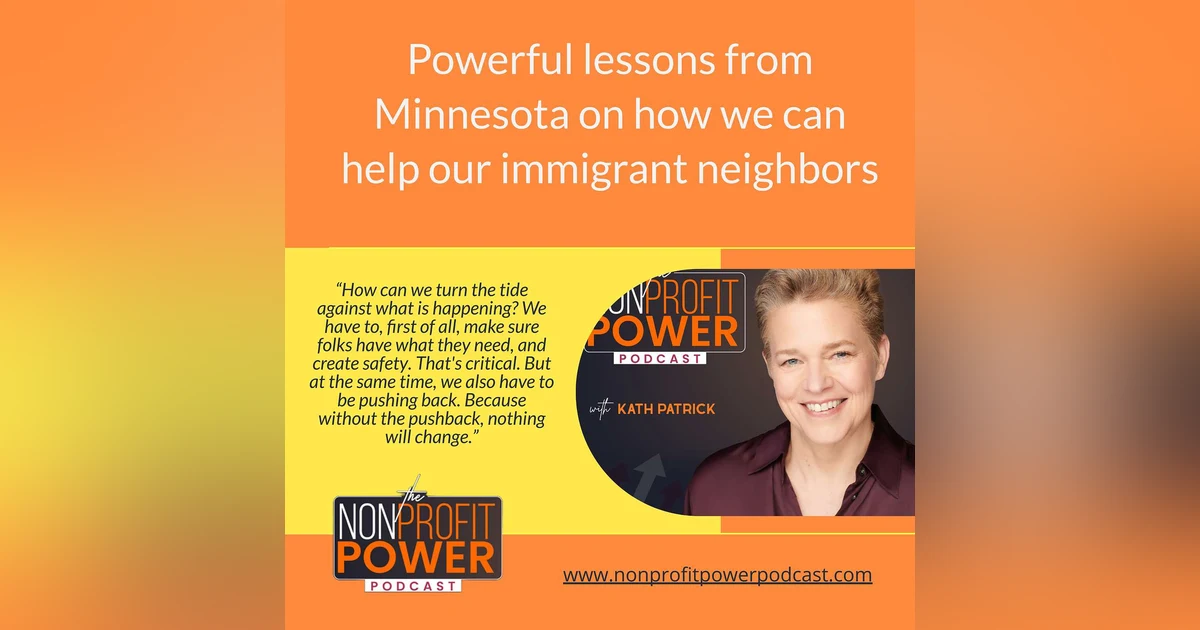

We're all witnessing some truly devastating and distressing actions against our immigrant neighbors. We may be watching this from afar, or we may be seeing it up close and personal. There are almost two reactions that happen at the same time. One is we are tempted to recoil in horror and push it away. And the other is to step forward and help. What is awesome about Nonprofit leaders is that generally we're wired to step in and help. It's what we do. But it would be e...

 Apple Podcasts

 Spotify

 Pandora

 Amazon Music
We're all witnessing some truly devastating and distressing actions against our immigrant neighbors. We may be watching this from afar, or we may be seeing it up close and personal.
There are almost two reactions that happen at the same time. One is we are tempted to recoil in horror and push it away. And the other is to step forward and help.
What is awesome about Nonprofit leaders is that generally we're wired to step in and help. It's what we do. But it would be easy to look at this particular situation and feel fairly powerless.
That's the conversation I want to have – about the fact that in spite of the horrific events that have been occurring in Minnesota, there are some powerful lessons that are coming out of the work being done there. By community members and by community organizations that are banding together and creating a powerful force of resistance against lawless action and in support for the immigrant community.
It's that combination of both resistance against what is wrong, and simultaneously stepping up to support those who are being targeted and harmed, that is the critical recipe for how we all can be thinking about how to respond.
In this episode, we share:
- Three questions to guide you in supporting clients who are members of immigrant communities
- How to help staff and volunteers who are members of immigrant communities
- The two-prong strategy that is working in Minnesota
- The powerful role that 34,000 Minnesotans have signed up to play in protecting immigrants and pushing back on lawless actions by the federal government
- Two downloadable tools that you can start using today to support and protect your immigrant neighbors
Help spread the word! If you found value in this episode, I’d be grateful if you would leave a review on iTunes or wherever you listen. Your reviews help other nonprofit leaders find the podcast. Thanks!!
0:00 You're listening to the Nonprofit Power Podcast. In today's episode, we share powerful lessons from Minnesota on how we can help our immigrant neighbors. So, stay tuned. If you wanna have real and powerful influence over the money and policy decisions that impact your organization and the people you serve, then you're in the right place. I'm Kath Patrick, and I've helped dozens of progressive Nonprofit leaders take their organizations to new and higher levels of impact and success by building powerful influence with the decision makers that matter.
0:40 It is possible to get a critical mass of the money and policy decision makers in your world to be as invested in your success as you are, to have them seeking you out as an equal partner and to have them. Bringing opportunities and resources to you. This podcast will help you do just that. Welcome to the Nonprofit Power Podcast. Hey there folks. Welcome to the Nonprofit Power Podcast. I'm your host, Kath Patrick. I'm so glad you're here for today's episode because we're all witnessing some truly devastating and distressing actions against our immigrant neighbors.
1:22 We may be watching this from afar, or we may be seeing it up close and personal. And there are almost two reactions that happen at the same time. One is, we are tempted to recoil in horror and push it away. And the other is to step forward and help. And what is awesome about Nonprofit leaders is that generally we're wired to step in and help. It's what we do. But it would be easy to look at this particular situation and feel fairly powerless. So that's the conversation I want to have today about the fact that in spite of the horrific events that have been occurring in Minnesota, there are some powerful lessons that are coming out of the work being done there by community members and by community organizations that are banding together and creating a powerful force of resistance against lawless action and in support for the immigrant community.
2:22 It's that combination of both resistance against what is wrong, and simultaneously stepping up to support those who are being targeted and harmed, that is the critical recipe for how we all can be thinking about how to respond. Minneapolis has been going through a terrible time with a massive ice surge and widespread lawless actions, including the killing of two peaceful protestors. Folks there could be forgiven for reacting with rage. But instead they are reacting strategically with determination and self restraint to turn the situation around.
3:04 They're protesting, but they're doing a whole lot more. And they're making a powerful difference. Public opinion is overwhelmingly against what ICE is doing there. And part of the reason for that is that organizers on the ground and thousands of community members who are helping to support the work are making sure that everybody knows what's really going on. As a result, public opinion is turning against ice. The administration is backtracking, and even Congress is waking up and attempting to take significant action to rein in the lawless behavior of ice. The work of organizers and thousands of everyday community members is proof of what's possible through determined and focused collective action, and that is incredibly exciting.
3:53 The truth is that when innocent neighbors are threatened and harmed, people will come out of the woodwork to take action, and they will bring incredible energy in the process. And one of the things that's so inspiring to me is that it's nonprofits who are leading this. And the reality is that some organization, some entity has to be prepared to direct all that energy and give folks something constructive they can do that will actually make a difference. Nonprofit leaders in Minnesota are stepping in and making that happen. They are filling that role. Now as a leader of a direct service Nonprofit, your role is different.
4:36 There might be exceptions, but for most direct service Nonprofit leaders who serve a broader community, and a portion of your clients are members of the immigrant community, your focus is on providing whatever the services are that you specialize in. So it's not likely that you're gonna be the one who takes the lead. But one of the most powerful things you can do is connect with whatever the most effective network or coalition in your community or state is that's working on this, and get involved with that. We can start by figuring out two things. The first order of business is how do we take care of our own?
5:16 And then we figure out how we help people beyond our doors. Let's take a look at taking care of our own first. Because we have to make sure we're fulfilling on our core mission. So the first question to ask is, what do our clients need? The vast majority of nonprofits are serving members of one or more immigrant communities in their area already. And so the question becomes, with respect to those community members, what do our clients need? What are their most pressing concerns? And how is lawlessness or any activity by ICE affecting their ability to live their lives and perhaps to access your services?
5:57 Once you've clarified that, then the question becomes, how can you adapt your services to make sure that those who are feeling the need to shelter in place during ICE presence can still be served? There are tons of examples of what folks have done in different places. They've had volunteers drive food and supplies to people's homes so they don't have to leave their house. They've volunteered to run errands and pick kids up from school and drop them off, et cetera. All the daily living activities that might cause an immigrant to have to leave their house to take care of basic necessities. Volunteers are filling in to do that for them so they don't have to expose themselves. That is clearly a direct service component of how folks are helping.
6:40 And so what's the version of that that makes sense in the context of the work that you do? And then crucially, what do your staff and volunteers need? Because for a lot of us, our staff and volunteers are also members of immigrant communities, and they're concerned, they're feeling pressure. They may be deeply personally affected by what's happening. So they're in a double bind. How can you adapt to create safety for them and their families? That's a really important conversation to have. Even if right now you're not experiencing a lot of ice activity in your community, the odds that you will at some point experience that are pretty high.
7:22 So now is the time to have those conversations. Once you've got that sorted, then you can have the conversation about how can we help beyond our doors? So again, there's a direct service component to that, that could involve expanding your services, coordinating with other nonprofits to add some support that helps make things easier for folks and so on. But there's also the question of beyond support, how can we push back? How can we turn the tide against what is happening? We have to do both. We have to, first of all, make sure folks have what they need, protect and create safety. That's critical.
8:03 But at the same time, we also have to be pushing back. Because without the pushback, nothing will change. There are two really powerful tools that are being used very effectively in Minnesota and other places. Of course everybody's aware of the mass demonstrations calling for change, all the ice out actions and demonstrations. Those are very important and create a lot of visibility, and create an easy opportunity for a lot of folks to be involved. In addition to that, one of the most powerful things that has been tremendously effective in Minnesota, is the idea of the constitutional observer. And i'll say a little bit more about that in a second. First I wanna take a moment to call out the less visible ingredients of success in Minnesota.
8:48 First of all, there is an organization that has taken responsibility for coordination. So you definitely wanna find that in your community, figure out who that is. That organization in Minnesota has a clearly defined strategy that's got two major prongs, which they call Defend and Drive. The Defend part has three components, which is to be a resource hub, a policy watchdog, and an engine for rapid response. And that rapid response strategy includes a bunch of things. They maintain a helpline infrastructure, they deploy observers and they organize public demonstrations.
9:30 And within each of those, there are a whole bunch of details that make those systems run. The drive piece has two major components of its own. One is to shape the public narrative and conversation about immigrants and move public opinion. And the second is to mobilize a diverse network towards transforming systems. Long term advocacy. That coordinating body in Minnesota is the Immigrant Defense Network, which is a project of the COPAL Education Fund. The Immigrant Defense Network is training thousands of constitutional observers. It's hard to even imagine just how vast this operation is. In just the last few weeks, more than 34,000 Minnesotans have signed up to be trained.
10:16 Just think about that. And a lot of those have come in the most recent weeks following the killings of Renee Good and Alex Pretti. When you've got 34,000 people signing up to be trained, and hundreds more every week, you need a system, right? So one of the things they've done is they've created an excellent handbook for constitutional observers, which they have very graciously made available for free download online, and I will link that up in the show notes for you. They want other people to pick this up. They created it for sharing. The notion behind the constitutional observer is the concept of civil initiative as opposed to civil disobedience.
10:57 Civil initiative is not about intentionally breaking the law. Instead, it's demanding that we draw a line in the sand and prevent further erosion of our rights under the Constitution. The role of constitutional observers is basically three things. The biggest one is to observe and document. And this is all the folks out there with their whistles and their phones, right? They're holding up their phones, taking the video, and they're blowing the whistles to let people know that ice is in the area and making lots and lots of noise to call attention. And I'll say more about why that's so effective in a minute. As an observer the idea is to keep a safe distance.
11:41 You're not up in the faces of the ICE agents. You're avoiding any physical contact. And you're focused on recording events with photos and videos. There's also a role to ask questions to ICE and to the surrounding witnesses about what's happening. To share basic legal information out loud, and they give you a tool to do that. They give you a red card that is basically your rights in a nutshell. And then to report back. You take notes on the behavior of ice and whoever else. Take notes on arrests, the environment, get names and contact information of witnesses and family members so they can be notified.
12:22 You gather as much of that as you can and then you report back and share that information so that the coordinating organization can use that to take whatever are the next steps. So your role is truly as an observer, and a documenter of what's going on. And there is enormous power in that. The second piece is to inform folks about their civil rights. Because everyone who is in the United States has rights guaranteed by the Constitution. The Fourth Amendment right to privacy, ice and police cannot enter a person's home without permission or a warrant signed by a judge. Fifth Amendment protections, the right to remain silent.
13:03 The right to refuse to sign documents or provide documents. And the sixth Amendment right to legal counsel. You have the right to be advised on criminal and immigration consequences. Simply knowing that set of rights can be incredibly valuable to someone under duress in a difficult situation. It's also valuable to be reminding all the bystanders that these are the rights that this person is entitled to. And if those rights are being violated, then there is greater awareness now. In Minnesota, the constitutional observers all carry these so-called red cards that have the legal rights information that they can read out loud to anyone present.
13:44 And make sure that anyone being detained by ICE knows their rights, but also that the people around them are understanding that rights may be being violated. And again, the Immigrant Defense Network in Minnesota and COPAL have those cards available for download, and I will include that link in the show notes as well. They've made it very easy to borrow the tools that they have created, and they very much want people to use those tools. The last role is to offer to connect the loved ones of those detained to a local legal helpline that's maintained by the network. And they make that super easy to do with a QR code. The value of these constitutional observers is hard to overstate.
14:26 It's really several things. Sometimes the presence of a large number of observers will cause ice agents to leave and stop what they're doing. It's less likely to occur in a mass action where you've got lots and lots of ice agents. But when it's a small group of them and they get called out and they have a spotlight on'em that they don't want, they will very often just go away. That's a short term micro win, but it matters a lot to whoever might have been vulnerable to them in that moment. Another huge impact is that multiple people taking video of ice activity is critical for documenting what actually happened.
15:07 That matters for two reasons. One, it makes it very difficult for the administration to misrepresent what happened, and we know they will try. We saw that unfold in real time with both of the ice killings in Minneapolis. Ice and the administration both tried to massively misrepresent the actions of those who were killed and tried to argue that they were being evil terrorists attacking ice, when in fact it was ice that went completely rogue and behaved in completely inexcusable ways. The overwhelming video evidence that had been gathered by constitutional observers exposed those lies and forced the administration to reverse their narrative.
15:50 And it allowed everyone in the country to see what had actually happened. That's absolutely critical because over time, that can turn into a much bigger win as public opinion turns more and more against them. The second benefit to all that video evidence is that it can also be used in state and local lawsuits that are occurring now and will occur in the future. And those lawsuits are designed to rein in lawless ice behavior and ultimately to hold individual ice agents and the agency overall accountable for their actions. And the video evidence is crucial for that. So out of one core strategy comes a huge collection of benefits that is super effective.
16:36 And part of what makes this so amazing is both the thoroughness of the strategies and the creativity. In addition to the constitutional observers, there are also surveillance volunteers who are centrally coordinated, who attempt to keep tabs on the location of suspected ice vehicles. This involves dozens of volunteers crisscrossing the city, being coordinated by a central dispatcher, and they're all reporting in on suspicious vehicle activity and helping alert the community so that people can stay safe, but also making it harder for ice to misbehave. They're also using the private messaging app Signal to communicate with each other and the central dispatcher so that ICE can't thwart what they're doing.
17:26 Coordinating that effort is an extraordinary feat, and it's virtually all volunteer run. Again, 34,000 people looking for a way to help. And so they're contributing in all different kinds of ways. And then just for like super fun creativity, they've got, you know, all the whistles? They're using 3D printers to make'em. So there's an endless supply of whistles. Just print a bunch more. There's creative thought, there's ingenuity, there is incredible strategic adaptation happening on the ground all the time. And when we realize what's possible. When we realize what dedicated motivated community members who are so unhappy with what is happening, that they are willing to show up and be visible and do whatever is needed to help support the work.
18:24 That's really powerful. And it's not only shifting public opinion, but when you shift public opinion, politicians start to notice. The fact is public opinion is shifting quite rapidly and politicians are noticing and they're starting to recalibrate. In addition to that, another thing to be really aware of is that mayors have a special perspective on this. And there's some very encouraging things that are happening on the mayoral level. There's a national group called the US Conference of Mayors. It's the mayors of any municipality bigger than 30,000 people, so there's a lot of'em. They just had their big meeting in Washington DC, and a lot of the conversation there among the mayors was about how to prevent and respond to ice incursions in their cities.
19:13 And it's important to understand that the US Conference of Mayors is a bipartisan entity. It's mayors from both parties. They're really not about partisan stuff. They're more about making cities and towns work better and sharing ideas. But what's extraordinary is that given that it's a mix of Republican and democratic mayors, the conference released an official statement calling what occurred in Minneapolis unacceptable and demanding immediate intervention. The US Conference of Mayors does not typically go around demanding things, so this tells you that they are pretty worked up. And in fact, the president of the whole conference, who is a Republican, the mayor of Oklahoma City.
19:56 Called what was happening in Minneapolis a crisis, and pledged support for the Minneapolis mayor, who is a very outspoken Democrat and who's been very vocal in his criticism of the administration. A lot of the mayors have said they've instructed their local law enforcement not to work alongside federal agents in immigration enforcement. One mayor has asked judges to allow people to attend immigration hearings virtually to avoid being detained when they show up at the courthouse. Another mayor has held exercises with city staff to play out scenarios if federal agents increase their presence there. Another's having community meetings with residents to make sure they understand their rights.
20:36 So think about this. Think about all the kinds of things that can happen at the city and town level, the community level. Where your local mayor, or county board chair depending on your setup, might be far more of a resource than you may have been realizing. They're super aware of this and they are not happy. They understand that what is happening with ICE is a threat to the wellbeing of their communities, and they are looking for ways to respond and to push back. So once again, public opinion is shifting rapidly. Local elected officials. Response to this is shifting rapidly.
21:17 It's our job to help keep that up. In whatever ways we can, whatever ways make sense for us in the work that we do. So have a conversation with your team and your board about your organization's role and how you can do your part both at home as it were, with the folks you're dedicated to serving, and beyond your doors. And remember, you are not alone. There are thousands, thousands of community members ready to stand with you and do their part as well to keep our immigrant neighbors safe. We can do this together. We are doing this together. And the work that is being done in Minneapolis and Minnesota statewide is both deeply inspiring but also a great roadmap.
22:07 And lucky for us, they are happily sharing not only the roadmap, but all of the tools you need to hit the ground running as you do this important work. Thanks for listening, and I'll see you in the next episode right here on the Nonprofit Power Podcast.