
How to Fix it when Funders Say They Love You, but Still Under-invest in Your Work - Part 2
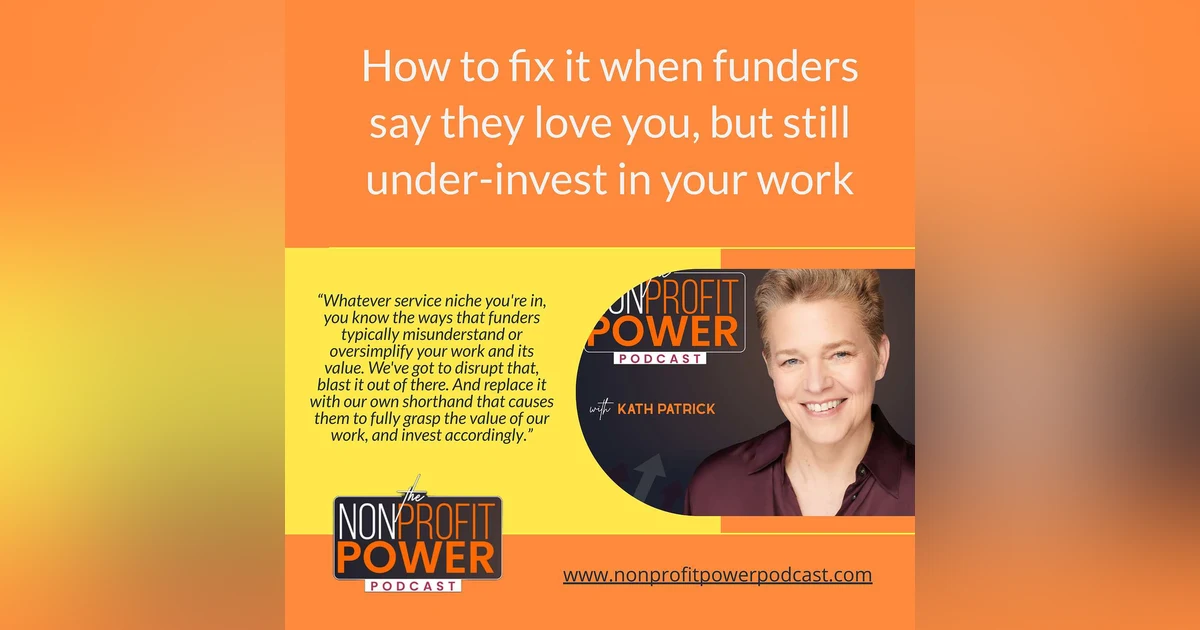
Last week, I tackled how to diagnose exactly what's going on when funders say they love you, but they're still not investing at the correct level. In that conversation (Episode 145) we laid some really important groundwork to help you map out exactly where the problem is occurring, how it’s manifesting with each decisionmaker, and what exactly is causing it. Today, as promised, we'll get into how you fix it. You won't be surprised to learn that this is almost entirely about mess...

 Apple Podcasts
 Spotify
 Pandora
 Amazon Music
 Last week, I tackled how to diagnose exactly what's going on when funders say they love you, but they're still not investing at the correct level. In that conversation (Episode 145) we laid some really important groundwork to help you map out exactly where the problem is occurring, how it’s manifesting with each decisionmaker, and what exactly is causing it.
Today, as promised, we'll get into how you fix it.
You won't be surprised to learn that this is almost entirely about messaging. But there's some really interesting quirks about how we adjust that, based on the diagnosis we arrived at when we were analyzing which causes of this problem are at play with any given funder.
The good news is, we’re focusing on short bits of messaging that are strategically designed to address each of the common causes. With six key sentences, you can build the core of the messaging you’ll need to move those funders toward the high-level investment your work deserves..
In this episode, we share:
- Why some funders seem impervious to the information you’ve been sharing with them
- The most common messaging mistake you may be making as you to try to fix the problem
- How to create shorthand concepts that will help funders get the true value of your work
- Four key principles for creating shorthand messaging that sticks
- How to disrupt the mistaken ideas funders likely have about your work
- The six sentences you need to turn around the misconceptions that are keeping funders from investing in your work at the proper level
Help spread the word! If you found value in this episode, I’d be grateful if you would leave a review on iTunes or wherever you listen. Your reviews help other nonprofit leaders find the podcast. Thanks!!
You're listening to the Nonprofit Power Podcast. In today's episode, we're tackling part two of what to do when funders say they love you, but still under-invest in your work. So, stay tuned. If you wanna have real and powerful influence over the money and policy decisions that impact your organization and the people you serve, then you're in the right place. I'm Kath Patrick, and I've helped dozens of progressive nonprofit leaders take their organizations to new and higher levels of impact and success by building powerful influence with the decision-makers that matter. It is possible to get a critical mass of the money and policy decision-makers in your world to be as invested in your success as you are, to have them seeking you out as an equal partner, and to have them bringing opportunities and resources to you. This podcast will help you do just that. Welcome to the Nonprofit Power Podcast. Hey there, folks. Welcome to the Nonprofit Power Podcast. I'm your host, Kath Patrick. I'm so glad you're here for today's episode. Last week, we tackled how to diagnose exactly what's going on when funders say they love you, but they're still not investing at the correct level. If you haven't listened to that yet, be sure and go back and check that out, because there's some really important groundwork that's laid in that episode. But today, as promised, we're gonna get into how you fix it. You won't be surprised to learn that this is almost entirely about messaging. But there's some really interesting quirks about how we adjust that, based on the diagnosis we arrived at when we were analyzing how many of the four main causes of this problem are at play with any given decision-maker. As we talked about last week in episode 145, This is a very specific problem that we're tackling. This is not a situation where they don't know you, they haven't figured you out yet, all of that. That's a separate set of issues. This is very specifically this common problem of they keep saying nice things about you, they say how much they love you, and then they turn around and when it's time for them to invest, it comes in either at a way low value or maybe they don't even invest at all. When you've got that going on, there are four main causes. The first three are kind of in one bucket, and then there's a fourth that could be overarching. It can be any one of the following or all of the above. Number one, they don't understand the complexity of the problem you solve. Number two, they don't understand the cost of the problem you solve. Number three, they don't understand the depth and/or magnitude and significance of the impact of your work, both in terms of how it changes lives and how it affects costs overall and brings those down. And then the last thing is that, no matter which of the first three things are happening, what is virtually always happening is that in their head, they're short-handing what you do. And almost always they are using the wrong shorthand. If you listened to the last episode, you may have already gone through the process of identifying what it is that your key decision-makers are consistently oversimplifying or failing to comprehend within those three categories that I just mentioned. And hopefully you've gotten pretty detailed with that, and you've mapped it out in some way, so you have started to see patterns And when you start to see those patterns of, oh, this misunderstanding or this misconception or this huge knowledge gap is happening across multiple decision-makers or even multiple categories of decision-makers. My advice is always to look for those patterns. Wherever you see repeats, that's the place to start. Because that tells you that there is absolutely something going on with your messaging that is contributing to the problem. So you've got that. The other thing you've done is identified the shorthand that they're using that's wrong in those three categories. Now, if you haven't done that, I do recommend that you start there, because the fixes I'll be sharing today will be a lot easier if you've done that groundwork first. Go ahead and listen today, but just know that if you wanna jump into this and start fixing this problem, the very best place to start is what we covered in 145. So this all feels kinda complicated, right? But it all boils down to basically a two-part problem, which is what aren't they getting, and what do they think instead? Now, sometimes they simply don't get it about one of those pieces, the problem you solve, the cost of the problem, the impact of your work. But most of the time, if you think about it, if you really burrow in, you realize that If there's something they're not getting, they've also made up some information to fill that gap. Often the problem is that they're just oversimplifying all of it. For example, I've just been working with a couple of clients on this. If you provide a fairly complex nutrition solution, and they've shorthanded it down to you feed people, obviously there's some huge gaps in understanding there. If they think that you're solving food insecurity rather than nutrition, then they're not only oversimplifying the problem, they're also misidentifying it. They've got some stories in their head that are what they think about what you do, right? And you know this because when you run into it, you've heard them say stuff that makes you cringe. We have to address both of these pieces. We have to address the part about what aren't they getting, cause that's critical. If they don't get the true answer to the three main categories we're dealing with here, then they will never invest at the correct level. They have to have clarity on all three pieces in order to come to the easy conclusion that of course, we need to be investing at the highest level in this incredible work. But we're where we are now, and we're trying to get them to there. Part of what's in the way is what aren't they getting. And the other part of what's in the way is what do they think instead? What have they made up? How have they filled in those gaps in ways that really do not serve you and that contribute to that underinvestment? What I've noticed is that when a decision-maker isn't getting something, a lot of times nonprofit leaders will design a whole bunch of messaging aimed at helping them get it more. So they go into more detail, more data, more, more, more, without having taken into account what the preformed ideas are in the decision-maker's head about all the aspects of your work. The trouble is you're not writing on a blank slate. You're competing with the ideas that are already in their head. So we have to do both things. We have to give them the correct set of information and pictures and perspective and understanding And we also have to remove the erroneous understandings and opinions and pictures. Because if we don't get rid of the garbage that's already there, that's firmly formed in the decision-maker's mind, a lot of our new information will just kind of slide off like Teflon. And I know you know what I'm talking about. I hear this all the time from my clients and in my coaching groups, where it's just like, "I don't get it. We keep telling them. It's not like we haven't told them, but it's like they're impervious." Well, actually, you're not wrong. They are impervious for a specific reason. They've already got what they think is a complete picture in their head, or a good enough picture. So we've got to dislodge that and then replace it with the true stuff that's actually gonna shift their perspective on investing. So let's talk about this shorthand that they're all doing. First of all, this is the human condition. We all do it, so we can't stop them. Let's be really clear. We cannot stop them from shorthanding our stuff down into something that's kind of compact and manageable. The thing is, if we don't give them the right shorthand, they're gonna make up their own. You've already seen them do it, and that's part of what's driving you crazy. So what we want to do is focus on creating the bits of shorthand that will improve their understanding of those key pieces that will then lead them to the realization that high-level investment in your work is the only strategically smart thing to do. So here's a caveat. I mentioned this last week. Be aware that it's possible, maybe even probable, that you've contributed to the unhelpful shorthand they now have in their head. And I know you didn't mean to do that, but here's how it happens. You know they've got limited attention spans. You often have very little time in which to work. And so what's very common is to really condense what you do in the first sentence and say So in a nutshell, we do blah, blah, blah, and then, "And here's how that works." And then you go into the rest of the stuff, the details that they would need to know. The problem is they stopped really deeply listening at the first part. When you gave them the shorthand, they're like, "Oh, good. I can peg them into that slot. That's where they go, Okay, great." And the rest of it's just kinda like blah, blah, blah, blah, blah, and they might hear blah, blah, blah, happy client story, blah, blah, blah, number of people served, blah, blah, blah, this, that, and the other. Stuff that might be of interest to them depending on their decision-making role. But they're not getting any of the complexity that you need them to get in order for the investment to happen. So our task, number one, first of all, clean up your own shorthand. This may get a little uncomfortable, but my goal here is not to make you feel bad about your messaging. Not at all. My goal is to help you identify anything you may be doing with your messaging to make it quick and easy for the decision-maker to understand that might accidentally be misinterpreted by them if they don't listen to the detail that follows. So we have to make sure that even our shortest shorthand contains at least one key element of complexity of those three pieces. In a minute, I'm gonna get into what that looks like, but I want you to understand that first taking a look at the shorthand you're currently using can be really valuable. Because you'll start to say, "Oh, wait, if I look at it through that lens, what if I imagine they didn't listen to anything I said after that? Is there any way that could be connected to how they are currently shorthanding our stuff out there in the world that is not helping us?" Just be alert to that. You're not trying to beat yourself up over it. Just be alert. We can't fix it if we can't see it, right? What we're gonna do is take a look at how we create better shorthand that creates openings for more detail, for more complexity. But we don't want any of our shorthand at any point to imply that any of this is simple and easy, because it's not. And as soon as they've got simple and easy or free in their head, you're doomed, frankly. Because if they think the problem is simple and easy to solve, then it ought to be cheap to solve. And besides, you're a nonprofit, so your stuff is free anyway, right? And I know you've dealt with that. I hear about it every day. So we're gonna take a look at four key principles here. The first is to distill without dumbing down. The second is to lead with impact, because impact gets attention. Too often we lead with what we do and not on the impact that it makes. If you wanna get a decision-maker's attention, a great way to do that is to lead with impact, because that snaps them to attention and say, "Oh, wait, you accomplish what?" So we'll talk about some ways to do that. The third principle is to create hooks that will stick in their mind. Then you can add detail to the hook. The last thing is we have to do our best to disrupt any unhelpful shorthand that's already in their head. Again, this is a lot easier to do if you know what that is. It's much harder if you're guessing. But the good news is they will have told you. If you've spent time talking with them or if you've listened to them speaking about your stuff anywhere else in the world, you'll know how they're shorthanding stuff that's problematic. So you can very quickly say, "Oh, well, they think... such and such wrong thing. Oh, they totally misunderstand which problem we solve." Going back to my earlier example, they think we solve food insecurity. We don't solve that. We solve a nutrition deficit. That's hugely different. So that's the first thing we have to correct, is they don't understand which problem we're solving. Pick your niche. Whatever service niche you're in, you know the ways that decision-makers typically misunderstand or oversimplify. And we've gotta disrupt that. Now, let's go back to the first thing of distilling without dumbing down. Distilling without dumbing down is really about taking each of those three categories, the problem you solve, the cost of the problem you solve, and the impact of your work on both the people who receive the services and on the cost. A great place to start is to come up with one to two sentences for each of those things. The complexity of the problem you solve. What is the problem you solve very specifically, and why is it complicated? You get one sentence for the what is the problem you solve very specifically, and one sentence for why is that more complicated than most people think? Then you get two sentences for the cost of the problem you solve. One of these sentences can be about the cost to the person who's in the problem. What is it costing them in terms of their ability to care for their family, in terms of their ability to contribute to the community, their ability to thrive, their ability to be pain-free. Whatever it is that you work on, what is the most painful aspect of the problem from the perspective of the people you serve? That is the human cost. And then there is the economic cost, which is what is it costing the public assistance system, the community coffers? However that plays out, and It's different for every niche and every sub-niche within that. You know what costs are being incurred when a person stays in that problem and doesn't get it resolved. There's all kinds of costs happening all over the place. So you want one sentence for what are the economic costs of not solving that problem. Then you get two sentences for the third thing. Which is the depth, magnitude, significance of the impact of your work. This is gonna build off of the second thing. So you're gonna get one sentence for the impact on the person who's in the problem. What is the most meaningful transformation they experience? What changes for them that has a profound impact on their life, on their ability to thrive, on their wellbeing, on their family, whatever it is. The second one is what is the impact on the cost? How are you characterizing your ROI? What is that? Already you are way closer to having shorthand that's gonna work. This is your scaffolding for shorthand that will work. Now, take a look at those six sentences. And ask yourself, in those decision-makers' heads, the shorthand they're currently using that's wrong, how can you match up pieces of your six sentences to attack that? That's the first thing. Just start to get a feel for that. Now, hold onto that for a minute because we're gonna talk for a minute about how you disrupt an idea, a picture, a concept that the decision-maker has lodged in their brain. You already know from experience that giving them different information without addressing the thing that's already there does not work. And it gets super frustrating 'cause, like, I don't understand. I keep giving them more, and they're not getting it. That's because they think they already have the answer in their head. They don't need to listen to anymore. They've already got it. So we have to poke holes in the thing that's already in their head. And there are lots of techniques for this. I'm just gonna give you a couple to get you started, and hopefully that will start you thinking about how this works. Some of the principles at work are we have to challenge it, but we have to challenge it in a way that makes the decision-maker want to think about it. What does not work, and I know you know this from life experience, even if it's not with decision-makers. What does not work is to say, That's wrong. What's really true is blah, blah, blah." Or, "Well, actually, what's really true is blah, blah, blah." The minute humans hear those words, that's wrong, well, actually, whatever, all of which are euphemisms for that's wrong. They shut down because they feel like you're attacking them. And you know what they're gonna do then? They're gonna defend their wrong idea even more. Because you've attacked it, and they've made that mean some stuff. So we don't wanna do that. What we do wanna do is find a way in that invites them to think about how each of these pieces is more complex or a little bit different than what they've been thinking. For example, if they've made a leap, assuming that the problem is easy to solve. You can say things like, "I know you'd think that, wouldn't you? Because it looks like that should be so. But what we've found in working with clients every day is that there's something deeper going on." And then you go to your one or two sentences around the complexity of the problem, or the cost of the problem, either way, depending on what you're dealing with. And you want to plant an alternate picture. This is where the hooks come in. The hooks are little things that get caught in their brain that then they can build more information around. Very often it's what it feels like to be in the problem as the client. What does that feel like? That touches on universal human emotions. It allows the decision-maker to visualize it in a way that's non-threatening. If you say, "This person is in pain And describe what that's like or whatever it is. Just a little piece. Again, you're not going on for a long time, but you're giving just a little something to help them visualize a different thing than what they had in their head. And then hopefully you wait for them to go, "Oh, hmm. Yeah, that would be a problem." At that point you can say, so you can see how if that's what's going on, then it's really not as easy to solve as it looks like on the surface. What we really have to do is solve three separate problems that are going on beneath the surface. And that's what our services do. And because we do that, because we go that layer deeper on the problem, we're able to fix it for real, which really then has huge cost impacts." Something like that. You can find a way in on any one of the areas of misunderstanding and then build all of your stuff in on that. I wanna pause for just a minute and offer a caveat that's been in my head but I haven't said out loud. Which is that this kind of messaging is really designed for conversation. I would not do this in writing. All of what I'm talking about is designed for messaging in conversation, when you're talking directly with the person, particularly when you're trying to disrupt an idea that's already in their head. That is very hard to do with written material. You could try to do it with video, but honestly, that's way more work than just talking to the person. So this is really all designed for conversation. I wanna be clear about that. Please don't go out and create an infographic to do what I'm talking about here. That will not work because they won't look at it. They'll glance at it, but they won't take in what's there because it doesn't agree with what's already in their head. The best, most effective way to disrupt what's already in their head is to talk with them and lead them through a process. And it might take more than one conversation. Where you begin to help them get, oh, this thing that they thought was super simple and super basic isn't. Another great way to do this, and one of the best hooks there is, particularly when you're talking about investment, is you lead with the cost impact. If you've got an impressive, dramatic cost impact, ROI, that you can lead with, do so. You can say something like, Lots of folks think that what we do is really great and that it's a feel-good service, but here's the reality: it has a huge cost impact. We are able to reduce cost in X category by Y dollars or by Y percent on a consistent basis." Or, yes, we change people's lives and that's very important and very powerful. But what a lot of people don't understand is that this is the cost impact. You can use phrases like, "Well, what a lot of people don't understand." And you haven't said, "You, decision-maker in front of me. I don't know that that's you." You totally know that's them, but you're not calling them out. You're saying, a lot of people. A lot of people just kind of focus on the impact on clients, which is great because that's huge. But what a lot of folks don't understand is the cost impact that we have, and that's what I wanna share with you, is how powerful our cost impact is. If they were already simplifying the problem or the cost of the problem, and you drop in their lap a giant hook of, "Hey, we save this gigantous amount of money. We have this gigantous ROI." That does multiple things. It's a great hook. It's gonna stick in their brain. It's gonna make them ask a follow-up question, "Wait a minute, I didn't know that. What do you mean? How do you do that? How can that be?" Whatever they ask. Once they're engaging, once they're asking questions, then you can start feeding them some of the stuff from your shorthand messaging and see how that does. Don't start adding detail till you've given them your best shorthand for the three pieces. Cause that's where you start. If they can integrate those three shorthanded pieces and adopt them as their own, then they have the scaffolding built in their brain to take in all the other stuff that you would love to share with them. All your awesome data, all of your awesome details on all the things. Your analysis of the problem, your client stories, and your ambitions for the future about how you can make an even bigger impact. All that will be so much more able to penetrate, so much more welcome to that decision-maker once you've built the little scaffolding in their head that helps them understand those core pieces. The best disruption techniques are paired with a replacement idea. But you want to have a bridge. So things like, "I know, you would think that," or, "Yeah, We hear that a lot. That's a lot of folks' perception, and it's kind of puzzling to us because what we've found as we work with our clients is blah, blah." Then you can give an example, a very brief example. For example, Susie Q is a typical client, and she has this, this, and this going on, which already you can see is a way more complicated situation than just sort of that surface characterization of whatever the oversimplification of the problem is. You read their body language and watch their interest, and if they're not getting it, then you can try a slightly different angle and say, "So, like, for example, here's two major things that happen in Susie Q's life every single day that make it impossible for her to work, or impossible for her to care for her kids," or whatever's going on. And then, so we built our services to address all of that. Because what we found is if you don't address all the pieces of this very complex problem, you don't get the results. You don't really move the needle on it. And how do we know we've moved the needle? ROI. Cost impact." You can come at this in a number of different ways, but it's a soft approach. You don't wanna say, "That's wrong." You don't wanna say, "Well, actually," or any of those other things. You give them the grace of, you understand why they might think that. I would even be careful with phrases like, That's a common misperception," cause that's still saying, "You're wrong." So more things like, I know You'd think that. We hear that a lot, and I get why folks think that. But deep in the work, here's what we've found to be true." And then you give an example, something they can picture. So that they have a vivid picture in their head of the person in the problem, of all the different ways it manifests, which then translate to complexity of the problem. The more you can do that, the more you can paint pictures for them in their mind, the stickier it will be. Analogies are a great way to challenge an oversimplification. There's a neat trick if you know the decision-maker well enough to be aware of something they're an expert on. It doesn't have to have anything to do with work or policy or anything. It could be fly fishing. If you know that they're an avid fly fisher or an avid gardener or an avid anything and they have a lot of expertise on that, you could ask them, you're into fly fishing, right? What's the most common misperception people have about that that drives you crazy?" And they'll say, whatever stupid thing people say about fly fishing. Bad example 'cause I'm not a fly fisher either, so I'd probably say one of the dumb things. Like not understanding the difference between a wet fly and a dry fly, and the technique that goes with each of those. Could be something like that. At least I know that much. The fly fishers I know, the dry fly fishers think they're cooler than the wet fly fishers. So if this person is a dry fly fisher, which takes a lot more technique, they could say "This drives me crazy. They think I just stand in there and throw something in the water and let it float down the stream and do that all afternoon. They have no idea the technique that goes into dry fly fishing." Okay. Cool. Anything. It doesn't matter. Just something they're expert in. Ask them what it is that people get wrong, that they misunderstand, that they oversimplify, that they assume about the thing that drives them the most crazy. And then you peg that to your thing that they're misunderstanding. And be like, "Oh my God, that must drive you crazy. The thing that drives us crazy is," fill in the blank over simplification. Cause what's really going on is blah." But you've opened them to a perspective shift. When you can make this work, it's gold. Because what you've done, when you've invited them to share something that makes them nuts, that places them in an emotional state. Once they are in an emotional state of visualizing the annoyance of people get this wrong all the time, ah, and it, ugh, this is why it irritates me. You listen empathetically, "Oh my gosh, that must make you nuts. The thing that makes us nuts is..." And then say why it makes you nuts. Because it's an oversimplification, because it completely ignores a huge piece of the problem, because it assumes the thing is simple and easy, when in fact it's super complex, and therefore very costly to solve correctly. And then if you don't solve it correctly, you just keep incurring the cost. Whatever it is. When you can do that, it's amazing. I'm handing you a trick in the toolkit that is advanced level, and is available only when the circumstance is right. And basically, the circumstance would be you have enough of a relationship there already you can ask something like that. You would not ask that of someone you just met, right? That would be weird, 'cause then you feel like a stalker. "Oh, I know you're a fly fisher. Uh, tell me." That's, that's weird. Now, here's a way you could do it that would not be weird in an early encounter. And that would be if they are known for an area of policy expertise that is not connected to your stuff. Let's say you work on healthcare, and their niche is housing. They may not know anything about what you do with the healthcare end of things. That's not their area of expertise. But they know how complicated the housing issue is. That would be ideal. Because there's a super complicated problem with all different tentacles and all sorts of complexity and very challenging policy solutions. And you could say to them, like, if they're on the committee that deals with housing issues, you could say, when you're working in the housing arena, what's the thing that people constantly misunderstand or get wrong or oversimplify that really makes you crazy and makes your job harder?" That's a way you could ask it because that's public information. If they're an expert or on a committee or whatever that signals expertise in that issue. That's an entry that does not make you look like a stalker if you know that thing about them. And it's really very nicely analogous because you're in a policy arena also. So that can work great, and that's much more available to you. So that's one great technique for disrupting, is to invite them to get into the head space of, "Oh my God, when they oversimplify my stuff, it makes me nuts 'cause people don't get da, da, da, da, da, da, da, da, da." And then you get to come back with why the particular oversimplification of your stuff makes you nuts because da, da, da. And now they're in a sympathetic space. They're like, "Oh, that must be terrible." Even if they were guilty of the same thing five minutes before. Doesn't matter because you've put them in an empathetic state where now you're comrades in combating stupid oversimplification of things that are complicated that really matter. That's one of my favorite ways to do this. But the other more simple things are things like, "I know. You'd think that was true. A lot of people think that, but here's what we found. Here's what we learned. Here's what we discovered through the process of working with clients over the years, da, da, da." And that allows them to let you in with new information. That's a lot. I'm gonna call it at this point, because I could do this all day. And I, my goal is not to overwhelm. My goal is to give you some stuff you can use right away. That will improve your ability to attack this huge problem of decision-makers oversimplifying one or more pieces of your stuff, and parking that oversimplification in their head as what's true about what you do. We gotta blast that out of there, replace it with your own shorthand. So your assignment is those six sentences. And to think about one or two of those disruption tools that you might wanna try the next time you talk with a decision-maker who is exhibiting this problem. Give all that a try, and let me know how it goes. I do this with my private clients and in my coaching groups all the time, but I always wanna hear from listeners about what you're finding that's working for you. If you have questions, I wanna hear them. Love to tackle those in another episode. But for right now, I wanna just let you go play with this and get to work on shifting those decision-makers' perspectives. Thanks for listening, and I'll see you in the next episode right here on the Nonprofit Power Podcast.