
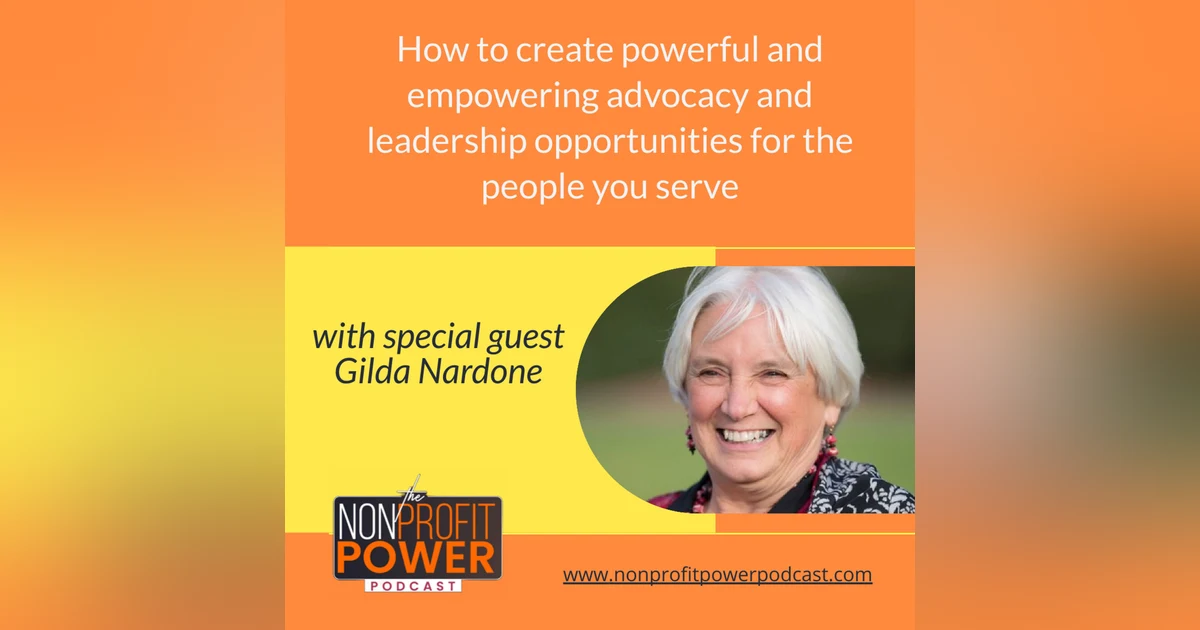
How to Create Powerful and Empowering Advocacy and Leadership Opportunities for the People You Serve - Episode 30

 Apple Podcasts
 Spotify
 Pandora
 Amazon Music
 I had the opportunity to interview Gilda Nardone, who shared how she built a leadership and advocacy training and support system that helped her organization’s program graduates become powerful advocates on issues they care about. A few of them even went on to run for and win local elected office, where they now influence policy as decisionmakers themselves. Gilda recently retired from her role as the long-standing Executive Director of New Ventures Maine, and she was kind enough to share the many lessons and insights gained from developing and running that incredibly impactful system they called their Ambassador Leadership Program.
In this episode, Gilda shares her insight and advice on:
- Operating from an empowerment model from the start
- How to successfully launch and grow a sustainable ambassador program
- How to involve clients/graduates in the design of the program
- Three key areas of skill development that help equip clients/graduates to advocate on issues they care about
- How to help clients/graduates tell their story in a way that engages and compels
- How to build in opportunities for clients/graduates to learn from each other and build community
- How to create runways to advocacy and leadership opportunities beyond your organization
If you enjoyed this episode and found value in it, please reach out to Gilda and let her know. You can find her on LinkedIn @Gilda Nardone.
I’d appreciate it if you’d take a moment to leave a rating and review of the podcast on whatever platform you’re listening on. Thanks!
You're listening to the nonprofit power podcast. Today's episode reveals how to create powerful and empowering advocacy and leadership opportunities for the people you serve. So stay tuned. If you want to have real and powerful influence over the money and policy decisions that impact your organization and the people you serve, then you're in the right place. I'm Cath Patrick, and I've helped dozens of progressive non profit leaders take their organizations to new and higher levels of impact and success by building powerful influence with the decision makers that matter. It is possible to get a critical mass of the money and policy decision makers in your world to be as invested in your success as you are, to have them seeking you out as an equal partner, and to have them Bringing opportunities and resources to you. This podcast will help you do just that. Welcome to the nonprofit power podcast. Hey everybody. Kath Patrick here. Thank you so much for tuning in to another episode of the nonprofit power podcast. I'm so glad you're here for today's episode. I had the opportunity to interview who shared how she built a leadership and advocacy training and support system. That helped her organizations program graduates become powerful advocates on issues they care about. A few of them even went on to run for and win local elected office, where they now influence policy as decision makers themselves. Gilda recently retired from her role as the long standing executive director of New Ventures Maine. And she was kind enough to share the many lessons and insights gained from developing and running that incredibly impactful system they called their ambassador leadership program. Let's get right into that interview. Mhm. Hey there folks. Welcome to the nonprofit power podcast. I have with me today, an awesome guest who is going to share some really powerful information with you. Until her recent retirement, Gilda Nardone was the executive director for over 40 years of new ventures, Maine. In addition to her responsibilities of strategic planning, fund development and financial management. And leadership development of staff and advisory council members for her statewide organization. She also coordinated their civic engagement activities, and helped establish and expand their graduate ambassador leadership program, which we're going to be focusing on today. Joda has received multiple state and national awards in recognition of her long-term advocacy on behalf of Maine women and families. And she has a master's degree in educational administration. And as a graduate of leadership, Maine. Welcome Gilda. I'm so happy to have you on the podcast. Thanks for joining us. Us.
audioGildaNardone Part 121203678856Thanks, Kath, for having me.
How are you doing today?
audioGildaNardone Part 121203678856I am doing well. It's a nice day here in Maine.
Very nice. So I'm very excited to talk with you. I've been wanting to do this for a long time, and there are so many things to talk about, but the thing I really want to focus on is the ambassador program that you ran during the many years that you were executive director at new ventures, Maine. But before we jump into that, it would be great if you would tell our listeners a little bit about who you are and who you help. And what new ventures Maine is all about.
audioGildaNardone Part 121203678856New Ventures Maine is, a statewide organization that helps Adults primarily, who are in work life transition, figure out what's next for them on their path. that might be pursuing further education, defining a new career direction, starting a small business, or managing their money and building their assets.
Excellent. You're a statewide. So you have participants from all over the state, which is kind of a trick because Maine is a really big place geographically and not so big population wise.
audioGildaNardone Part 121203678856Right. And actually, because a lot of our programs are online in addition to in person, we serve people beyond the state of Maine. and because we abut New Brunswick, people in Canada as well.
Oh, wow. That's very cool. I would imagine new ventures, Maine has served thousands upon thousands of people over the many years that you were executive director there. That's a lot of folks who got a lot of help over time. And I'm sure you've had participants who went on to do extraordinary things and a lot of folks for whom. A big win or a big success was simply to have an economically stable existence when they hadn't had one for a long time. So. Understanding that there's a big range and that people probably come to you facing really different levels of challenge. where they may have just one or two things. And are like, Hey, if I could just fix this up, I'd be great. And other folks who are dealing with multiple things and may need a lot more services and a lot more time before they can get to a place where they feel like they're stable and have their feet under them. Do you want to talk a little bit about that?
audioGildaNardone Part 121203678856Well, one of the philosophies of the organization has always been to meet people where they are in their own life transition. And with that approach, we see people, as you've clearly identified, along a spectrum of need for where they are in their lives. Some are in crisis and need more support and a range of organizations and individuals working with them to provide that support. And others are pretty stable and mostly need some direction and coaching to help them move forward. So, again, important to meet people where they are and help them clarify for themselves what the next steps are going to be, and then support them in making those next steps happen for them and their families.
So. So. tell me a little bit about. about. the ambassador. I need it by this moment. And I've been blessed with the reasonable. To achieve, but let's start looks what. And what. it did.
audioGildaNardone Part 121203678856well, it really came about with the insight of a marketing consultant who we were working with to do some rebranding. And as part of that effort, she did some focus groups with some of our graduates and she was frankly, blown away by the positive response those graduates had to their experience with the training and coaching they received from staff across the state. And they expressed their interest and gratitude by wanting to give back in some way to the organization. And she came back to us and said, you need to tap this wonderful resource because the graduates can really help you in so many ways. So that was the genesis of beginning to think about a more intentional approach to work with the graduates who were in a place to be able to think about giving back in some way, whether that was to our organization or to their own communities. we started there and began to conceptualize what that might involve and how that could be beneficial, not only to our own organization, but to the graduates themselves. what skills, Please And experiences would help them move forward in a positive way, help them develop some of their own leadership skills
Excellent. So how did you do that? I mean, Uh, we're busy serving people with all the things you listed and then, oh, okay. Now we'll have a leadership development program for people too? That must've felt a little daunting. How did you do that?
audioGildaNardone Part 121203678856did feel daunting at various stages of the development of the program. we started small. before covid our organization was organized into 6 regions of the state, depending on the size of that geographic region, it might be 1 county or several counties. And we started in 1 region. And that group identified some graduates who were interested in participating and together we helped develop the program that then moved on to expand in other regions of the state and eventually statewide. But it was really that first group of graduates in the Midcoast region who helped us conceptualize what this entity might be, and how to make it beneficial for everyone.
I think that's a huge point to bring out that you, involve the graduates in the design of the program from the beginning.
audioGildaNardone Part 121203678856Absolutely. And they continued to provide feedback throughout the process of development, regionally, but also statewide.
I want to have folks understand just how impactful this program was on two different levels. One was obviously for the graduates themselves and their skill development. But the other was that they ultimately wound up being quite the advocacy force for the organization as well. Can you talk a little bit about what their role was in advocacy and what kinds of things they were able to do?
audioGildaNardone Part 121203678856from the beginning, we focused in three areas, advocacy being one of them. But there was a strong emphasis on, communications and outreach. So, part of that was being able to tell their own story in different ways to different audiences. and that core then transferred over to, the advocacy work. and the other area that we looked at was their community leadership role. in terms of advocacy, it really started with what issues were important to them and their families? What were they passionate about? And often that tied back to their own life experiences. they'd all come from different places and had different experiences and were passionate about different things. So, always the advocacy tied back to what their passion was. And part of that was for the work of the organization that had helped them. and then as part of the advocacy training, we started with basic civic engagement activities, helping individuals become informed voters and making sure that they knew what policy issues different candidates were espousing as they were running for office. Learning how the political process works in our state, both at a community level with a town or city council at the state legislative level, and also at the federal level. we have a congressional delegation of only four people. So at the federal level, those, Individuals and their staff are very accessible to us as well. So the advocacy really ranged from becoming more informed and engaged, to becoming much more active in interacting with policy makers. that sometimes took the form of in district conversations or, days at the state house where they learned how the legislative process worked and shadowed their legislator for a period of time. Some individuals actually testified before committees on bills. One of the most impactful, I think, were graduates involvement in what we refer to as our legislative and funders reception. Our legislature runs on a two year cycle. So every two years after the new legislature had been sworn in, our advisory council hosted a reception for new and returning legislators. that was a wonderful opportunity for our graduates, with some training and coaching, to be available on both an informal basis, having conversations with legislators and other decision makers. And always, as I mentioned, of them would give a more detailed rendition of their own personal story and told that story from a policy perspective. here's who I am and what I experienced. Here's what I learned from the program that benefited me. And here's how I'm applying those skills in my community. And why it should matter to you as a as you think about and listen to your constituents.
That's amazing. You've just described a skill set that honestly, there are a lot of nonprofit leaders who would like to have that skill set. Tell me a little bit about how you went about preparing and training and coaching folks who decided they wanted to do this.
audioGildaNardone Part 121203678856Well, it started with their personal story, literally with some prompt questions, writing their story out. And then in a conversation, working with them to think about, well, so if you don't have an hour for somebody to listen to you, what was key about your story that you wanted to communicate? Working with them to figure out how might you tailor that story a little differently, to have an impact with that particular person that you're trying to educate and perhaps even to influence. sometimes that was policymakers, sometimes that was foundation staff or an individual donor that they would be communicating with. Sometimes it was with a reporter or, a local community group like a Rotary, who was interested in learning more about the work of the organization and its impact.
That's fabulous. I know plenty of nonprofit leaders who still freak out a little bit when they're in front of a camera or when they're being asked to talk to the press or powerful people, or a high stakes, high high stress situation. What was the process of coaching people? Giving them enough practice opportunity, creating safe space for them to practice those skills in a low stakes stakes environment so that when when they worked their way into a high stakes environment, it didn't have a freakout factor. After or. If it did, it was manageable. And my other question one is, was that just your internal team, doing that coaching and training?
audioGildaNardone Part 121203678856it was a combination of, all of the above. certainly the local staff and statewide staff were actively engaged. And they often brought in local resources to work with them around the communication pieces. we had, a couple of consultants who worked with us over the years on advocacy issues, and they were very involved in, particularly helping graduates think about how impactful way, and they provided I'm excited. Bye. Both tips and role playing situations. so that there was preparation at the regional level and at the statewide level. And then before every 1 of the receptions, 1 of our consultants would do a little refresher so that people were primed right before they began to have those conversations. So it's repetition and different kinds of environments, and never sending someone out by themselves. always, it was a team approach. a graduate or two and a staff person and other people. sometimes graduates wanted to know everything about the organization, what all of our funding sources were and, numbers and statistics, and we could assure them that, yes, they needed to have a general sense of that information. But the staff person was there to provide some of the detail, and their role really was the personal story piece of that presentation so that they didn't feel like they needed to do it all.
That's all totally amazing. And it sounds like a lot of work. There were probably periods of time during the year, that would be higher intensity and others. It would be lower intensity. I'm guessing, but it still sounds like there was a lot of training, a lot of coaching practice sessions, setting people up for success, which is awesome. But that all involves humans doing work. I'm curious if you have a sense of what the investment of staff time and energy and consultant time and energy was involved. To both create this initially and then to sustain. On it.
audioGildaNardone Part 242203678856Well, it was an investment of mostly staff time, but some consultant time as well. And as I mentioned, we started smaller and regionally and then expanded. So, it did require of the regional staff to think about who they wanted to invite to participate in this process and then to actually conceptualize how they were going to structure meetings so that the training and coaching could be provided. Gradually, we began to do more statewide and a bit more time efficient because we plan training that was delivered statewide to everybody. I think that's really more of the model moving forward. Although there was really valuable learning that happened at a regional local level as well. onetherhe thing I would mention is that the graduates learn from each other too. So in addition to staff and consultant trainer, involvement, they often really welcomed getting to know and interacting with graduates who are from a different part of the state. So often, a group from one part of the state would beam in to a group meeting in another part of the state and share what they were learning together. And at one of the statewide gatherings, which we periodically held, we actually asked each region to showcase a best practice of the leadership program, and that was really interesting. they all approached it very differently, but again, it was an opportunity for them to share with each other what they were learning and what was most valuable for them.
I love that because it sounds like it also was kind of creating a community of ambassadors who were then engaging and supporting one another, which is totally awesome.
audioGildaNardone Part 242203678856Yes.
that makes me think of something you said earlier, which was that part of how you started out with folks who were interested in doing this was that you were first identifying what they cared about and what they might want to work on in their own communities. can you talk a little bit about what kinds of things they focused on? I seem to recall, there were a couple of people who actually went on to do some really amazing things as local advocates in their community.
audioGildaNardone Part 242203678856I think, it really was encouraging people to think about what they're passionate about, and the aspects of those issues that they wanted to see some change happen, and how could that happen? I'm thinking of one graduate who was herself a survivor of domestic violence. And, got engaged in our program, became an ambassador, also enrolled in college and was a very active volunteer in our local domestic violence, program. And she has gone on to do great things. She adjective. was selected as the student speaker at her graduation as an adult learner. She received a full scholarship to law school and now is an attorney and advocating for survivors of domestic violence and others who need access to legal representation. So we've seen people take their life experiences and really transform them into how they personally could make a difference in the areas that they are most concerned about. individuals involvement really span the gamut of economic security issues from education and workforce development, business development, asset building, child care and elder care issues, safety issues, health care. Two primary areas our ambassadors were engaged with was new ventures Maine's policy agenda and funding. we do receive state funding, so that was an important part of our education efforts. the other area was CASH Maine, which is our collaborative, free tax assistance program in Maine and, our graduates did a lot of education around the earned income tax credit. So they actually got involved in tax policy issues and that was really exciting to see. and so graduates, were interacting with a number of different policy issues and, standing committees in our legislature. we were very lucky in our state to have a very strong, woman's lobby that was a 5 0 1 C four. And so if people really wanted to get actively engaged in lobbying efforts, there was a sister organization that they could align with.
That's awesome. And do I remember that there was at least one person who wound up running for local office as well?
audioGildaNardone Part 242203678856Yes, several of our graduates have locally and been elected to school boards and town city councils, and served on local planning committees, that sort of thing. they've really gotten engaged made a difference in that way. And eventually there may be some who actually will be elected to state office too,
That's amazing in and of itself that they've run successfully and won local office. And they're now on the inside influencing policy in their communities, which is huge. To what extent do you think it would have been likely that they would have done that without being part of the ambassador program?
audioGildaNardone Part 242203678856I think training and the support of the ambassador program gave them the confidence to believe that their voice mattered and that they really could make a difference.
I think you've effectively addressed this question throughout the entire conversation, but I want to raise something that I hear from time to time from direct service nonprofit leaders who, when they hear about the idea of having current or former clients participants, Engage in advocacy on behalf of the organization, or even on behalf of policies and funding issues that affect those individuals directly. That there's this kind of feeling of, well, that's exploitative in some way. I don't know if we should be doing that. And. And it seems to me that you've I just rebutted that completely in terms terms of whether it's exploitative mative is largely really determined by how you design the program in the first place?
audioGildaNardone Part 242203678856Yes. And, you know, our organizations programs, which focus on education and career development, business startup, financial education, asset development, are based on an empowerment model. So, This is really an extension of that, of meeting people where they are and where they want to go and making sure that it's a mutually beneficial relationship. And, a lot of this work, as you know, is based on relationships and building relationships, whether that's participant graduate to staff, a graduate to a funder or to a policymaker. It's really about building relationships built on mutual respect for what each contributes to a shared goal.
Back to your process for engaging, and bringing people into this program. Once you had your ambassador program set up, and and you kind kind of knew what you were doing. Did you have a process for inviting prospective ambassadors in? How did you go about that? did you uh, target target people based on your sense of where they were? Did you throw it wide open? Open, what did that look like?
audioGildaNardone Part 242203678856we started with more structure in the beginning. We gradually loosened up about that. always, we were identifying people who had been involved in our various programs and either they had taken a longer class or a staff person had worked with them one on one over a period of time. So we were working with a pool of people who staff knew and sort of knew their story, knew their strengths and areas that they might want to develop. initially, we had a more formal process of staff, nominating people. And then we really came down to staff identifying and then inviting people to participate. And that seemed to make more sense. in terms of the time and energy that goes into supporting and sustaining, an entity like this, we wanted to keep it flexible. some people remained engaged over a long period of time. Some people came and went as demands in their own personal lives interfered or health issues or whatever and that was fine. I should also mention that internally, we would refer to both the big a ambassadors and the small a ambassadors. the big a ambassadors were those that mutually, we were working together to provide training and support, and they made a commitment to be engaged in one or two activities during a year's period. some of them were, much more engaged were not. And then there were people that weren't involved in a more formal training process, but with a little coaching could step up and wanted to step up. we learned from both and we learn not to be rigid about that. we really wanted to make sure that people felt like they had the skills and experience and opportunities to practice but certainly we have many graduates who acted as ambassadors on a more informal basis than a formal basis.
Got it. So I imagine and there's some folks listening to this going okay, that's awesome. I want that. How do I get that? You've done a. A lot to describe describe your process for how you initiated did this whole endeavor, and and then how it evolved over time and some of the learning. I'm curious if you have some lessons learned, either happy or painful, that would lead to advice you might give to someone who says, yeah, I want to do that. What do they do?
audioGildaNardone Part 242203678856Well, I think you have to be realistic about what your capacity is because as you as you've identified, it does take time and energy and not all staff are as excited about leadership development and being engaged in policy as I and some other staff are. do an honest assessment of what your capacity is and what your goals are. What are you trying to achieve? And I think what we learned from this was that it was more realistic to think about it as an alumni engagement activity rather than a whole leadership program. because although I and some others were really interested in the leadership program approach, it was harder to sustain over time, particularly as some key staff left and other changes were happening. Covid had a real impact on all of us in so many ways. So being realistic about capacity, clear about what your goals are, and, what kind of a structure would help your participants, your graduates stay involved and move their skills to a next level. Which will benefit the organization, but also will benefit them in their lives that give them tools that they can use in a variety of different circumstances. At 1 point, another staff person and I were involved in a leadership cohort with other leadership programs, and we got very excited and ambitious. that was not sustainable, in the long run. We needed to pull back and really assess what we could carry on, with the resources that we had, given that leadership development was not a key program area, even though some of us would have Like to have moved in that direction. But we did really see and recognize our role with grassroots leadership ,that we were working with individuals who didn't necessarily see themselves as leaders and helping them develop their talents. and developed over time really close working relationships with other leadership programs in the state. So one of our goals was once, an ambassador had been involved with us and learn some new skills, that if they wanted to participate in other leadership programs or get involved in other organizations advocacy work, we provided scholarship assistance for them to do that. so we saw ourselves as a grassroots leadership pipeline into other leadership opportunities that were happening in the state. And that really helped us let go of, Oh, we have to be all things to our graduates, which we didn't have the capacity to do longer term.
I would imagine that for those who really wanted more, that this was a tremendous opportunity for them. And that raises a question that I think will be on everyone's mind. If they're looking to do something like this is the question of resources. Obviously you made a decision to invest staff time and energy in this work, and to create this ambassador program. And to go through the experimentation and then subsequent iterations of it until it got to be up and running and really showing it's worth. But when you started, you didn't know that. And I'm interested to hear from your CEO brain, how you thought about investing organizational resources in the form of staff time and energy, which ultimately does cost money. Where did you see the value and the reason or reasons to make that investment?
audioGildaNardone Part 242203678856Well, gratefully, we had Some foundation support over time as we were developing the program. that really helped to have some designated funding that could cover staff time for that work. I think if we tried to develop a whole new leadership program into the future, that might have been a bit of a stretch given the funding streams.
I assume those were existing funders that you already had a relationship with, or did you go out and get fresh money for this?
audioGildaNardone Part 242203678856some of both, and it tended to be funders who were particularly interested in grassroots leadership development, so they were very interested in supporting this work. And actually, one of the funders was a donor advised fund when we had this statewide gathering where the regional group shared their best practices, several members of the board of that fund participated in that meeting. So, that was a really good way for them to get a flavor of what their investment was supporting and they really appreciated that. That's it.
That's probably a strategy that should be used more often. so often for funders, they don't really get to see, up close and personal, the impact that their investments have. and when they can see it, that can be really powerful.
audioGildaNardone Part 242203678856Yes,
This has been amazing. Thank thank you so much. Is there anything else that you would want to share to call this episode complete?
audioGildaNardone Part 242203678856you had asked me, what was a highlight and I was thinking back to the organization's 40th anniversary, which also happened to be, a new legislative year. And we identified 40 graduates statewide, all different, very diverse backgrounds and learning experiences, and profiled each of those 40 graduates. several of them came to the reception so that was so exciting. We got to see the Ambassador Leadership Program in action because they were all interacting with legislators and with university and department, funders. and then two of them told their more detailed stories. One of them was a nurse who was doing incredible work in the healthcare field, and the other was a child care provider who had started her business as a result of our program. that whole year was an opportunity to really engage our ambassadors in lots of different ways, to really show the impact of the programs and the changes that they were bringing about in their own lives.
That's excellent. Thank you so much. You have shared so many insights and helpful concrete advice for folks who might like to try to take on some sort of an ambassador or advocacy program for their participants and clients. And, you know, I think it's possible you may have also flagged another topic that I need to bring you back for, which is that whole legislative reception thing you guys do. And that might be worth its own episode. But for right now, I really appreciate your helping people understand more about how the ambassador program worked. And hopefully people listening understand that it is not only doable, but that the benefits that come from it are so significant that it really winds up being a profoundly valuable investment.
audioGildaNardone Part 242203678856Well, thank you for having me on the podcast, Kat.
Thank you again. and, enjoy the rest of that sunny day in Maine. Jane.
audioGildaNardone Part 242203678856All right.