
How the Identity You Choose to Operate from Determines Your Advocacy Results
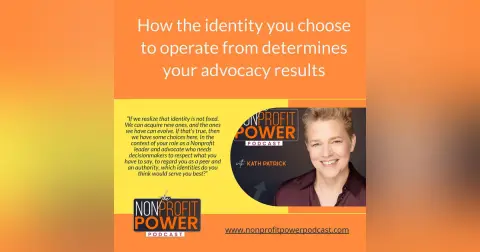
Identity is one of those things that we really tend to take for granted. We often don't recognize just how much of an impact it's having on how we show up in all aspects of life. When we think to ourselves, “I am…” or “I am a…” Whatever follows, however we finish those sentences, is far more important than we often realize. Because they speak to our identity as we see it. And our identity drives our perspective, our priorities, and perhaps most importantly, it drives how w...

 Apple Podcasts
 Spotify
 Pandora
 Amazon Music
 Identity is one of those things that we really tend to take for granted. We often don't recognize just how much of an impact it's having on how we show up in all aspects of life.
When we think to ourselves, “I am…” or “I am a…” Whatever follows, however we finish those sentences, is far more important than we often realize. Because they speak to our identity as we see it.
And our identity drives our perspective, our priorities, and perhaps most importantly, it drives how we show up.
We tend to think of identities as fixed. They simply are who we are. But it's not so simple after all. The fact is, we can choose which identities we want to operate from.
The identities we choose to operate from as Nonprofit leaders has a lot of implications for how we show up, and what kind of impact we have, especially in our advocacy work.
In this episode, we share:
- The four essential identities that make the biggest impact on your advocacy success
- Why those identities can often cause discomfort for many Nonprofit leaders
- Commonly occurring identities that will reduce your advocacy
- How to identify any identities you’re currently operating from that may not be serving you
- How to begin to operate from the identities that will serve you most effectively as an advocate and as an leader
Help spread the word! If you found value in this episode, I’d be grateful if you would leave a review on iTunes or wherever you listen. Your reviews help other nonprofit leaders find the podcast. Thanks!!
You're listening to the Nonprofit Power Podcast. In today's episode, we share how the identity you choose to operate from determines your advocacy results. So stay tuned. If you want to have real and powerful influence over the money and policy decisions that impact your organization and the people you serve, then you're in the right place. I'm Kath Patrick, and I've helped dozens of progressive nonprofit leaders take their organizations to new and higher levels of impact and success by building powerful influence with the decision-makers that matter. It is possible to get a critical mass of the money and policy decision-makers in your world to be as invested in your success as you are, to have them seeking you out as an equal partner, and to have them bringing opportunities and resources to you. This podcast will help you do just that. Welcome to the Nonprofit Power Podcast. Hey there, folks. Welcome to the Nonprofit Power Podcast. I'm your host, Kath Patrick. I'm so glad you're here for today's episode because identity is one of those things that we really tend to take for granted and often don't recognize just how much of an impact it's having on how we show up in all aspects of life. When we think to ourselves I am, or I am a. Whatever follows, however we finish those sentences, is far more important than we often realize. Because they speak to our identity as we see it. And our identity drives our perspective, our priorities, and perhaps most importantly, it drives how we show up. Examples of identities are I am an athlete, or I am a reader, I am a storyteller, I am a great cook, I am an animal lover. It doesn't take a lot of thought to see how those identities would shape a person's perspective and priorities. And if you imagine someone with one of those identities, it's pretty easy to imagine... how they would probably show up, how they'd be operating in the world. Those are all examples of identities that are part of our personal life. We also have identities in our professional life, in our role as nonprofit leaders. We tend to think of identities as fixed. They simply are who we are. But it's not so simple after all. The fact is, we can choose which identities we want to operate from. And that has a lot of implications about how we show up and how we make decisions, specifically as nonprofit leaders. Most people have many identities in play, and those identities kind of operate in layers. Some of them were formed very early in life, often before the age of five, and often those come from what our families told us, expected of us, where we fit in the family structure, all those things. Those aspects shape a lot our early identity. And those identities that were formed in the family structure often bleed over into the rest of our life. We often carry them with us for a long time. Then there are identities that have formed throughout life. And to some extent, identities are always evolving. Really obvious examples of identities that evolve are the ones that are associated with our professional life. We develop identities as practitioners in particular fields as we grow our knowledge and skills. What I've noticed is that, particularly in the nonprofit universe, identities that are connected to the training we got, the degree we got, what have you. So somebody who says, "I am a social worker." or I am an MSW, or however they say it That's a very clear identity. I am an MPH. I have my master's in public health. I have that expertise. That's who I am. That's my practice. I am a counselor. I am a therapist. So that's easy because it was a specific path to follow to get that credential. And once we have the credential, then we can proudly say, "I have this credential and I am the," whatever it is that that credential represents. That's easy. That's very clear and straightforward. I don't believe I've ever encountered anyone who had trouble claiming an identity that came from that kind of a pathway. But other identities, when there's not a clear pathway and not a clear set of criteria for how you know you're the thing or not the thing, those can be elusive. Identities like leader, authority, powerful, or even expert, those can be tricky. Because there's not an official stamp of approval for that identity. It's an identity people adopt and operate from. And when they do so credibly, other people recognize them as that thing, as operating from that identity. So we're gonna come back to that in a second. But I also wanna point out that sometimes we get stuck in an identity that isn't serving us And perhaps that identity never served us, or perhaps it did at one time, but doesn't any longer. Examples of the ones that tend not to serve us very well are those ones that got assigned to us by our families. So-and-so's the clown of the family. oh, They're the quiet one. Oh, they're the smart one. Oh, They're the shy one, the bashful one. Or sometimes it's a negative identity. "Oh, they're the one that talks too much. They're the one that's too big for their britches. They're the one who always thinks they have to be the center of attention." When those kinds of negative identities get assigned, sometimes we take those on and operate from them for years beyond childhood. And sometimes we push back against them and say, "No, that's not who I am. I'm this other thing instead." And we fight for that alternate identity. You can see how particularly those negative identities really wouldn't serve us. And, you know, most people have been saddled with at least one identity they weren't in love with from their growing up years that they've had to work to undo or to change. Or they weren't able to undo it or change it, and it's creating a drag, on their ability to get what they want. Here's the thing. If we realize that identity is not fixed and that we can acquire new ones, that the ones that we have can evolve. If that's true, then we have some choices here. Before we can do that, before we can think about what might we choose, it's important to get clear about which identities we've been operating from up to this point. Because again, we tend to think of them as, that's just who we are. That's just fact. It's reality But now we know that's not actually quite right. So if we can kinda take inventory and say, "Well, okay, When I start a sentence, I am or I am a fill in the blank, what comes to mind right away? It might be, "I am an athlete. I am a musician. I am a singer. I am a tennis player. I am a parent. All those things, all the identities you're operating from. Make a list of all the things that come to mind when you say, "I am," or, "I am a." And then you can sort them into which ones are strictly personal and which ones are strictly professional, and which ones are kind of in the middle. This is probably an exercise that you'll do over a period of time. You do an initial brainstorm and then other stuff will come to you as you think about it. Just put together a list. This doesn't have to be a big deal. Just, like, play with this and see what you write down. Then take a look at how many of these feel really good. When I look at these identities, all these identities that I have and that I'm operating from, which one of these make me feel really good? Like, "Yeah, that's who I am and it's awesome." And which ones of them, maybe you look at them and you go, "Well, I mean, I guess that's who I am. Um, I don't know." You know, probably, I think. And then which ones are ones you say, "You know, that's what everybody always told me I was, but you know what? I don't like how that feels. I never liked that. I don't wanna be that, or I I don't wanna be known as that. That's not really me." Take a look at that and then maybe within the three sets of strictly personal, strictly professional, somewhere in the middle. Within those, divide them out. Which ones are like, "Yeah, that's me." Which ones are, "Meh, not sure." And which ones are, "Mm, no, I reject that. I don't want that." And let that sit for a minute. Because particularly for the ones where you look at it and you say, that doesn't fit me. Maybe it did once, but it doesn't fit me anymore. That's not me now." Well, what would it look like if you decided to stop operating from that identity? I don't have to be that anymore. The family always said I was the shy one, the quiet one, but actually I love to connect with people. So, hmm, shy doesn't fit. that's just one of a million examples, but play with that and just see if there are some things where you've taken for granted as, "Oh, yeah, that's the identity I operate from." Well, do you wanna? And then ask yourself, well, what does fit? What would I prefer to operate from? Here's another thing to consider. What about identities that still feel true, but maybe they're not serving you very well? And particularly, maybe they're not serving you very well in your role as a nonprofit leader. Some really common examples of those are ones that I come across a lot in my coaching groups. Identities of the quiet one, the perfectionist, the peacemaker, the people pleaser, the performer. All of those are identities that can, as you can imagine, get in the way. Particularly in an advocacy context when trying to show up as a peer with a powerful decision-maker. And help them see in a really compelling way why investing in your stuff or investing in the policy you wanna make happen, that that is the smartest, best thing they could do. It's really hard to do that if you're operating from perfectionism, from performance, from a need to be the peacemaker or from a people-pleasing identity. The peacemaker's like we can't have conflict, everything needs to be okay all the time. We can't argue, we can't be confrontational, we can't disagree. Or the people-pleaser identity, which is more of a, it's really important that you like me. And if I ask you for something that feels like a stretch or feels like too much, then you might not like me anymore, and that, that's not good. You see how operating from any one of those or more than one of those identities could potentially get in the way of successful engagement and getting the results you want with decision-makers. So there's a very practical purpose to this conversation. All of this is ultimately about how do we become more effective advocates and more effective leaders. The operative point is you can choose which identities to operate from. But first you have to be aware, what identities you're already operating from. And make some decisions about whether those are serving you and whether they still fit. And if not, what would feel like a better fit? There are four identities that are extremely valuable for nonprofit leaders who are successful in leading their organizations, and who are successful advocates in getting the advocacy results they want in terms of investments and in terms of policy change. And those are the identities of leader. My audience for this podcast is nonprofit leaders. So if you showed up here, you already know on some level that you are a nonprofit leader. If you're a CEO, you're pretty clear on the subject. Maybe you're working in some other capacity within your organization, you're interested in all the stuff we're talking about here, You're a leader too. That may already be where you're operating from or it may be where you aspire to be. But if we don't carry the identity of leader, if we don't fully acknowledge and embrace that, I don't think I have to explain why that could be problematic even internally within the organization. I've seen examples of this. I worked with a leadership team a while back where a couple of the people who were on the leadership team were new to those roles. And they had come from inside the organization. They'd been promoted to leadership team positions. And they were absolutely refusing to embody that leadership role. They were operating from people-pleasing and peacemaking. They wanted all their former colleagues to still love them and not think they'd gotten too big for their britches. They really imagine owning their leadership and operating from that identity in a way that wouldn't cost them their relationships with the people they were working right alongside in direct service, and now they're in a leadership role, and it feels very uncomfortable. I see this a lot, and we had to do quite a bit of work to get those folks to embrace the identity of leader and to find a way to operate from that identity that felt good to them, and that was both effective and true to their nature. There are lots of effective leadership styles. It's not one size fits all. It has to align with your personality and your strengths. But there are lots of choices for how to operate as an effective leader. And honestly, a lot of times the aspects of leadership that often make people feel uncomfortable when they think about taking on that identity, are aspects that actually are ones we don't want anyway. Those are ineffective styles of leadership. Very top-down, ordering people around, that sort of thing. That's not leadership. That's insecurity wearing a leadership suit. but That's a whole other topic. So even the identity of leader can be tricky. Even trickier identities are those of authority. I am an authority on X. Powerful. I am powerful. I am a powerful leader. I am a leader who wields power strategically. Oh my. That sends a lot of people running for the exits, in my experience. But we have to take a look at why. If you want to influence decision-makers and get the results that you want from your advocacy, why would you not want to have some power in that process, right? It gets a little slippery because it's very hard to talk about identity without also talking about beliefs. But I don't want this episode to be forever long, so we'll talk about beliefs another time. But obviously you can see how they're intertwined. Our attitudes and beliefs about what power is and what it means, and people who have power, what does that mean about them, et cetera, et cetera. That's not really the point here. The point is, can you identify as a person who wields power? And then you can write your own rules about how you wield that power. That's entirely within your purview. Because our goal is to wield power in service of the work that we do and the people we serve to make sure that they have what they need, and that our organizations have what they need so that they can provide the services that are essential. Why would we not want the power to influence and to engage and to bring decision-makers along with us and get them fully invested in our work. Why would we not want that power? So if we have that power, then we become powerful. Another one that I've noticed is harder for folks than I would've thought, is the identity of expert. Which is very similar to authority, but a little bit different as well. It's sort of like one step down from authority. If you claim authority, you're like, "I am an authority on X." And therefore, I speak from a position of authority and certainty that I know 100% whatever it is inside and out. Your area of subject matter expertise, you know it inside and out. You know more than most people, and you expect to be looked to as an authority on that topic. I get why that can be hard for people to embody. And you don't wanna adopt the identity of authority if you aren't one. If you don't actually know what you're talking about, then, you know, it would be a bad idea to go claim that you're an authority when you're not. But that's not the problem I see happening with nonprofit leaders. The problem I see is they are an authority, but they won't claim it. They won't say, "Yeah, that's me. I am an authority. And a lot of times that'll go back to some childhood identities or beliefs or both about how that's bragging. Don't be so full of yourself. What makes you think you're better than everybody else? Da, da, da, da, da. Expert is like authority one step down. Expert says, I absolutely know this subject matter, this realm." I know it from all angles. I am an expert on it. I can give expert advice. You really wanna listen to me because I really know about this, and I am an expert. I am always amazed at the number of nonprofit leaders who are reluctant to claim the identity of expert if they don't have an advanced degree in that topic, they don't have some external credential that says, "Yep, it's really true. This person really is an expert. See? Look at all the letters after their name. That proves they're an expert." I will promise you, that is not what causes expertise. It's not a given. I have met any number of people with lots of letters after their name who were a lot less expert than you would've thought considering the number of letters. On the flip side of that, what I know from decades of experience of working with nonprofit leaders in every possible niche. What I know for a fact is that the people who have been doing this work, figuring out what services are the exact right ones, what meets people's needs, the people who are operating from a totally client-centered perspective and really wanting to solve hard problems and figuring out how to do that and creating a caring environment around that process. There's nobody who's more expert than those nonprofit leaders in that problem, in the best solution that results in that client being able to thrive as much as possible That is expertise. That's an expert worth listening to. And that is a type of expertise that very few policymakers and other decision-makers have. They simply don't have that experience or perspective. And they really, really need it in order to make good decisions. So when we resist the identity of expert, not only does it not serve us because it makes decision makers a little less likely to listen, a little less likely to say, "Yep, that's probably true." And a lot less likely to go all in on our stuff. It does us a disservice, but it also does our clients a disservice because we are advocating for policies and investments that are going to support the work we do that helps them get to the place where they can fully thrive And our hope is that along the way, that in the process of getting to the place of being able to fully thrive, we can also help them become more powerful advocates on their own behalf. And have them adopt the identity of advocate and powerful and expert. So here's my question to you. In the context of your role as a nonprofit leader and as an advocate who needs decision-makers to listen to you, to respect what you have to say, to regard you as a peer, regard you as a powerful authority who has the ability to organize people and to bring others to your cause. In the context of all that, which identities do you think would serve you best? And which of those are you now operating from already? Which of those would you like to be operating from? And going back to your lists of identities you've been operating from. Which of those would you like to consider letting go of and replacing with something that serves you more effectively? That's really where I'm hoping you'll go with this, is to just do the inventory and begin to think about, huh. If I have choices about which identities I operate from, what would serve me best? And specifically, what would serve me as a nonprofit leader and as an advocate? And then start to try those on, and work toward being able to claim them fully and operate from them consistently. When you can do that, watch your influence start to grow. Notice that decision-makers start to listen harder and offer greater respect. Those are the building blocks to getting their total buy-in, and that's the bottom line for advocacy success. Thanks for listening, and I'll see you in the next episode right here on the Nonprofit Power Podcast.