
How to Clear One of the Biggest Obstacles to Your Greatest Results


 Apple Podcasts

 Spotify

 Pandora

 Amazon Music
We all deal with the same essential obstacle to our greatest results. And the aggravating thing about it is it's an obstacle we tend not to be aware of.
Here's the thing. The expectations you set really matter. They will basically determine your outcomes. Think about it. When have you ever gotten great results by setting low expectations?
Of course, most Nonprofit leaders don't go around deliberately setting low expectations. But they can happen in the background without us realizing it. The reality is we're setting expectations all the time. The problem is we're mostly unaware of that happening.
We often set expectations based on our past experiences rather than our desired future. You can see how that might get us in a bunch of trouble.
Even more problematic, we're often operating from those expectations as if they were fact or truth. And because we view them as fact or truth, we seldom bother to examine them and to ask the questions: Are they really true? And are they serving us?
The unfortunate reality is that when we set expectations based on past experience, we often take actions that move us further away from our desired result.
If we want our expectations to align with our desired results, we need to interrupt what’s running on autopilot, and develop a powerful practice of setting expectations that serve us.
In this episode, we share:
- The one critical element at the center of setting expectations that will serve you
- Four clear actions to take to ensure your expectations align with your desired results
- Why your subconscious will try to lower your expectations, and how to outsmart it
- How to reset your expectations to take you directly to the results you want
- How to deal with well-meaning people who want you to lower your expectations
- Two powerful questions to help you stay on track to achieving your biggest ambitions
Help spread the word! If you found value in this episode, I’d be grateful if you would leave a review on iTunes or wherever you listen. Your reviews help other nonprofit leaders find the podcast. Thanks!!
0:00 You're listening to the Nonprofit Power Podcast. In today's episode, we share how to clear one of the biggest obstacles to great results. So stay tuned. If you wanna have real and powerful influence over the money and policy decisions that impact your organization and the people you serve, then you're in the right place. I'm Kath Patrick, and I've helped dozens of progressive Nonprofit leaders take their organizations to new and higher levels of impact and success by building powerful influence with the decision makers that matter. It is possible to get a critical mass of the money and policy decision makers in your world to be as invested in your success as you are, to have them seeking you out as an equal partner and to have them.
0:51 Bringing opportunities and resources to you. This podcast will help you do just that. Welcome to the Nonprofit Power Podcast. Hey there folks. Welcome to the Nonprofit Power Podcast. I'm your host, Kath Patrick. I'm so glad you're here for today's because we all deal with the same essential obstacle to our greatest results. And the aggravating thing about it is it's an obstacle we tend not to be aware of. Here's the thing. The expectations you set really matter. They will basically determine your outcomes.
1:34 Think about it. When have you ever gotten great results by setting low expectations? Of course, most Nonprofit leaders don't go around deliberately setting low expectations. But they can happen in the background without us realizing it. The reality is we're setting expectations all the time. The problem is we're mostly unaware of that happening. It's going on in the background. And what's especially problematic is that we often set expectations based on our past experiences rather than our desired future. And you can see how that might get us in a bunch of trouble.
2:14 Even more problematic, we're often operating from those expectations as if they were fact or truth. And because we view them as fact or truth, we seldom bother to examine them and to ask the questions, are they really true and are they serving us? The unfortunate reality is that when we set expectations based on past experience, we often take actions that move us further away from our desired result. And there's a couple things that go on there. We let past experience or current circumstance limit our imagination of what's possible. And we let past experience tell us that things are gonna turn out a certain way'cause that's how they turned out before.
3:00 What's so insidious about all of this is that we don't realize that when we do that, we are setting expectations. What we tell ourselves we're doing is being realistic. Using experience as our guide. As if that were automatically a positive thing. If you think about this, if we have these great results that we want. And we're operating from a set of expectations that tell us that all that's possible is what was possible in the past. Then you can see the disconnect. There's a total lack of alignment there between our expectations and our result. I see this play out all the time across all different kinds of nonprofits, where there's a genuine desire to achieve bigger, better results.
3:49 They really want that. And when they start talking about how are we gonna get those big results, you start hearing all the reasons why that's gonna be really hard. Well, we can't do this thing or that thing because we already know that doesn't work. Or we already know, blah, blah, blah. And as soon as we start saying things like that, that's a huge red flag. Because that's telling us we are setting our expectations about our ability to get to that result, based on the past. Based on current circumstance. What do you think is probably gonna be the result of that?
4:30 How likely is that to get us to those big results? If we want our expectations to align with our desired results, we need to do four things. Start with vision. I talk about this a lot because it's so important. Vision is at the center of everything. And it's the key to setting the expectations that will take you to your desired result. There's two reasons for that. First of all, the vision is what pulls us forward. It pulls us into the desired future. It calls to us. It motivates us to make the big things happen.
5:10 But the other thing that doesn't get talked about as much is that without the vision, our subconscious will work hard to keep us playing safe and playing small. It doesn't want us to do things that are outside of our experience. That's scary and potentially dangerous from its perspective. So what it wants is, let's just keep doing this stuff we already know is safe and that we know how to do. Growth and change are scary and bad from the perspective of the subconscious. We need that vision to counter the inevitable efforts of the subconscious to keep us playing safe and small.
5:50 So we ground ourselves in vision. Then the real work begins. The first thing is to identify the expectations that are already running on autopilot. Well, how am I supposed to do that, right? If they're on autopilot, how do I even know they're there? The way these show up are in thoughts like, well, that's just how things are. That's the way it is. Well, we already know, blah, blah, blah. When you start saying those things out loud or you notice them in the back of your mind. That's your subconscious trying to keep you safe and trying to keep you from going out and doing something different that might actually change what's possible.
6:31 Now, a thing that goes with this, and it's an important caution to be aware of, is a lot of times we will fight hard for our limitations. It's not just, we can't do this because X, Y, Z. We can't do that because blah, blah, blah. That's just how it is. That's the way things are. That's not even an option. Not only will we say that stuff, but we'll argue for it. We'll fight for it. This phenomenon occurs on the regular for everybody. It's the human condition because that's what your subconscious brain is built to do. So we have to outsmart it. But the first thing we have to do is recognize what it's up to.
7:12 Some easy ways to recognize when you're starting to fight for your limitations is when you hear yourself say or think things like, well, I can't do that, because. Now's not a good time, because. That would never work, because. It kind of matters what comes after the because, but it's those prefaces. It's not a good time. That wouldn't work. I can't do that. We can't do that because blah, blah, blah. Those are signs that you are fighting for those limitations. You're fighting for the thing that comes after the, because. That's almost certainly grounded either in something about your current circumstance that you don't like or something that has occurred in the past that wasn't great.
8:00 So first we gotta identify that that's going on. And those are a couple ways that you can start to flag that. I will tell you a tip. It's much easier to hear this when other people do it. That's why coaches can be so helpful in this context, because the coach is not stuck in your head with all of the baggage of the fighting for the limitations. The coach can hear it really easily. What you'll find is that you'll probably be able to hear it from some folks on your team. Unless you also share the same limiting belief. But a lot of times we can notice it in others. So that's helpful. You can kind of teach members of your team to catch each other at this. But we also have to get better at paying attention to what's going on in our own head, and recognize the signs of when we are operating from limited expectations, grounded in things that don't serve us.
8:52 Once we've done that, then the thing we need to do next is interrogate those expectations. And see whether they're actually serving you. Whether they're gonna lead you to what it is that you actually want. Haul'em out one by one. Is this a useful thing? Is this an expectation that is helpful to me? Is that gonna move me closer to this desired result that I've identified that I really care about and it's connected to my vision? Well, if not, then maybe it's time to let go of that. Or at least reexamine it and say, is that true all the time everywhere? Or is that something that happened once?
9:33 And maybe we drew some conclusions about that that might have been a little overdrawn. Maybe we over interpreted that. Maybe it didn't hand down an absolute truth. Maybe it's just an experience that we can learn something from, but it doesn't need to define us for the rest of forever. And it doesn't need to foreclose on what's possible in the future. Now, here's a caution. It can be scary to name what it is you really want. Cause if that thing that you really want, that result you want is big and ambitious. The bigger and more ambitious it is, the more scary it's gonna be to your subconscious.
10:16 And so that, again, is a reason to keep coming back to the vision and reminding yourself what the vision is about. And how the results that you want, your big ambitious results are aligned with and serving that vision, and that's what's calling you forward. That puts you in a better position to interrogate those expectations grounded in current circumstance or past experience that are about something undesirable. That are telling you reasons why the result you want is gonna be really hard, or maybe it's not even possible. Maybe we should just lower those expectations.
10:58 Interrogate the heck out of those and clarify, no, this isn't serving me. You know, sometimes you'll do that and you'll be like, I don't even know. I can't even remember exactly how we arrived at that conclusion. I remember like a few years ago this thing happened and it was really rough. And we kind of never did that again because we felt a little burned. But, eh, it wasn't like there was such strong evidence that that could never work. It just didn't work that time. So maybe there's some things we could learn about how to do that better so that we could get the results we actually wanted. There's a lot to look at there. And the more you're willing to be the neutral scientist, just examining, how true really is that, and how universally true is that?
11:45 And does that need to be governing our expectations? I don't think so. From there, you can reset your expectations. Based on what it is that you actually want,.And make sure that those expectations are completely aligned with taking you to the thing that you want. This can feel a little theoretical and less concrete. But let me just put it into context. I wanna give you one example that's pretty relatable and that has nothing to do with Nonprofit leadership. So we can take all the defensiveness out of there about, well, but you don't understand how it is at my organization, or my issue, or my town, or my blah, blah, blah, blah, blah. Um, by the way, you ever hear yourself saying that, guess what you're doing?
12:29 You're arguing for those limitations again, I hear it all day, every day. There's always something else going on there. And we get to the bottom of it and we rewire that. We reset it and we get to the expectations that actually serve us. But it's gonna be there in the background. So, let's pick one that doesn't call all that up. I'm gonna come at this from a physical health and wellbeing angle. And I'm gonna use a couple of personal experiences in this. I've been on the planet for a bit now. And there's been some wear and tear on all the parts. I'm a very physically active person. I haven't always treated my body gently. I have asked it to go do things that were quite ambitious. And so, you know, there's been some damage over time, i've had some significant surgeries to repair parts that stopped working.
13:17 And I've had some injuries that are honestly not fixable and I just have to work with them and try to maintain functionality as best I can over time. It would be easy to fall into setting expectations from the frame of, You went and made a mess of those body parts and you're lucky it wasn't worse. You shouldn't push things anymore. You should play it safe. I could go there. But here's the thing. I have a very powerful and compelling vision that pulls me forward. My vision is I am an athlete and I perform at the highest possible level.
13:57 I expect my body to work. I expect it to work well. I expect it to do what I ask it to do when I call on it. And I'm not inclined to take no for an answer. That's the vision. And that vision helped me stay focused when at a relatively early age, I had to have two hip replacements because the original equipment wore out. I was actually excited about it because I knew. My expectation was I'm gonna get this done and then I get to go back to peak performance. I know there'll be work between here and there. But the reason I'm doing this is not so I can, you know, manage to walk around the grocery store without pain, although that will be nice.
14:39 My vision is back to full functionality doing all of the things. Backpacking, jujitsu, horseback riding, all of it. All the things that are physically demanding and particularly physically demanding of hips. And that's not negotiable. That's gonna happen. That said, there were still a lot of potential pitfalls and autopilot dangers. Because by the time I was able to get this done, I was very limited in my physical abilities just because of pain. On one level, all I really wanted was for the pain to stop. I just wanted not to be in that much pain anymore.
15:20 It was the combination of the vision in front of me that was so clear and compelling and the high expectations that went with that, that I was never pulled into those limited expectations.. I was prepared to do whatever it took to get back to 100%. I wasn't even sure what that was gonna look like. Turns out it was a whole lot of very grueling physical therapy, but there you go. But I was willing to do that because I was clear about what I wanted on the other side. But what was interesting was I had a lot of people in my life, people who I otherwise consider good friends.
16:01 Who were arguing that I was being too ambitious. Who were trying to convince me that I should set my expectations lower. Because that was unrealistic, that was unreasonable. And I had to actually stop engaging with a couple of people in my life who kept after that. Talked to them and said, look, I understand that you're concerned about me. I appreciate your concern. Thank you. And actually, my surgeon and I are absolutely clear and confident that this is an achievable result. I just have to do the work. First of all, he has to do his job really well. And then I have to go do all the work to come back from this and to be back at a hundred percent.
16:45 I know it won't be instant, but I am determined I'm gonna do whatever it takes. And I had to kind of stop talking with those people in the lead up to the surgery because they couldn't let go of it. It on some level upset them that I was setting those high expectations. And they were trying to talk me back from that. I was very clear that did not serve me, and I had to make that not be in my world at that time. After the fact, it was all fine and they were all very happy that I was able to achieve the expectations that I had set for myself. But there was a lot of, well, now, don't be thinking that's gonna be possible.
17:26 I had to manage that because I was really clear. I did not need anything in my head, whether I put it there or whether someone else was trying to put it there. I did not want anything in my head that was not 100% aligned with the vision and the results that I planned to get. The result was I got what I aimed for. I got it all back. I had to work really, hard for that. But I got it all back. And today I am able to do everything that I was able to do before things fell apart, before the parts failed. So I'm thrilled. But I also know that if I had allowed myself to lower my expectations, it's very unlikely that I would've exceeded those.
18:12 I wanna be clear about something with this. At no point was I ignoring my circumstances. It's that I was not allowing them to dictate what is possible. All those things are also true when we're talking about stuff that's related to our work. Whatever our expectations for our work- related results, it could be about money or about growth, or about capacity. Always start with the vision. And maybe it's something really broad like everyone who needs this help is able to receive it, and they're gonna receive that high quality help from us.
18:54 Maybe that's your vision. Whether you're looking to expand your revenue or grow your service operation. To double or triple the number of people you're able to serve or expand your capacity to do additional services that you know people need, but are not now part of your portfolio. Whatever you're thinking about that is your desired result. Start with the vision. And then start paying attention to some of these autopilot expectations that are lurking around. Anything that might be causing you to set expectations about what's possible from past experience or current circumstance that is unwanted.
19:40 A couple examples of that that come up all the time. Funders are cutting back. So we'll be lucky if we can stay at our current revenue. It's not realistic to think that we could grow the revenue. The last time we tried to launch a major donor campaign, it fell totally flat. So we know that doesn't work. You see what's going on there. So we first try to identify what those are. What are those things that we're telling ourselves about what's not possible, or the limitations on what is possible, however you wanna frame that. And then interrogate the heck out of it. And ask, for every one of those, is that true everywhere, all the time for everybody?
20:23 So funders are cutting back. Does that mean that nobody, nobody anywhere, is getting more than level funding? I assure you it's not true. We tried to launch that major donor campaign. It didn't work. So we know that's not an option. Well, do we know that? Isn't it true that there are a whole bunch of nonprofits that have really robust and successful major donor campaigns? So it's not that major donor campaigns don't work. And it's probably not the case that there's something so unique and weird about us that major donor campaigns could never work for us. So, huh, maybe that's not actually true.
21:03 And if we choose to continue operating from that belief, does that serve us? Does that bring us closer to our desired result? Well, kind of no. So then we reset those expectations. What expectations would better align with our vision with our desired result? You could simply reframe and say, you know what? Lots of organizations have super successful major donor programs. So can we. We just have to figure out how. Another reset. Funders are still investing and we are aware of at least one organization in town that got extra this year. So we know that it's not automatic level funding.
21:46 So we definitely are gonna need the right messaging to help them see why investing in us at a higher level is the smartest decision they can make. That's the basic structure of uncovering those sneaky little limited expectations that are lurking around that we're not even aware of most of the time. Because they're just on autopilot. They're default. So we gotta get good at that. And one of the ways we can do that is we can start by asking better questions across the board. A pretty good question is, how could we get to our desired result?
22:27 This is what we want. We want this thing. How can we get there? That's a good question. A better question is what are all the ways that we could get to that desired result? It's a subtle difference. But the second question presupposes that there are multiple paths to getting your desired result. That already unleashes all kinds of possibility that wasn't there before. It also reduces the tendency to shoot down the one way. Major donor, eh. That's too hard. We don't know how, We can't afford to hire somebody to go do that for us. If you've only put out one strategy, one idea of how you can get to the result and it gets shot down.
23:13 Well, you know that happens, right? But if you think of five different ways that you could get to the desired result. And then find yourself or you and your team shooting down every one of those ways and saying, well, that won't work because dah, dah, dah. We can't do that because blah, blah. It starts to be harder to ignore the pattern that's happening there. Like, huh? No matter what we come up with as a pathway to our desired result, we've got a reason why it won't work. What's up with that? Hmm? What lowered expectations, what limitations are we fighting for without even realizing it here?
23:55 Another really helpful question that I like to go to for myself and with clients, is to investigate a higher level identity. For example, if your ambition is to grow your organization from 2 million to 5 million or 5 million to 10 million. What would the CEO of that bigger budget organization be doing? Let's say your ambition is go from two to five. What would the CEO of a$5 million operation be doing? What actions would they be taking regularly? How would they be spending their time? What would they be delegating to others? What would they be releasing as unnecessary?
24:37 Playing around with that expanded identity, that identity that goes with the end result that you're trying to get to, helps do a couple of things. One, it helps you see what you need to be doing, if you want to get there. But the other thing it'll do really fast, is it'll surface a whole bunch of limiting expectations. Because you might say, well, the CEO of a$5 million organization would be delegating X, Y, and Z, but I can't do that right now because blah, blah, blah. The CEO of a$5 million organization would be regularly talking with major donors, but I can't do that right now because blah, blah, blah.
25:22 As soon as you hear yourself say anything like that, you know you have just uncovered another limiting expectation that is grounded in present circumstance or past experience or both. That is not serving your getting to that big result that you want. The questions you ask yourself can be immensely valuable and can really help you get good at this. The bottom line is that raising your expectations leads to higher performance, which leads to better results. Lowering your expectations leads to reduced performance, and results that are pretty much the same as what you've had up to now.
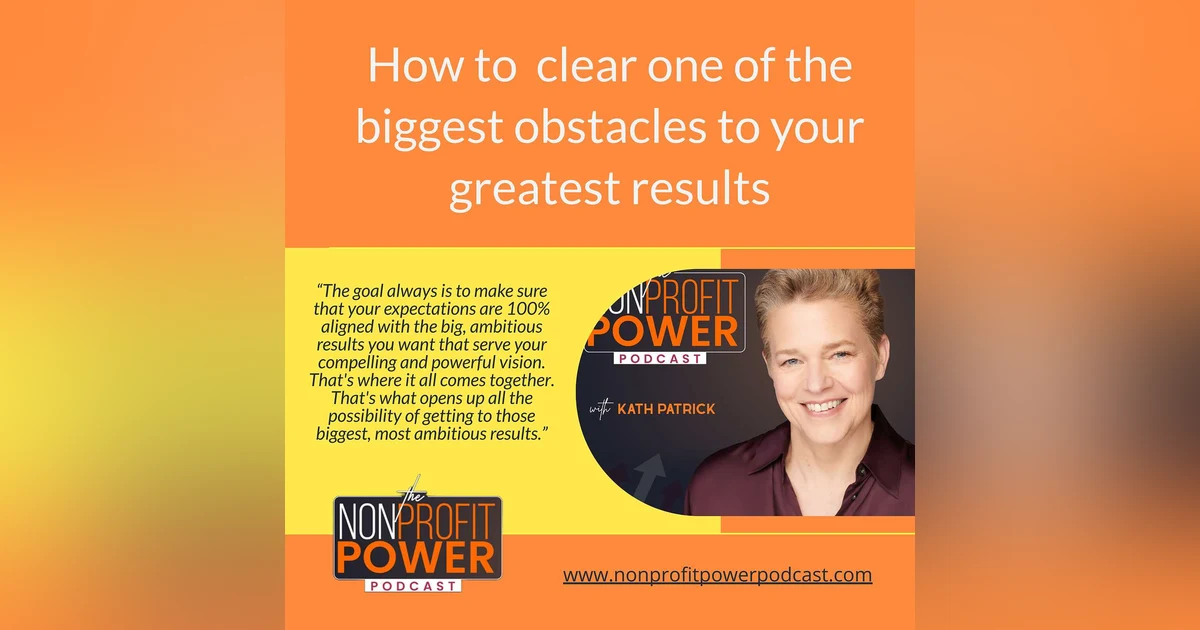
26:09 So you get to choose. These are some really helpful tools that will allow you to, for yourself and with your team, begin to make a practice of checking yourself the minute you start to slip into limiting expectations that are running on autopilot. 'Cause those are the ones you have to watch out for. And the goal always is to make sure that your expectations are 100% aligned with the big, ambitious results you want that serve your compelling and powerful vision. That's where it all comes together. That's what opens up all the possibility of getting to those biggest, most ambitious results.
26:52 And then some. Thanks for listening, and I'll see you in the next episode right here on the Nonprofit Power Podcast.