
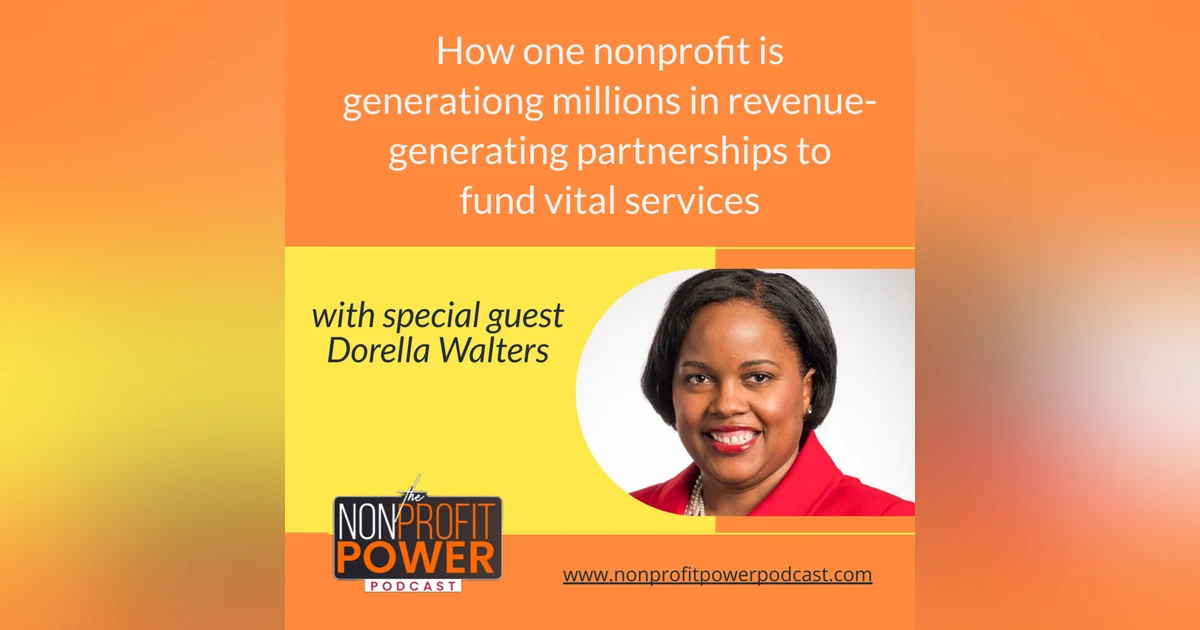
How One Nonprofit is Generating Millions in Revenue-Generating Partnerships to Fund Vital Services – with Dorella Walters - Episode 33

 Apple Podcasts
 Spotify
 Pandora
 Amazon Music
 I had the opportunity to interview Dorella Walters, who is the Chief Business Development Officer for God’s Love We Deliver in New York. Her job is basically to prospect for, and develop revenue-generating partnerships that do two main things: they diversify the organization’s funding portfolio, and bring in the dollars that allow them to serve a substantially greater number of people who desperately need their services.
She’s facilitated well over $10 million in revenue-generating partnerships for the organization, and she’s on track to do much more. She shared some very powerful insights about how she develops these partnerships, but also what it takes inside the organization to accommodate and embrace that kind of growth. And to be constantly looking forward, looking to figure out new ways to build relationships and partnerships that will allow them to meet the tremendous need that they know exists.
We talked a lot about strategic relationship development and messaging, which are critical in this process. But we also talked about vision, leadership and organizational culture, and how to develop a culture that embraces growth and change on an ongoing basis.
In this episode, Dorella shares her insight and advice on:
- How to center vision and mission as you build revenue-generating partnerships
- How strategic relationship building in policy circles and with business partners can overlap and serve to strengthen your credibility and influence
- How to build champions throughout a partner organization’s decisionmaking hierarchy
- Ingredients of a successful strategic partnership-building team
- How to cultivate and sustain a culture of innovation and growth throughout your organization
- How to engage your board in your partnership-building work
- How to support growth and learning for every team member in a meaningful way
If you enjoyed this episode and found value in it, please reach out to Dorella and let her know. You can find her on LinkedIn @Dorella Walters, or you can email her at dwalters@glwd.org.
I’d appreciate it if you’d take a moment to leave a rating and review of the podcast on whatever platform you’re listening on. Thanks!
You're listening to the nonprofit power podcast. Today's episode reveals how one nonprofit leader is generating millions in revenue, generating partnerships to fund vital services. So stay tuned. If you want to have real and powerful influence over the money and policy decisions that impact your organization and the people you serve, then you're in the right place. I'm Cath Patrick, and I've helped dozens of progressive non profit leaders take their organizations to new and higher levels of impact and success by building powerful influence with the decision makers that matter. It is possible to get a critical mass of the money and policy decision makers in your world to be as invested in your success as you are, to have them seeking you out as an equal partner, and to have them bringing opportunities and resources to you. This podcast will help you do just that. Welcome to the Nonprofit Power Podcast. Hey everybody. Kath Patrick here. Thank you so much for tuning in to another episode of the nonprofit power podcast. I'm so glad you're here for today's episode. I had the opportunity to interview derail Walters, who is the chief business development officer for God's love. We deliver in New York. Her job is basically to prospect for and develop revenue, generating partnerships that do two main things. They diversify the organization's funding portfolio. And they bring in the dollars that allow them to serve a substantially greater number of people who desperately need their services. To give you some idea of what she's been able to accomplish. She's generated well over $10 million in revenue, generating partnerships for the organization, and she's on track to do much more. Daria was kind enough to come on the show and share some very powerful insights about how she develops these partnerships. But also what it takes inside the organization to accommodate and embrace that kind of growth. And to be constantly looking forward, looking to figure out new ways to build relationships and partnerships that will allow them to meet the tremendous need they know still exists. We talked a lot about strategic relationship development and messaging, which of course are critical in this process. But we also talked about vision, about leadership and organizational culture and how to develop a culture that embraces growth and change on an ongoing basis. It's a really powerful episode, so let's get right into it.. Mhm.
KathI am super excited to have with me today Dorella Walters, who is going to tell you about herself. But the reason I've asked Dorella to join us is I think she has some extraordinary takes on not only how you lead growth and lead change, but also how you do that with a real focus on vision and having that at the heart of both advocacy and revenue generating activities, and how that all works together. So I'm excited to talk about all of that. but first, welcome Dorella! How are you doing?
DorellaI'm doing good Kath. Thanks so much for having me today
KathI'm excited. This is going to be a great conversation. before we dive into all that other stuff, tell us a little bit about your organization, who you help, how you help them and, what's going on right now.
DorellaWell, I am the chief business development officer at God's love we deliver. We are a leading provider of medically tailored meals in New York City Metropolitan area and it's outlying counties. And our mission is to serve individuals that are dealing with serious life altering illnesses, that have physical difficulties shopping and cooking meals for themselves. So we're serving those as our primary clients and then we're serving their families, any children or caregivers in the home. We have seen our numbers grow year over year, and last year we served more than 12, 000 unique individuals and we delivered 3. 6M meals. So we're really proud of that. And we just see the trajectory of growth for our organization kind of continuing on.
KathThat's amazing and it's as with all things in direct service nonprofit, it's like, totally amazing that you're experiencing this growth. And at the same time, there's a little bit of a freak out factor because it means the need is that great.
DorellaCorrect. And yeah, I mean, we're, we're always responding to the need. And I'm fascinated that as we continue to conduct outreach and engage with new partners, we're seeing more people that need our help. Lamentably, there's a lot of illness in our country and in the world. We want to make sure that our services are available to help someone as they're engaged in healthcare, maybe chemo or radiation, taking their medications. They should have the proper nutrition to be able to do that.
KathExcellent. So tell me a little bit. I know that, you're in a new role. You've been with the organization a really long time, which is a fun story all by itself, but you're in a relatively new role. Can you talk a little bit about what your new job is and what it is you're supposed to make happen?
DorellaYeah, so I have been with the agency for a long time for more than 20 years. And I've had different roles in the organization. Enrollment for clients, engagement, etc. So now I'm responsible for relationship building and engagement with partners and making sure that everyone that needs our services knows about the meals that we provide. But then also that we're able to partner with organizations to be able to have greater impact around medically tailored meals, medical nutrition therapy, and it's establishing another revenue stream for the organization. We are a nonprofit. We're a non sectarian organization. We fundraise for our dollars. That's been our case for many years. But with this new role, I'm able to partner with health care by establishing contractual agreements with either insurance plans or hospitals and health systems to be able to work with those organizations so that they cover the cost of our meals as part of their way of addressing the high cost they're seeing with some of their patients. And that has generated increasing dollars for the organization year over year. So now the organization is like, concentrate on that, Dorella. And I've got a mighty team of two joining me, and we're super excited that we're able to work with all of the communities that I've worked with all along. But now I'm able to have different kinds of conversations with them to be able to leverage what we do in order to help them improve their level of care for all of the people that we all care about.
KathExcellent, so I want to follow up on your focus on building strategic relationships because obviously that's a lot of what we talk about here on the podcast. Tell me a little bit about how you see that strategic relationship building work is similar to, or different from sort of the policy advocacy work that you've also been involved in.
DorellaWell, I think there are synergies policy and advocacy and the work that I'm doing now, I am grateful that I had the opportunity to do so much in the policy arena in terms of making sure that all of our elected officials and healthcare as a whole had a greater understanding of medically tailored meals and medical nutrition therapy as impactful interventions to address food insecurity and malnutrition. This new role incorporates that. I have to use the same vernacular and the same kind of themes and concepts to assist the people that I'm speaking to, to really understand that there is value to investing in providing medically tailored meals to their patients. And that that value is a worthwhile investment and can yield a greater return on investment for those insurance plans and hospitals. I think that's where knowing that an insurance plan or a health system is really kind of hesitant sometimes, or should we do this? We're fully capable of being your partner in this endeavor. We have done this throughout the city and elected officials are working with us to further the impact and the breadth of medically tailored meals, not just in the state of New York, but in the country. You know, that's our medically tailored meal bill that's been presented by Congressman McGovern. That kind of connectivity is what helps me in the room. It gets me into the room sometimes, but it keeps me in the room, and it keeps the conversations going.
KathThat's huge. I'm glad you called that out because I think a lot of times it's easy to see things in separate piles or silos of oh, well, I have my policy work over here and I have my contracting work over here. And we can even start to think that those sets of decision makers have nothing to do with one another. And in fact, as you point out, there's a lot of alignment and a lot of overlap. And there's a certain amount of street cred, if you will, that goes with having relationships in one arena.
DorellaYes.
Kathto then be able to be leveraged in another arena simply because you can say, well, when I was in conversation with majority leader, so-and-so, or you know, Senator, blah, blah blah, or whatever that, that gets noticed.
DorellaIt gets noticed, but it also, let's be fully candid here, it proves to the audience I'm speaking to that God's Love We Deliver has the expertise, the capability of navigating those arenas. And really has been working for a very long time to further the thought leadership that's connected to medical nutrition therapy and medically tailored meals. And understanding that food provision as a whole key and essential to acknowledge and understand and if it is absent from a plan of care, how detrimental that can be to individuals. And I think having that ability to say, yes, we're talking to this elected official, et cetera, et cetera, and the local or state Department of Health at the same time so that there's no confusion in that we have the knowledge and understanding as to how all those things connect. and I'm very clear that I can't diminish either relationship structure, if that makes sense. Like, it's important to honor and pay attention to new York City Department of Health, New York State Department of Health and, from a national perspective, CMS, et cetera, to make sure all of those audiences have the same level of understanding of the messaging that we're trying to keep front of mind, because there's lots of messages out there.
KathIt's a really good point. I'm interested to know, as you talked about growing these kinds of revenue generating partnerships as part of the overall work, as part of the evolution and growth strategy for the organization, where has that been? Where do you see it going? And what is its relative importance in the context of the organization's ability to expand its reach?
DorellaSo, our board and our leadership has really looked at how do we continue to exist as an organization? We've had several levels of evolution, let's call it that. Really understanding who needs our help, how do we leverage helping them, and how do we then continue to exist to be able to do that, right? So, that's from expanding from an HIV only organization to other serious illnesses, to being able to expand to this healthcare partnership design that becomes part of our revenue portfolio that supports our overall mission. And that's our intention. The mission is the goal. And expansion means seeing more and more individuals that are dealing with these kinds of illnesses So, our organizational leadership has really said, health care partnerships is a way to make sure we're also able to cover our costs in different and diversified ways. We've been able to see that that revenue that comes in over the meals that we're providing to those particular members or clients. Is helping us, you know, oh, we can actually buy more meal containers. We can actually do this. We can actually do that. So it's supporting our overall mission. And I think our leadership has seen that if my team is able to do that with the support and collaboration of our program team, our operations teams, all of that, what could that look like? So, we know we have the ability, right? The opportunity for expansion and impact is significant. Especially when we look at the advocacy and policy goals that we've had for a few years. So, I see that we're going to, look at what the rest of the state looks like in terms of our services, because we are distinctly different than what other providers do. And we work with those other kinds of providers, because we are not a forever program. We know that there's a season where they may need us, and then as they're getting better, they're perhaps getting into SNAP enrollment, getting into, grocery bag pickup, etc. So, we're part of the plan of care for a season in time, and we're excited to do that. And I think we're super excited to see that healthcare is meeting us at that place.
KathAnd I'm pretty sure that it's the case that a big part of the reason why they're meeting you in that place is that you have done a tremendous amount of work to help them see things that way.
DorellaYes, let's just say this has been a few years now. I have had quite a learning curve in terms of just talking to these organizations, recognizing that like any other organization, there's hierarchy of leadership, there's bureaucracy in the way they may operate, there's cultural dynamics that I, as an outsider, may not be aware of. So how do I then move through that space to make sure that we are building champions within those organizations. That then when they are making decisions, it's about, you know what, we need to include food and nutrition and that's going to be God's Love We Deliver. And that doesn't happen in a one time meeting. That is relationship building, cultivation, advocacy, policy, supporting policies when we're aligned and making sure that's like, you're right. Everyone should have access to those SNAP benefits. Because they're eligible for them. So, yes, of course, it should be increased. And making sure that we're keeping the lines of communication open. And, you know, for a long time, I was a team of one. And I think people somewhere in the world may have underestimated what I could do. But I am doing it with the support of my colleagues. And I'm like, everyone, let's bring people over for lunch. Let's bring them over for a volunteer opportunity. And then, you know, I think people saw, oh, look, the operations. Oh my gosh. They're, capable of serving more people. So that's been an exciting evolution.
KathYeah, I bet it is interesting because I think a lot of times in the for profit sector, whether it's health care or any place else that might be a prospective contracting partner for somebody in whatever arena, that there's a for profit conceit that nonprofits, by definition, must be less competent, less professional, that whatever they're doing over there, it's probably, you know, kind of half baked. And so when they come in and see, I mean, I've seen your kitchens, your massive operation that rivals any commercial food preparation operation that you would find anywhere. But I expect that is a surprise for some folks.
DorellaIt is. It's a surprise. I'm tickled by the surprise always because I work here. I see that it's a 10, 000 square foot kitchen all the time. but I think that's indicative, of why certain things either don't happen or don't move as quickly. Because you're battling preconceived notions. And those preconceived notions could be in a healthcare organization or it could be in an elected official. And it's about both understanding that there's skill set, there's capacity, there is infrastructure solidness. So that then if you invest dollars, invest support for new construction, whatever all of those things are, that this nonprofit is going to impact the communities at a greater scale. And I think that's where advocacy and policy and relationship building, it all connects. And, I'm excited to continue to represent the organization
KathThat's awesome. I'm interested, can you tell us a little bit about your overall growth, your revenue growth in particular, and how that looks and how you're continuing to develop that.
DorellaSo, we are a philanthropic organization where mission based fundraising is the huge arm of our organization. So right now we're about 57 percent philanthropy and that's coming in from individual donors, corporations and foundational grants. Then we have government around 12%. So think of our HIV AIDS population through Ryan White funding, which we're super honored to continue to receive. And and let's say local state funding as well. And then we have our partnerships, which is now 31 percent of our budget. And that's a big deal. It's grown year over year, but year over year, we have overshot expectations. And that's been my slow and steady, you know, the train is coming, keep it on the tracks, keep it on the tracks. And that approach has kind of reflected to our leadership. They've incorporated into the budget planning. So I have a goal and I look at it as supporting mission. this year, the minimum number to serve is 12, 000, and we anticipate that we'll probably reach 13, 500, maybe 14, 000 people served. And for me, need to make sure that I'm supporting enough dollars coming into the organization to make sure all of those families get the services they need. So, yeah, we've grown as an organization. We are already in two sites because our office staff has grown. Our staffing is now over 180 people and that's significant fast people growth. Primarily they are in the kitchen and, delivery departments or operations departments, but we need people to talk to every client. We need dieticians and all of that. So, yeah, our growth is, has a diversified portfolio and it will always be philanthropic. But one other thing to take note of is the relationships that I'm building also impact our philanthropy team because we've been thankful to be able to receive grants from some of these national insurance plans. Even though we have contracts with the local insurance plan, from a national perspective, we've also been able to get grants because we've proven impact on the dedicated contract relationship that we have. So, you know, it's always connecting the dots, making sure that the relationships are tied together and acknowledged. And that we understand what each department is doing.
KathThat's totally fascinating. I didn't know about the grant angle from the health care folks. I'm interested you talked about you've been doing this, which is a little mind blowing. You've been doing this as a team of one and now you get to be a team of a total of three of you. You just sort of casually talked about a bunch of things that encompass a lot of high level skills. All of the strategic relationship building skills are one layer, which are not inconsequential, but then there's also all of that overlap and connecting that you're doing and, making sure one relationship knows about another and making sure each of those is leveraged in whatever possible way to increase the success with each other relationship. When you went out to get more team to help you do even more of that, were you able to go out and hire for that? Or are you training in house? How common on the ground are folks who know how to do that?
DorellaThat's a great question. So, I was able to hire for it and I don't know if we're going to go down this line of conversation, but I'm a homegrown model, a product of what was invested in me in these 20 plus years at God's Love. I have been able to go on advocacy visits and learn policy and learn, aspects of how to talk about nutrition, et cetera. So all of that goes into what I call a toolbox. So that toolbox has kind of helped me get to the place that I am today. And then when I realized that this can no longer continue, we need to have some more people help in this endeavor and started writing out job descriptions, realizing, okay. Let's see what the market bears. Let's see what's out there. And thankfully we found the right people for my team and we'll be growing a little more this fiscal year. And the intention has been relationship building and how do we then make sure we are keeping our finger on the pulse as to what is happening in the lives of the clients we are serving. And then at the same time, keeping our finger on the pulse of what health care is monitoring or is watching or is afraid of, and that we could potentially help solve as God's Love We Deliver. And that means we're talking about policy impact, takeovers and mergers and acquisitions, and population changes, and migrants coming to New York and all of these pieces. How does that affect our now, and how will that affect us in the next few years? So I've been able to find people that are active learners, are able to collaborate well. I am, I remembered how to delegate and it was, I really love doing this, but I am releasing this to you because I can't do that and do this. And that's like sometimes a realization for a manager and a leader, you're like, Oh, wow. My goal was to have individuals join me that I would have full confidence in leaving them in the room, representing God's Love We Deliver. And I'm confident and so excited that I have that. And that's an interesting thing, because once you start to build for that, then you can be in more rooms. If that company has all of these divisions, let's say it's a hospital, social work, case management, the oncology unit, et cetera. That means we have to talk to all of those different groups of people so that then they believe in the organization's mission, want to partner, and will want to be champions for our work. And in being the champion, it means they're referring eligible clients. They're talking about us in the context of, we should include them in this idea, in this pilot, in this impact study, in this research study. All of it has dots being connected, and I'm excited about that. And I think if every nonprofit kind of thinks of it that way, every employee can be an ambassador or should be an ambassador for your mission.
KathThat's excellent. I want to call out something that's been happening this entire conversation. And now I want to talk about it specifically, which is that almost everything you've talked about and the ways you've talked about it, reflect two very important things. One is that you're clearly a big picture thinker. and yet you have a amazing grasp of detail. But at the same time, what's behind all of that is clearly a vision. and I think I am almost hearing multiple visions really. One is around the people you serve and how you help them. And the other piece a vision of what the organization needs to become and how it needs to operate in order to fulfill that other big vision. So, can you talk about that a little bit more explicitly and how you are leading your team around that how you're leading relationship building work, and perhaps even how you are showing up as a leader as part of the leadership team. In that role.
DorellaYeah, so I had noticed I had shifted in just the way I was talking about our agency's work in the healthcare arena, let's say in New York State or even in the country. And, you know, what does that require of us? Who are we going to be as an organization? And any response would be honorable, because at any point you're helping the people that we were created to help. But as I started to realize that it was about, there's more people that need us. There's no one like us in this particular area, then, how do we get there? Operationally of course, there's innovations, there's shipping, there's technology, whatever all of that is. But to reach those people, it's about kind of, moving your mind towards, well, what's the next level, right? Like, if you watch science fiction and fantasy films, how do you amp up? What's the next thing? And the next thing is, what is scaling? What does that look like? If all of your wishes were manifested, and medically tailored meals was a covered benefit in New York state or in the country as a whole. What does that look like? How do we rise to that? How do we prepare for that? And I think I found myself really looking at what preparation look like as a part of this leadership team. And having those kinds of conversations across the leadership levels of the organization. I think sometimes people thought, well, you're just moving too fast. I'm not really. The sick people are there. We're trying to feed them. It's good to go. But I think the speed of it sometimes is faster for those that may not be in my mind or in my house. So I'm trying to make sure that we're educating and messaging around, our ambition is to move to 5 new contracts this fiscal year. And those contracts should have a minimum of 50 or 100 new individuals to serve. we should be prepared to exceed that. And then people will be like, why would you exceed that? Because if there's more than 200, we should be there to do it. And how do we do that? Right? So, sometimes I am moving faster than, our operational planning and thinking, and I think that's where we've been trying to figure out who do we have in roles? How do you look at equipping the people in your house to make sure that they have the muscle, the capacity to move their departments to the next level. And the next level can be serving more people. Serving more diverse diagnoses, different cultures, whatever all of that is. For How does that then elevate? And we were using a phrase deepening the bench, it's a baseball phrase, apparently making sure you have enough pinch hitters, in your house and I love to pinch hit. I think that's great. And it's not everyone's skill set, nor does it have to be, but if you've got a few of them across the organization in different places, then they can see differently. And I think that's exciting for an organization when players or staff and colleagues can see differently and say, I would love to do this. How could we do this in the next 2 to 3 years?
Kaththat's fascinating. It sounds like that has happened somewhat accidentally, or has that been intentional to get that cross visionary fertilization going on?
DorellaIt's interesting that you should ask that. So, full disclosure, we started partnering with health care in 2005. And 2005 was an accident where we agreed to do a thing, let's say that. We were like, maybe this is a thing and then it became a more solid thing. And then, our CEO at the time, Karen Pearl was moving towards greater intentionality around that. And remember, all change requires messaging. All management requires managing up, down, sideways, diagonally, the whole thing. And how to do that in an organization that is growing. And that's where it's sometimes that not everyone is at the level of understanding that maybe I am. So how do I help other people get there? So, using, let's say, our communications team as an example, a natural tendency to talk about our mission and our volunteers and our fundraising and all of these other things. And then now it's like, commenting on health care, commenting on innovations like that. How do we look at that skill set? How do we incorporate that into a plan for a fiscal year? So I think accidental at first, intentional now and even more intentional if you were to ask any of our board members. They're like, we're introducing you to all of these friends that we have that we never thought about them. We thought about them as donors, but not necessarily as partners to God's Love. So that too was like a shift. Realizing, oh, they do work at a hospital and a health plan. Maybe they can introduce us to someone and then that's where all of that started to connect at that level as well. At some point for any organization, right? You're kind of like a toddler, let's say, and then you move into your team and you're just walking right? Like, you're it's humming and then how do you make it hum even better in a stronger way?
KathThat's great. there are some fun visuals that ran through my brain with that. I get the high humming and the train running. There's a lot of mixed metaphors going on there. So kind of related to that, with all that evolution and growth and change and helping people not only come along for the ride internally, but to enthusiastically be running alongside the train and saying, yes, let's go. Talk about how you see organizational culture and sort of the care and feeding of organizational culture, but also the shaping of it so that it supports and aligns with that kind of evolution and growth as almost a steady way of being,
DorellaYeah. So culture is key to any organization. And I think for God's Love, as we continue to grow in the number of people served, the number of staff, the number of places we are operating out of, we are very cognizant of culture and cognizant of how do we honor the concept of connectivity. Because we, as a one site operation had lots of connectivity with colleagues from different departments. So how do you then mirror that as the organization grows into multiple sites, et cetera? And that's hard to think about and figure out. But then it's also contingent on the people, the staff and the volunteers cultivating and working towards a new interpretation of culture, a new interpretation of working together and collaborating, et cetera. And, through our new CEO, David Ludwigson, he's been able to create these moments where we're able to connect with each other. We do entire departments volunteering at some of our offsite. We switch office spaces. We do all of these kinds of things, but culture is key. And culture is contingent on mission and vision of the organization. That is what we exist to do. There can't be anyone in our house that doesn't see that. So, all of us as department heads, et cetera, every meeting starts with the mission moment. We're trying to make sure that everyone understands this is the place we're trying to get to. That person must get their meal as planned for, et cetera. And if they're not enrolled with us, they have to be. So how do we find them? That's where my team comes in. How do we connect those dots? But culture is also kind of this esoteric fluid thing and how do you keep your finger on the pulse of that? I think we have an amazing human resources team, but it doesn't all lie with human resources as a department. It's got to be all of us as leaders, regardless of where people are in the organization. Even if someone is enrolling our client, you do have players that are engaging, are collaborative, are the ones that check in with each other. And I think that's where you've got to honor and cultivate all of those people and moments to make sure that your culture continues to be strong, but continues to evolve. And I think that's the thing to always keep looking at. So our leadership group looks at it every time we meet. What do we need to do? How are we planning for this? How are we going to talk about this? How do people learn? How do people understand? So some people are all about technology, send it as an email and that's it. And then other people are like, you should sit with me for 10 minutes and explain the points to me. So I think that's the other thing to always be kind of aware of. And that's all okay, but you can't ever forget it. That's the thing that damages culture.
Kathamen. That's really well said. It takes such intentionality to build and sustain and can so easily be damaged through carelessness or inattention
DorellaCorrect. Correct.
KathA lot like strategic relationships.
DorellaCorrect. and it's hard and it feels like even to myself and to others. Oh, there's so much we have to like, we have to send holiday notes. And when do we do that? Depends on which holiday people are. Like, just tell them thank you. Just tell them thank you, we're doing great together. Excited to talk to you in the new year. just help people feel seen, feel heard. Right? that helps culture. That helps relationships. The electoral process, or a bill moving into it, is a long process. But if we keep the relationships going, the conversations going, then it won't fall by the wayside.
KathExactly. Completely accurate. so this has been amazing. I could keep this conversation going, for 3 more hours.
DorellaThis was great. I love having these conversations.
Kaththis has been so much fun and I really appreciate it. You've been brilliant as usual. And I think have had. a lot to share that I think people are going to find incredibly valuable. Is there anything else that you would like to share or raise that would be important before we wrap this up?
DorellaI think, you know, for anyone that's thinking about leadership and culture and staffing. It's important to always remember and honor the individual that you're supervising, and if they're open to growth and learning, how can you or your organization help to facilitate that? How do you encourage that? And it may not be that it's actual paying for, you know, this college course, but it's meetings and workshops, and let's talk about what you learned and how do we connect it to what we are doing today at the organization? Because I think that helps to evolve an individual, Like I am not the same person that started at God's love, but I'm also a definite representation of the supervision and collaboration I've been able to have, through my tenure here. And people will ask, well, how did you become you? And I'm like, well, you know. But it's, it's very much this is what I had the ability to do. We had X number executive directors and et cetera, who always were like, the door is open. And I would go in and ask, is this something I should do? Does going to, get my master's, does this match? And what's the purpose of getting the master's? Having conversations around that, working towards that, doing it while I was, you know, full classes and, work. And then knowing that, Oh, what I'm learning over at the school is, this is the day to day. This is how it connects. And I think if that's one thing that the listeners can take from this it's about cultivation is key for both you and the team within your organization. And if someone wants to grow as a bird and fly away from your organization that's okay too because you've helped create that. And you'll always have a new one to come, you know. But that's not a bad thing.
KathYeah, that's such a good point. I wish that that understanding were more prevalent. I've worked with a number of, nonprofit leaders who really struggle with that one, and who feel betrayed or upset, or, like, someone took advantage of them if they got support and growth in the organization and then went off to do a new opportunity. And it's like, no. First of all, they were amazing while they were there. And It's like energy. energy can't be created or destroyed. It can only, be moved around. And so it's the same thing with talent and skills and all of that. If that's out there in the world, and it's doing good work, yay!
DorellaExactly. Exactly. I have some former staff that, they're EDs in other places, they're social workers doing whatever. I'm like, hooray, you know, like, that's amazing. and I think that's just something to be aware of, that if we're in this work to make change, to make impact in our world, then it's happening in your day to day work. It's happening in an agency's mission. It's happening all across. If you're able to at least see that as a connective line, then everything's okay. You got to keep moving
KathYeah, and it comes back to the even bigger vision, right? That we all pretty much most of us in nonprofit world have a bigger vision for what we want society to look like what we want community to look like, and that we have a vision of every member of the community having what they need in order to thrive.
DorellaCorrect.
KathAnd if that's the vision, then you've never wasted an effort by helping somebody be more effective at pursuing that.
DorellaCorrect. Correct.
Kathno matter where they go.
DorellaExactly. And there's justice in that. So that's where all of those, activities, justice and collaboration and impact, all of that, ties into this. This was great, Kath. Thank you.
KathThank you. it's a great note to end on. I think. this has been fabulous. I know there are going to be people who want to, follow up and either share with you how valuable this was, or perhaps ask a question or two. if people would like to reach out to you, is there a particular way that's best to connect?
DorellaSure, people can connect via LinkedIn. You can find me there, or you can just email me at dwalters glwd. org.
KathGreat. that up in the show notes too, This was awesome. I'm hoping I might get you back at some point, because there's like 100 other things that would be really cool to talk about in addition to this. But, for now, I'm really grateful that you could take the time and thank you so much.
DorellaThank you, Kath, and happy to join you whenever.
If you enjoyed this episode and found value in it, please reach out to Daria and let her know how much you appreciated it. And it would be awesome if you would leave a rating and review. Wherever you're listening to the podcast. Thanks for listening and I'll see you in the next episode.